Amazon Prime Settlement Refunds Eligibility and Payment Dates
The Amazon Prime settlement provides automatic refunds to eligible U.S. customers affected by the enrollment and cancellation practices covered by the FTC case....


The Amazon Prime settlement provides automatic refunds to eligible U.S. customers affected by the enrollment and cancellation practices covered by the FTC case. The maximum combined payment is $200 across the settlement program. That does not mean every eligible customer receives a $200 payment.
The September 2026 revision broadened the refund process and removed the need for new claims. However, an initial refund and a possible supplemental payment are different stages. The exact court timetable also differs from the FTC’s shorter public summary, as explained below.
This guide explains who may qualify, what to do with a payment and where to ask for help. It also examines what subscription businesses can learn from the case.
What Changed in the Amazon Prime FTC Settlement
The September revision expanded automatic payments to additional customers, including eligible people with 11–20 Prime benefits used during an applicable year. The FTC announcement says this expanded distribution would start on October 1, 2026. September FTC update.
The Combined Cap Is Different From the First Refund
The original payment phases refund qualifying membership fees up to $51. The revised order allows a conditional supplemental distribution of up to $149, subject to a $200 combined cap. It does not simply replace every initial $51 payment with $200. Original payment rules. Revised residual payout order.
For example, $51 plus the maximum $149 supplement would equal $200. This arithmetic illustrates the cap; it is not a prediction of any customer’s award.
Automatic Does Not Mean You Can Ignore a Payment
You do not need to file another claim for future qualifying payments. You may still need to accept an electronic transfer or deposit a check before it expires. Those are payment-acceptance steps, not a new claim application.
Read More:
Amazon Prime Settlement Key Facts
Question | Current answer |
Total settlement | US$2.5 billion |
Consumer redress | Up to US$1.5 billion |
Civil penalty | US$1 billion |
Maximum combined payment | US$200 across phases |
New claim for future payments | Not required |
Delivery | Check, PayPal or Venmo |
Expanded distribution scheduled from | October 1, 2026 |
Conditional supplemental distribution | Begins by end of April 2027 |
Acceptance | Check your payment deadline |
Keep the refund amount, payment acceptance deadline and settlement administration timetable separate. A distribution can start on one date while recipients have a later deadline to accept their money.
Who Is Eligible for the Amazon Prime Settlement
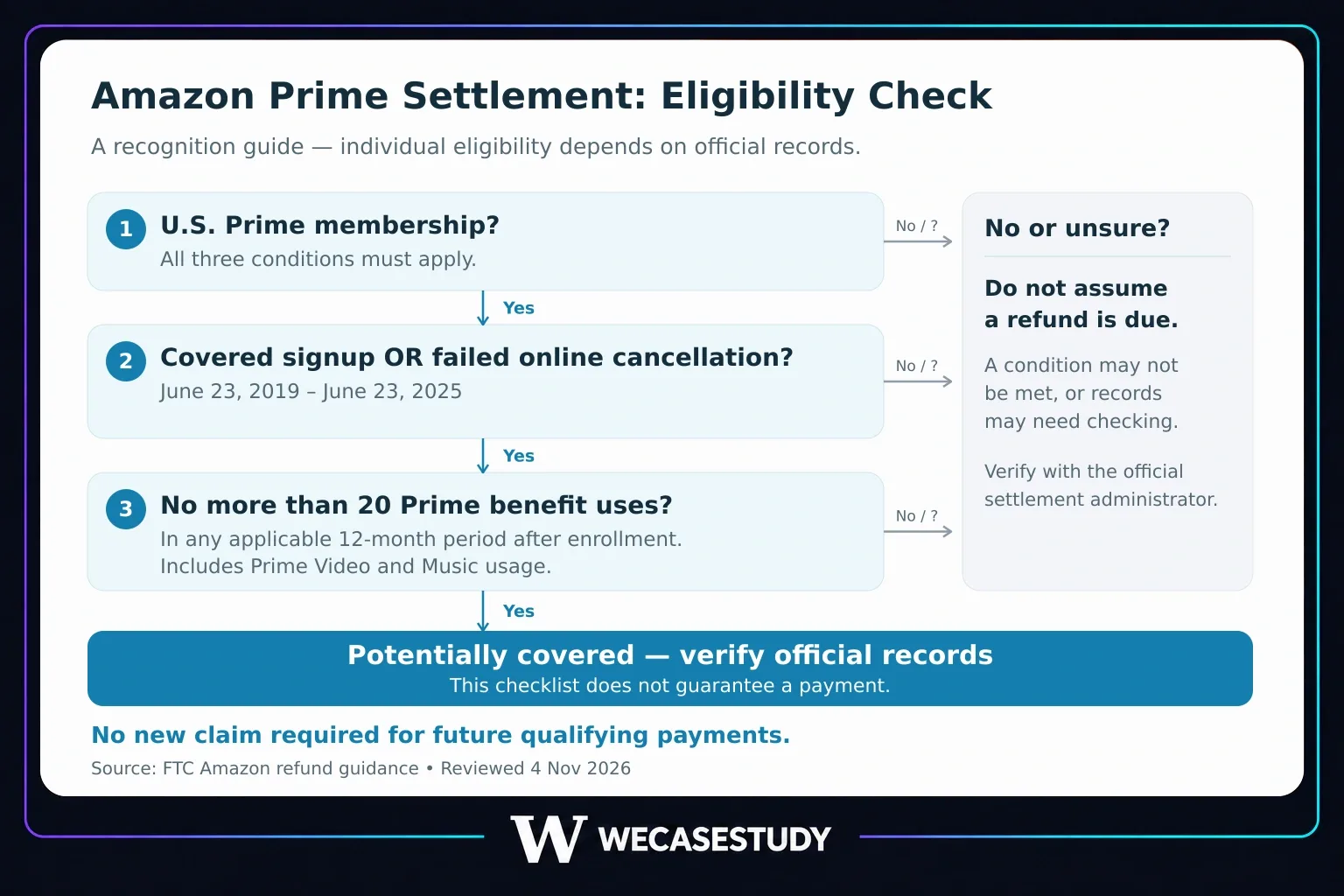
The FTC’s current refund guidance gives three requirements:
You had a U.S. Prime membership; you enrolled through a challenged signup flow or unsuccessfully attempted online cancellation between June 23, 2019 and June 23, 2025; and you used no more than 20 Prime benefits in any applicable 12-month period following enrollment. FTC eligibility requirements.
Which Signup and Cancellation Processes Count
The challenged enrollment routes are the Universal Prime Decision Page, Shipping Option Select Page, Single Page Checkout and Prime Video enrollment flow. The alternative cancellation route concerns an unsuccessful attempt through the covered online process. Definitions in the original order.
How the Prime Benefits Test Works
The test concerns recorded benefit usage during the applicable year. It is not a count of how many different benefit categories are included in your membership. Music and video usage can count, not just shopping-related activity. FTC benefit usage guidance.
This checklist helps you recognize a potentially covered situation. Amazon’s records and the program rules determine individual eligibility; a personal estimate cannot confirm that a payment is due.
How Much Will You Get From the Amazon Prime Settlement
There is no single award for all customers. Qualifying fees, previous distributions and the conditions for any supplemental round affect the total.
Could You Receive an Additional Payment
A supplement depends on accepted payments, rather than simply having received a notice. If less than $1 billion has been accepted when Amazon reconciles the fund at the end of March 2027, the order requires a pro rata distribution to qualifying previous recipients who accepted a payment. Entered order paragraphs 5 and 6.
A prior $51 payment does not guarantee another $149. The additional amount can be lower, and a customer who was merely sent money is not necessarily in the same position as one who accepted it.
Why the Settlement Total Is Not Divided Equally
The $2.5 billion headline combines a $1 billion civil penalty with up to $1.5 billion in consumer redress. It is not a $2.5 billion pot divided equally among Prime members. Original FTC settlement announcement.
Neither the headline total nor an estimated number of affected customers is a valid way to calculate your own refund.
Do You Need to File an Amazon Prime Settlement Claim
No new claim is required for future qualifying distributions under the revised process. An article directing everyone to complete a new claim form may describe an earlier stage. Current refund instructions.
Why Older Articles Mention Claim Forms
In January 2026, FTC consumer guidance described emails and postcards inviting some consumers to submit claims. That historical process explains the claim forms still mentioned in older search results. January 2026 consumer guidance.
Use the current official guidance to verify what you need to do now. Keep an old notice for reference, but do not assume its process or deadline governs a later payment.
Which Amazon Settlement Payment Group Are You In
Use the situations below to identify the next practical step, rather than treating the table as an eligibility calculator.
Your situation | What the current rules mean |
No payment received | Check eligibility and ask whether a payment has been issued. |
11–20 benefits used | Potentially in the expanded group if other conditions are met. |
Previous payment accepted | May be included in a conditional supplemental distribution. |
Earlier claim submitted | No new claim is needed for future qualifying payments. |
Check or transfer expired | Ask the administrator; reissuance is not guaranteed. |
Asked to pay a fee | Stop and verify through official contacts. |
When Will Amazon Prime Settlement Payments Arrive
There is no universal payday. The FTC refund page says eligible customers will receive refunds by April 2027, while the detailed court order distinguishes initial distributions, reconciliation and a conditional supplemental round.
The court timetable below is more precise for understanding those stages. A program completion date does not extend an individual check or transfer deadline.
Why the dates differ: the FTC’s September press release refers to a February 2027 threshold and a supplemental round by April. The entered order instead requires reconciliation by the end of March and supplemental issuance to begin by the end of April. This article follows the entered order for the operative schedule. FTC summary. Entered order pages 7 and 8.
Dates in the Entered Court Order
Source: September 14, 2026 order, paragraphs 3–9. The September 10 date below concerns program administration, not a promise that you can delay accepting payment.
Date | What it means |
October 1, 2026 | Expanded automatic issuance scheduled to begin. |
March 5, 2027 | Cutoff for unaccepted escalation payments. |
End of March 2027 | Reconciliation against US$1 billion in accepted payments. |
End of April 2027 | Conditional pro rata payments must begin. |
At least 60 days after supplemental issue | Acceptance period for that supplemental payment. |
September 10, 2027 | Extended settlement program endpoint. |
How Will Amazon Send Your Refund
Amazon can send settlement payments by mailed check, PayPal or Venmo. Verify any unexpected notice independently before accepting a transfer.
The FTC’s public guidance says payments expire after 60 days. The revised order also sets a March 5, 2027 cutoff for unaccepted escalation payments and gives supplemental recipients at least 60 days. Follow the specific deadline on a verified payment; do not wait for the overall program to finish. FTC payment guidance. Entered order acceptance provisions.
What to Do If Your Payment Has Not Arrived
First compare your circumstances with the eligibility section. Then check whether you were sent a payment that still needs to be accepted, or whether the issue is an incorrect name, address or payment status.
For a missing payment, an expired check or an incorrect recipient detail, contact the administrator. Explain what notice you received and when, and ask whether your payment was issued, accepted, voided or awaiting distribution. Use an independently verified contact route and supply only information the administrator needs.
The FTC identifies these contacts for individual payment questions:
Email: admin@SubscriptionMembershipSettlement.com
Phone: 1-888-999-8094 Administrator details published by the FTC.
Official settlement website: SubscriptionMembershipSettlement.com Official settlement site identified by the FTC.
A contact request does not establish eligibility or guarantee reissuance. The revised order allows some unaccepted payments to be voided without reissue.
How to Spot an Amazon Prime Settlement Scam
The FTC says it is not contacting people about these refunds. A caller claiming to be the FTC and offering to obtain your payment is a warning sign. FTC scam warning.
No one from Amazon should ask you to pay a fee to receive settlement money. A promise of guaranteed money or special access is another warning sign.
Navigate to the FTC refund page independently and use its administrator details. Do not rely on a phone number, payment link or login page supplied by an unexpected sender.
Why Did Amazon Settle With the FTC
This is a federal FTC enforcement settlement about Prime signup and cancellation, rather than a private class-action claims scheme.
The FTC alleged that Amazon enrolled customers without adequate informed consent and made cancellation unnecessarily difficult, including through interfaces described as dark patterns.
The September 2025 settlement imposed monetary relief and changes to how customers join and leave Prime.
The FTC’s settlement announcement describes requirements for a clear decline option, prominent price and renewal disclosures, and an easy cancellation route using the same method as signup. It also describes an independent supervisor for the redress process. Required signup and cancellation changes.
Amazon’s Position and the Court Record
Amazon said it and its executives had followed the law and that the settlement allowed it to focus on customers. The original order generally says the defendants neither admit nor deny allegations, except as specified. It also records an earlier partial summary judgment finding that Amazon obtained billing information before disclosing all material subscription terms, in violation of ROSCA. A settlement is therefore not a reason to erase either Amazon’s position or the findings actually recorded by the court. Amazon’s statement. Original order findings.
What Subscription Businesses Can Learn From the Amazon Case
Prime connects recurring payments with delivery, shopping and entertainment. This makes both signup conversion and membership retention commercially important.
The case shows why those metrics need context. A completed signup does not tell a business whether the customer understood the commitment, and a low cancellation rate does not prove satisfaction.
The following is WeCaseStudy’s business analysis. It is not an audit of Amazon’s current interfaces or a legal compliance assessment.
Measure Customer Understanding Alongside Conversion
Keep the price, renewal frequency and cancellation information near the decision to subscribe. Test whether users can explain those terms before purchase, rather than checking only how many click the signup button.
This is useful for trials and bundled memberships, where the product offer can distract from recurring charges. Monitor complaints and unintended renewals alongside conversion; clearer information may change headline signup performance.
Measure Successful Cancellation Alongside Retention
Track how long cancellation takes, where customers abandon the process and whether they can confirm that renewal has stopped. Separate deliberate decisions to stay from sessions that end because the user cannot complete the task.
This approach is useful when a retention offer is optional and users can still leave easily. A lower short-term retention figure may accompany a clearer exit path, so evaluate trust, support costs and later reactivation as well.
These are measurement proposals, not demonstrated improvements from this settlement. The reviewed documents do not establish how the changes affected Prime conversion, churn, revenue or customer trust.
What the Payment Data Actually Shows
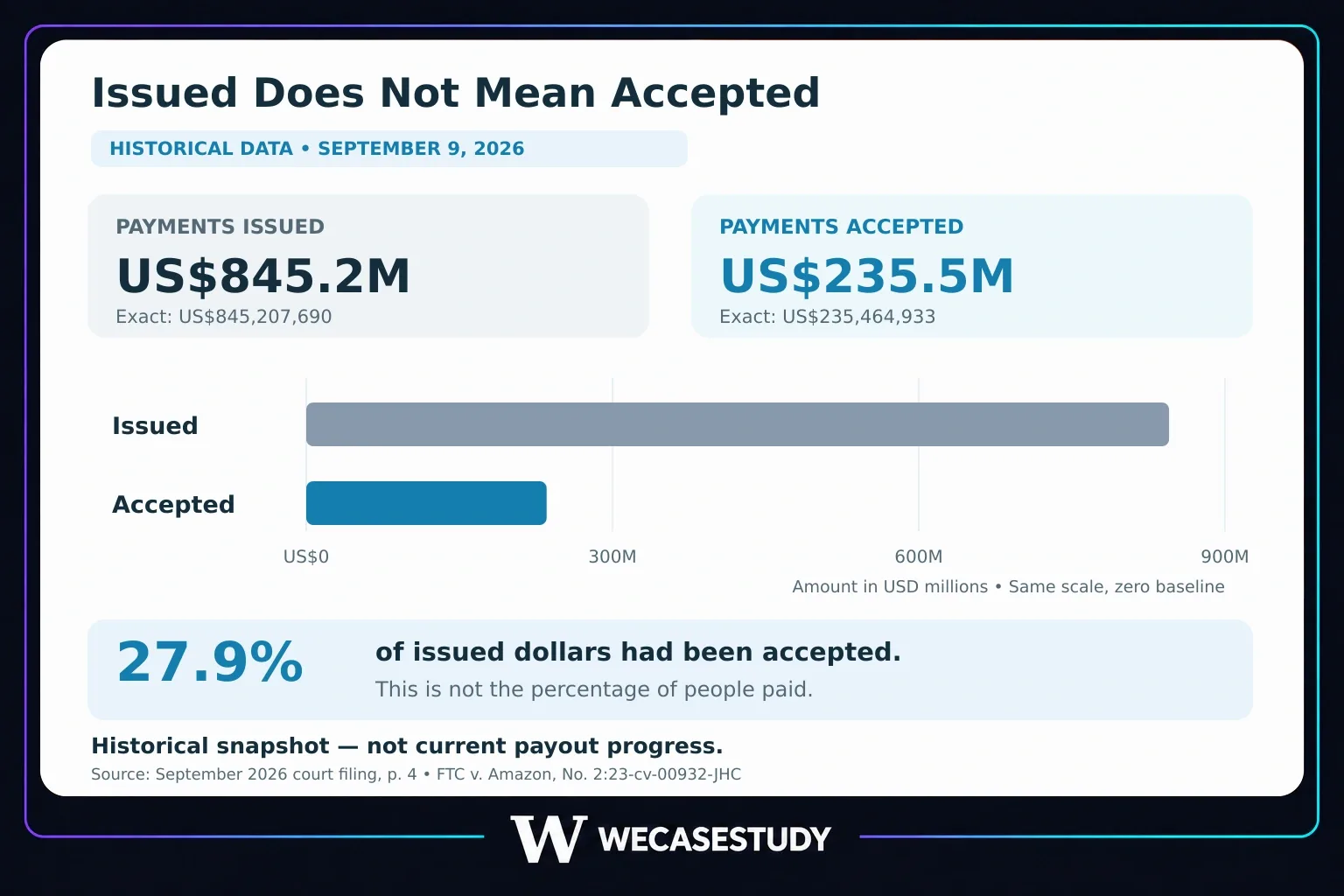
The September court filing reports a September 9, 2026 snapshot: US$845,207,690 issued and US$235,464,933 accepted. Our calculation is US$235,464,933 divided by US$845,207,690, multiplied by 100: approximately 27.9% of issued dollars accepted at that snapshot. This is not the percentage of people paid, and it is not a current completion figure.
For a business, this illustrates why delivery and completion need separate metrics. Sending a notice or payment is an operational step; the customer successfully receiving value is a different outcome. The snapshot alone cannot explain why payments were unaccepted or predict the final distribution.
Apply the Lesson From Three Perspectives
Consumers need recognizable notices, usable payment methods and clear deadlines. Product teams need visibility into unintended signup and failed cancellation. Refund administrators need to track issuance, acceptance, expiry and exception handling separately. Those groups can experience the same process differently.
A Repeatable Review for Subscription Teams
Run the same three tasks on desktop and mobile: decline the subscription, identify the recurring price and renewal terms, and complete cancellation. Record the steps, time and any ambiguity for each. Then compare the results with complaints and support contacts. We did not run this interface test on Amazon; it is a practical exercise readers can apply to their own product.
Amazon Prime Settlement FAQs
Is the Amazon Prime Settlement Legitimate
Yes. It arises from FTC v. Amazon in federal court. Verify a specific notice through the official FTC page and administrator; the existence of the settlement does not authenticate every message using its name.
Does Every Prime Member Get a Refund
No. Membership alone is insufficient. The covered signup or cancellation process, dates and benefit-usage test also matter.
Can I Still Ask About an Expired Payment
Yes, contact the administrator about its status. Do not assume it can be reissued: the revised order expressly permits some unaccepted payments to be voided without replacement.
Does This Settlement Cover Every Amazon Refund Dispute
No. This program concerns the Prime enrollment and cancellation practices covered by the FTC case. An ordinary order return, delivery problem or a different Amazon dispute does not automatically qualify.
Research Method
This desk-based review was completed on November 4, 2026. We checked the supplied article against FTC guidance, the entered orders and Amazon’s statement. When public summaries differ from the order, the article identifies the difference and uses the entered order for the detailed schedule.
We did not inspect individual accounts, verify a reader’s eligibility, test the payment portal or independently audit the redress program. The official settlement website could not be opened in this review; its address and administrator contacts are grounded in the FTC’s published guidance. Business recommendations and the 27.9% calculation are WeCaseStudy analysis, with the underlying snapshot identified above.