

Amazon Luna Cloud Gaming: Cost, Games and Prime Strategy
Amazon Luna cloud gaming lets you play supported games on a compatible screen while Amazon's servers run the game remotely. Eligible Prime members receive...

Amazon Luna cloud gaming lets you play supported games on a compatible screen while Amazon's servers run the game remotely. Eligible Prime members receive Luna Standard as a membership benefit, while Luna Premium offers a larger subscription library. You do not need a dedicated gaming console, and Amazon's own controller is optional.
For players, the decision depends on the games available, the equipment they already own and the quality of their connection. For businesses, Luna raises a different question: how can an established subscription service make a new activity easier to discover, try and share?
Amazon's recent decisions connect these questions. Prime provides access, Prime Video provides another place to discover games, and social features reduce some of the effort involved in playing together. This case study examines those choices and their trade-offs. The public evidence documents product changes; it does not establish that Luna has increased Prime retention or become a profitable standalone business.
Product information checked on October 17, 2026. Prices refer to the US unless stated otherwise. The strategic analysis covers Luna's 2025 redesign and subsequent changes through this review date.
What Is Amazon Luna Cloud Gaming?
Luna is Amazon's service for streaming games over the internet. Instead of buying a gaming PC or console to process the game locally, you use a supported television, computer, tablet or phone to receive its video and audio. Amazon's Luna overview describes the service and its available access options.
The distinction matters when choosing a platform. A cloud subscription gives access under the service's rules, catalog and regional restrictions. It does not mean that every game you own elsewhere becomes playable or that each included title will remain available indefinitely.
How Does Amazon Luna Work?
When you start a session, a remote server runs the game and renders its graphics. Your device displays the stream, while your controller or other supported input sends commands back to that session. AWS explains the computing and delivery process in its technical account of Luna's architecture.
This reduces the graphics processing required from your own device. However, the connection becomes part of the control system. A delayed video frame can affect when you see an opponent; a delayed input can affect when your character responds. Video streaming can buffer ahead, whereas an interactive game has to respond to the player's next action.
How Much Does Amazon Luna Cost?
The two central access options are Luna Standard and Luna Premium. Amazon's June 2026 terms define Standard as a benefit for eligible Prime members and Premium as a paid expanded library. Its public Luna FAQ lists Premium at $9.99 per month in the US. Verify the current offer before subscribing: fees can change, and the applicable amount appears on Amazon's subscription and account pages.
Option | Access and cost | Practical decision |
Luna Standard | Included with an eligible Prime membership; Prime itself is paid | Check whether the included games meet your needs before adding another subscription |
Luna Premium | Paid subscription; publicly listed US price of $9.99 a month, subject to the current offer | Check whether its additional games justify the recurring expense |
Luna Standard With Amazon Prime
For someone who already keeps Prime for other benefits, Standard can be tried without a separate Luna subscription payment. Someone considering Prime only for gaming should assess the full membership cost instead. Calling the service simply "free" obscures that difference.
This is also the first business-model lesson in the case. Bundling changes the customer's purchase decision. It does not remove the provider's cost of supplying games and streaming sessions.
What Luna Premium Adds
Amazon's Premium support page says the plan includes everything in Standard plus an expanded library, and is available to both Prime and non-Prime members. Buying Prime is therefore not a prerequisite for every Premium user.
Before paying, identify the additional games you would actually play. An occasional user may find Standard sufficient, while a regular player may value Premium's wider selection. Neither decision should rest on a headline game count alone.
What Games Can You Play on Amazon Luna?
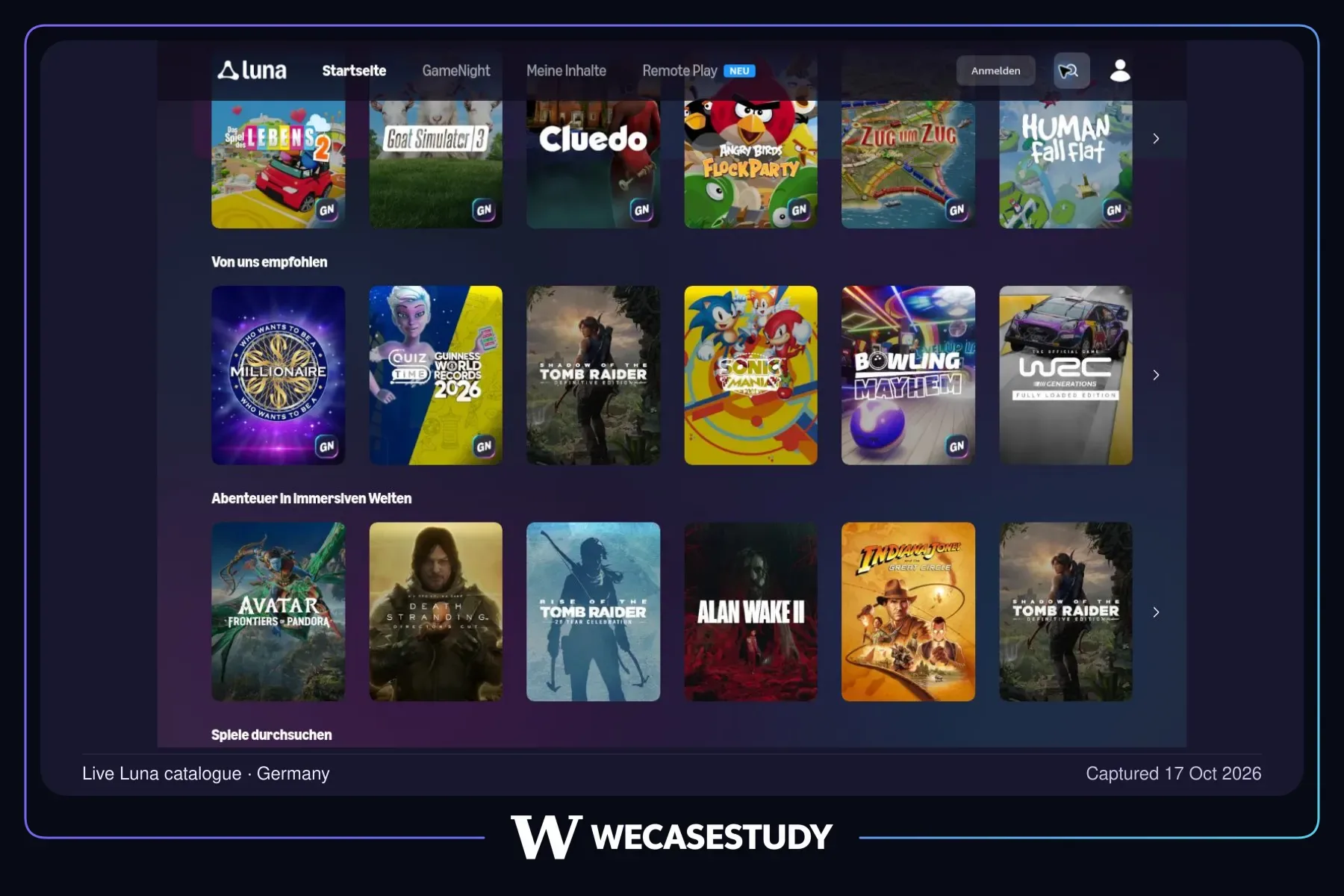
Luna combines major releases with smaller games and social experiences. In its October 6, 2026 update, Amazon described Standard as containing more than 80 games and announced additions including Sonic X Shadow Generations. That is a dated catalog statement, rather than a promise about permanent availability.
GameNight is the social part of the offering. Supported experiences let participants use phones as controllers, reducing the need to supply a separate gamepad for each person. Check the requirements of the individual game: phone controls should not be assumed to work across the entire Luna catalog.
Luna also presents downloadable PC games through Free Games with Prime. These are a separate benefit from streaming the Standard or Premium catalog. A game offered for redemption on an external PC platform is not automatically a game you can stream through Luna. The October update lists cloud games and claimable PC games separately.
If one particular title determines your decision, check the live Luna catalog before paying. Confirm the required plan, your region and whether the listing is for cloud play or a downloadable PC claim.
Supported Devices, Internet Requirements and Availability
Compatible Devices and Controllers
Amazon's compatibility documentation covers supported browsers on computers and mobile devices, compatible Fire TV and Fire Tablet hardware, and selected Samsung and LG televisions. Compatibility depends on the model, operating system and software version, so the brand name alone is insufficient.
The Luna Controller is optional. Supported third-party controllers and keyboard-and-mouse setups provide alternatives where the game and device allow them. GameNight offers phone-based input for supported experiences. Before buying an accessory, check whether equipment you already own is compatible.
Internet Requirements and Streaming Limitations
Amazon's streaming requirements specify a sustained connection of at least 10 Mbps for 1080p video quality and recommend a wired network, or trying the 5 GHz band when using a suitable wireless router.
Download speed is only one part of the experience. Latency, competing traffic and inconsistent Wi-Fi can still affect play. The Luna terms also say streaming quality depends on factors including device, location, connection and bandwidth, and do not guarantee a particular resolution or quality.
Try a game on the actual device, network and time of day you expect to use. For a title that demands precise timing, pay attention to responsiveness rather than relying only on a speed-test result. This is practical setup advice, not a claim that this article has measured Luna's latency.
Read More: Amazon Business Prime
Where Is Amazon Luna Available?
At the review date, Amazon's regional eligibility page lists cloud gaming in the United States, United Kingdom, Canada, Germany, France, Italy, Spain, Austria, Poland, the Netherlands, Belgium, Sweden, Portugal and Luxembourg.
Other regions can have access to claimable PC games without cloud delivery. Prime membership availability therefore does not establish Luna streaming availability. The Prime Video integration also has its own device and market requirements; it should not be assumed to operate everywhere Luna does.
How Amazon Luna's Strategy Has Changed
Luna's recent development shows Amazon adjusting both the access model and the route into gaming.
In October 2025, Amazon redesigned Luna and introduced GameNight, broadening the Prime-accessible offering and emphasizing approachable group play. This provides important context for later changes: the social direction began before Remote Play arrived.
In April 2026, Luna announced the removal of third-party stores, individual purchases and third-party subscriptions, with affected streaming access ending in June. Reporting by Cloud Dosage and The Verge documented the change. Ownership in an external store and permission to stream through Luna are different rights; losing the latter did not necessarily erase the former.
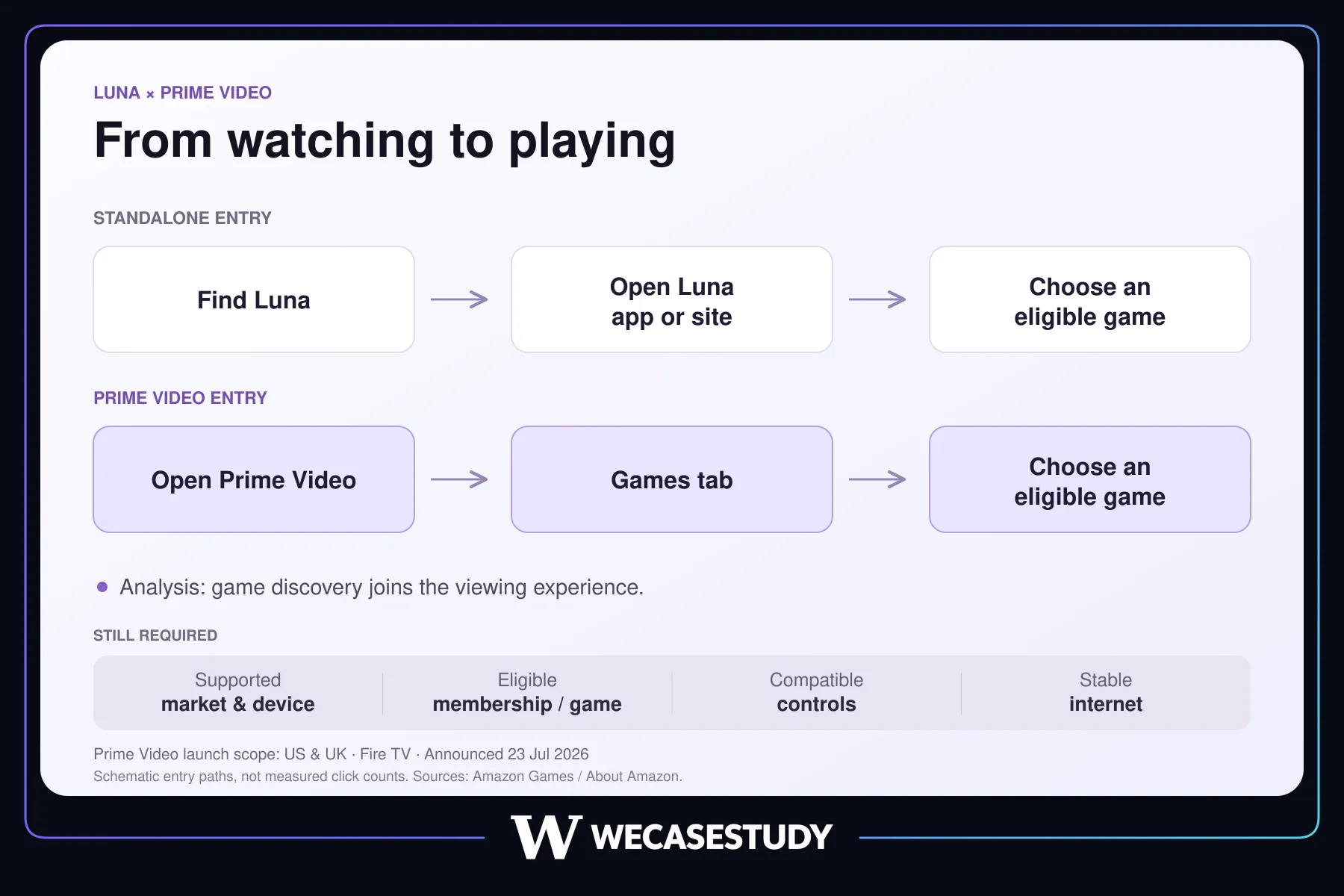
On July 23, 2026, Amazon added Luna games to Prime Video on Fire TV in the US and UK. Gaming could now be discovered beside existing entertainment content on those supported setups.
On September 10, 2026, Amazon introduced Remote Play. An eligible Prime or Premium host could invite up to seven people into supported sessions. Guests needed an Amazon account and supported device, but did not need their own Prime or Premium subscription.
The October catalog update continued investment in games. These events document an evolving service; they do not, by themselves, measure the commercial success of the changes.
Why Amazon Is Bringing Cloud Gaming Into Prime
Prime Bundling and the Subscription Decision
Luna addresses a familiar adoption problem: a person may like the idea of playing but resist buying hardware, choosing another subscription or learning a new platform. Amazon's July announcement explicitly discusses such barriers and describes the audience as including people who would not consider themselves gamers.
For an existing Prime member, the separate subscription decision for Standard disappears. That can make experimentation easier. However, an included benefit can remain unused, and someone who enjoys a game once may never return. Any claim that bundling has increased engagement requires usage data.
A useful evaluation would follow eligible members through first play and repeat play. Comparing exposed and unexposed groups, or observing a staged rollout, could help assess the effect of the integration. Those are proposed evaluation methods, not experiments reported by Amazon in the sources reviewed here.
Prime Video as a Distribution Channel
Prime Video gives Luna a route into an entertainment session already under way. A customer browsing a familiar app can encounter a game without first deciding to seek out a separate gaming service.
The strategic interpretation is that Amazon is using an existing customer relationship to distribute an adjacent activity. It can reduce a discovery step, but that does not establish lower customer-acquisition cost. Such a conclusion would require spending, conversion and attribution data.
The integration also creates a product-design question. Games need to be discoverable without making the interface less useful for viewers who only want video. A business copying the approach should assess both new-product use and the effect on the original experience.
GameNight and Remote Play
A group game has several participants to onboard. Requiring each guest to own compatible hardware or maintain a subscription can prevent a session from happening even when the host is interested.
Phone input and guest access target different parts of that problem. Phone controls reduce the need for additional gamepads in supported experiences. Remote Play lets people participate from different locations without every guest taking out a paid membership.
This may help a host assemble a group, but it also creates a conversion question for Amazon. Guest participation could produce repeat use, paid upgrades or neither. The relevant evidence would include invitation acceptance, completed sessions and returning guests. The existence of an invitation feature cannot establish those outcomes.
The Trade-Off Behind a Simpler Offer
Concentrating cloud access around subscription catalogs makes the main offer easier to explain. It also weakens the proposition for users who previously relied on streaming an external game collection. The April changes therefore deserve attention as a cost of the shift, rather than being described only as simplification.
Amazon's AWS capabilities provide a foundation for delivery, but shared corporate ownership does not reveal Luna's unit economics. Cloud capacity, content rights and support still have costs. Public architecture documentation cannot establish whether a streaming session is profitable or whether Luna operates more cheaply than a competitor.
Amazon Luna vs Xbox Cloud Gaming and GeForce NOW
The most useful comparison begins with where your games and subscriptions already live. The services provide different routes to cloud play, so catalog totals are not interchangeable measures of value.
Service | Core access model | Question for the player |
Amazon Luna | Standard for eligible Prime members and Premium's expanded subscription catalog | Does the included or paid Luna library contain games I want? |
Xbox Cloud Gaming | Supported games through eligible Game Pass plans, selected free-to-play games and selected owned games | Do my preferred Xbox games and plan support cloud play? |
GeForce NOW | Streaming supported PC games associated with linked store or publisher accounts | Are the games I own supported, and what membership or storage conditions apply? |
Microsoft's cloud-gaming guide explains that availability depends on the game, region, plan and platform. NVIDIA's GeForce NOW guide describes linking PC libraries and distinguishes ready-to-play from install-to-play games. Check the conditions for the individual title before subscribing.
From a business perspective, Luna connects gaming access to a broader consumer membership. Xbox links cloud delivery to its gaming ecosystem, while GeForce NOW supports access to compatible PC libraries. These descriptions help explain the different offers; they do not rank actual performance or prove that one model is commercially superior.
For an existing Prime member curious about casual play, Standard is a reasonable starting point. A player with a substantial PC library should first investigate whether GeForce NOW supports the titles they own. Someone already using Game Pass should check cloud eligibility there before adding another service.
What the Evidence Shows About Amazon Luna's Strategy
Documented Product and Distribution Changes
The record establishes a series of choices: a redesigned Prime offering, a retreat from external-store streaming integrations, another discovery channel through Prime Video and more accessible social participation. Together, these decisions support an interpretation of Luna as an increasingly integrated Prime entertainment benefit.
They also show which constraints Amazon is trying to address. Hardware requirements, a separate payment decision, discovery and group setup each receive a different product response. This mapping is the case's main analytical value: it connects specific adoption barriers with specific interventions.
Business Outcomes That Remain Unproven
The sources reviewed do not provide enough data to establish Luna's active-player growth, repeat usage, Standard-to-Premium conversion, contribution profit or causal effect on Prime retention. The appropriate conclusion is limited to the documented product strategy and its plausible mechanisms.
Commercial evaluation would require more than access counts. It would need to show whether people return, whether the service changes membership decisions and whether the resulting value covers its costs. Catalog additions and feature launches are inputs to that assessment.
For a stronger causal judgment, before-and-after figures would also need context. A change in playtime could reflect a major new game, seasonal demand or marketing, rather than the distribution feature being studied.
Lessons for Subscription and Platform Businesses
Introduce Adjacent Products Where Customers Already Spend Time
Before building a separate acquisition channel, examine whether the new activity fits a customer journey you already serve. A software company might place a relevant new tool inside an existing dashboard, then measure discovery, first use and return use.
This lesson applies when the audience and purpose overlap. An unrelated addition can create clutter or weaken the original product experience. Existing traffic alone is insufficient justification for integration.
Measure the Steps Between Access and Habit
Define the behavior that would make a bundled benefit valuable. For a group product, that could mean a host starting a session, guests joining successfully and the group returning later. Track those stages separately so a large eligible audience does not conceal weak adoption.
If first use is healthy but return use is low, improve the ongoing experience before assuming that more distribution will solve the problem. If people fail before the first session, investigate setup and access instead.
Evaluate Simplicity Alongside the Users It Excludes
A narrower offer can be easier to understand while serving some existing customers less well. Before removing an integration, identify who depends on it, what they lose and whether an alternative preserves the job they need to do.
The Luna case demonstrates decisions worth studying, while leaving their financial outcome open. For players, the immediate test is whether the games and streaming experience fit their needs. For product teams, the transferable work is to identify an adoption barrier, design an intervention and measure the behavior that follows.
Research Method and Sources
This is a documentation-based case study, not a hands-on review or latency benchmark. It uses Amazon's terms and support pages for access conditions, dated Amazon Game Studios announcements for product changes, AWS documentation for delivery architecture, and official Microsoft and NVIDIA pages for the comparison. Independent reporting provides an additional account of the April 2026 withdrawal of third-party integrations.
Older promotional pages can retain superseded information. This article prioritizes current support documents and dated change announcements, while linking the relevant source beside each major factual claim. Strategic interpretations and proposed measurements are editorial analysis; the article does not claim access to Amazon's internal decisions or operating data.