AMD Case Study: How Lisa Su Used Zen, Ryzen, and EPYC to Challenge Intel
Lisa Su led the AMD turnaround by concentrating engineering on Zen, a CPU architecture AMD could use in both PCs and servers. Ryzen and EPYC gave each buyer a different reason to switch.

AMD lost $660 million in 2015. Revenue had fallen 28% to $3.99 billion, and the company ended the year with $785 million in cash, cash equivalents, and marketable securities against $2.26 billion in total debt. Its older PC products were losing ground, and it had just exited the dense server systems business. Yet the company was preparing a new processor core for both high-performance desktops and servers. A company under pressure to deliver immediate results was staking its recovery on a design that would take years to reach buyers. AMD 2015 annual report
Executive Summary
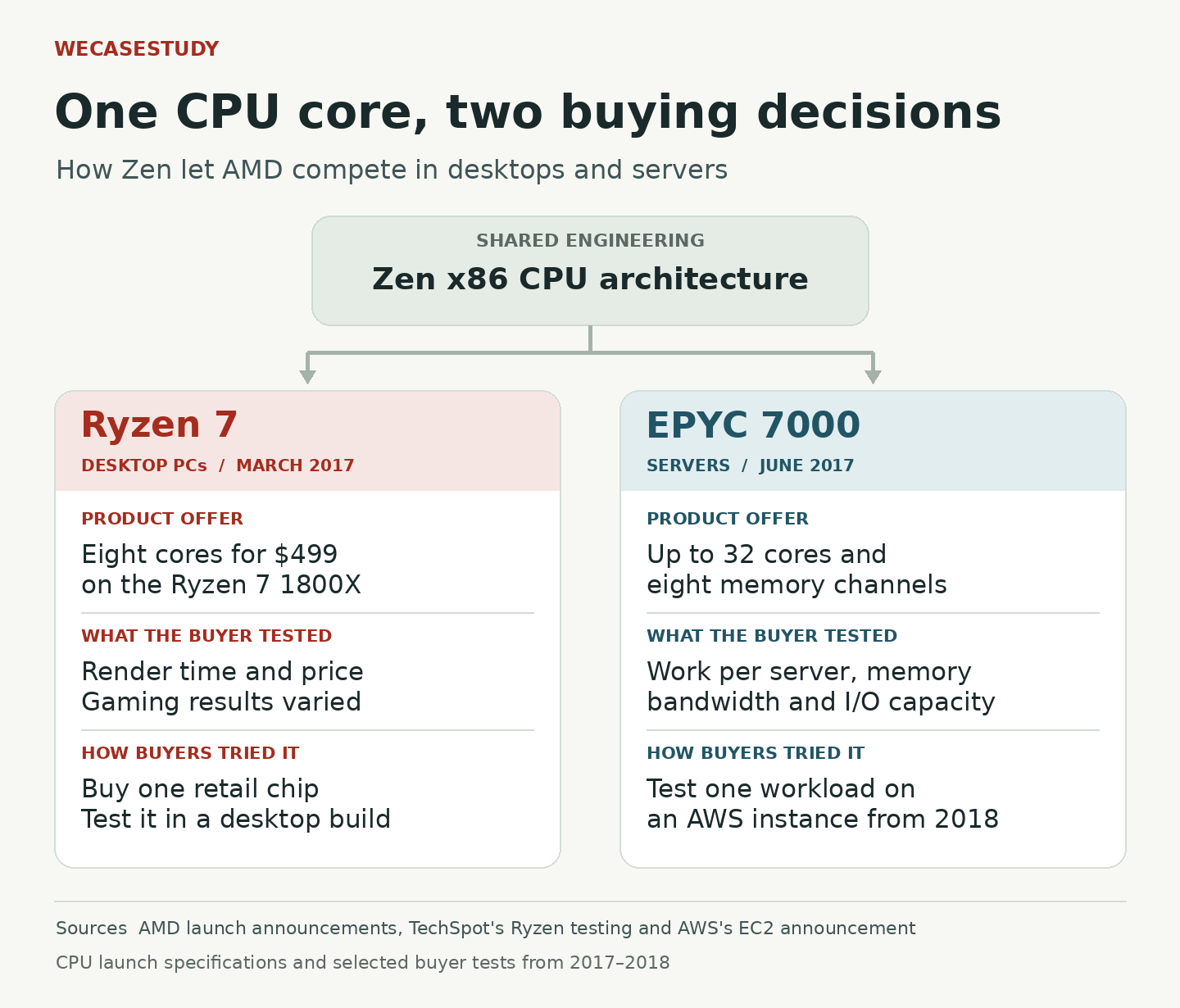
Lisa Su led the AMD turnaround by concentrating engineering on Zen, a CPU architecture AMD could use in both PCs and servers. Ryzen took it to desktop buyers in March 2017 with a price and performance comparison they could verify. EPYC followed in June with enough cores, memory bandwidth, and connectivity to reconsider how much work one server could handle. AMD could share the engineering and give each buyer a different reason to switch. AMD 2015 analyst day · Ryzen launch · EPYC launch
Company Background
Su became CEO in October 2014 after serving as AMD's chief operating officer. AMD could draw on x86 processor expertise, Radeon graphics, and an existing business designing chips for Sony's PlayStation 4 and Microsoft's Xbox One. In 2015, Computing and Graphics lost $502 million at the operating level, while Enterprise, Embedded and Semi-Custom earned $215 million and AMD shipped a record number of semi-custom chips. AMD reported those activities together, so the contribution of the console contracts cannot be isolated. The segment's profit shows why management had reason to protect that business while rebuilding CPUs. CEO appointment · 2015 annual report · 2015 CFO commentary
The console relationships mattered because the two markets exposed AMD to different risks. A console design committed engineering time to a customer's launch schedule and generated sales over its hardware cycle. Rebuilding the desktop line exposed AMD to buyers who could compare it with Intel every time they upgraded. Running both gave AMD a way to earn revenue from its CPU and graphics expertise while waiting for a general-purpose processor with stronger performance. AMD 2015 annual report
Industry Context
Intel spent $13.1 billion on R&D in 2017, more than twice AMD's entire revenue that year. AMD had to pick specific purchase decisions it could win. A desktop enthusiast could verify a chip's performance in a single machine. A server buyer had to validate the whole system, including software, support, and operating cost. The familiar x86 software ecosystem gave AMD a route back into both markets while leaving it with very different approval processes to work through. Intel 2017 financial statements · AMD 2019 annual report · Independent Ryzen review · EPYC launch
Strategic Timeline
| Date | Decision | Consequence |
|---|---|---|
| October 2014 | Lisa Su became CEO. | An operating executive took charge of the product portfolio. CEO appointment |
| 2015 | AMD put Zen on its public roadmap and exited SeaMicro. | The company chose to target high-performance PCs and servers through processors. 2015 analyst day · 2015 annual report |
| Q3 2016 | AMD raised about $1.4 billion before issuance costs. | Debt repayment lowered expected annual cash interest by about $55 million. CFO commentary |
| March and June 2017 | Ryzen and EPYC launched. | One architecture reached two distinct markets. Ryzen announcement · EPYC launch |
| November 2018 | AWS introduced AMD-powered EC2 instances. | Customers could evaluate EPYC through their existing cloud provider. AWS announcement |
| August 2019 | AMD launched Rome, the second EPYC generation. | The line reached 64 cores, and Google confirmed internal production use. Rome launch · Google Cloud |
Growth Strategy
AMD launched the eight-core Ryzen 7 1800X at $499. Intel's eight-core Core i7-6900K had a recommended customer price of $1,089. Independent tests explained who stood to gain from the difference. Buyers rendering video or running other heavily threaded applications could put the extra cores to work, while some high-frame-rate gaming tests at 1080p still favored Intel. Ryzen gave a specific buyer a clear reason to change brands. Ryzen launch · Intel specifications · TechSpot launch testing · TechSpot gaming follow-up
EPYC's first generation offered up to 32 cores, eight memory channels, and 128 PCIe 3.0 lanes per processor. For some workloads, a buyer could consider one socket where they might previously have needed two for memory or connectivity. Actual savings depended on throughput, redundancy, and software licensing. Moving from two sockets to one helps less when the software bill follows the number of cores. EPYC launch
AMD had two ways to price a competitive advantage. On the desktop it put a visible price on an eight-core chip so a buyer could compare it with another CPU. In servers the relevant comparison could be the cost of a fully configured machine and the work it could complete. A component with more memory channels can affect the cost of the rest of the system, so a server salesperson could make the case even where the processor's sticker price told a buyer very little. Ryzen announcement · EPYC launch
Marketing Strategy
Ryzen's price and core count gave reviewers a comparison they could investigate independently. That comparison had a shelf life. Later in 2017, Intel released six-core eighth-generation desktop Core i7 and i5 processors, giving AMD less room to repeat the same argument. Server marketing worked on a slower clock. When Google confirmed it used second-generation EPYC internally, buyers had evidence that the chip had passed a large customer's own deployment criteria. Ryzen launch · TechSpot launch testing · Intel desktop launch · Google Cloud deployment
Business Model
AMD sold general-purpose Ryzen and EPYC chips through channels including system manufacturers and distributors. It also designed semi-custom chips to customer specifications. Console contracts exposed AMD to a few customers' product cycles. General-purpose CPUs exposed it to comparisons with Intel every generation. Zen spread core development across client and server lines while leaving power management, memory, and platform validation to the needs of each market. The payoff depended on reusing expensive work and preserving enough flexibility for each product to compete. 2015 annual report · 2020 annual report · AMD engineers' IEEE paper
Competitive Advantages
Foundry access gave AMD a second way to compete. In 2016 it accepted a $340 million accounting charge tied to amending its GlobalFoundries agreement, which gave it limited rights to source certain 14nm and 7nm products elsewhere. By 2019, Rome combined 7nm compute dies from TSMC with an I/O die made on a mature 14nm process. That flexibility depended on an agreement negotiated years before the product shipped and still left AMD exposed to foundry capacity. 2016 annual report · 2019 annual report · Zen 2 architecture disclosure
Intel disclosed a roughly six-month slip in its then-labeled 7nm CPU schedule in July 2020. Ryzen, EPYC, and Rome had already launched by then. Intel's delay gave AMD more time to capitalize on a product advantage it had already put in buyers' hands. EPYC launch · Rome launch · Intel Q2 2020 results
The foundry choice also identifies a limit on how quickly an incumbent can respond. A competitor could adjust prices or reconfigure its lineup sooner than it could improve manufacturing yield on a new node. For AMD, that made the window worth pursuing only if it could ship processors in volume. Steady supply mattered alongside design performance once server customers began committing capacity. Intel desktop launch · Intel Q2 2020 results · 2020 annual report
Biggest Failures and Recoveries
AMD's 2011 Bulldozer-based FX-8150 had strengths in some highly threaded tasks, but weak single-thread performance hurt common uses. AMD targeted better instructions per clock with Zen and added simultaneous multithreading. The turnaround began with addressing a performance weakness that showed up in everyday workloads. AnandTech Bulldozer review · AMD 2015 analyst day
AMD also closed SeaMicro in 2015, taking a $76 million charge for exiting the dense server systems business. EPYC returned AMD to the same market in a narrower role. AMD supplied the CPU, and server makers and cloud providers sold and supported the systems. That put AMD's engineering behind the component it could differentiate and gave partners a product they could build on. 2015 annual report · EPYC launch
Biggest Successes
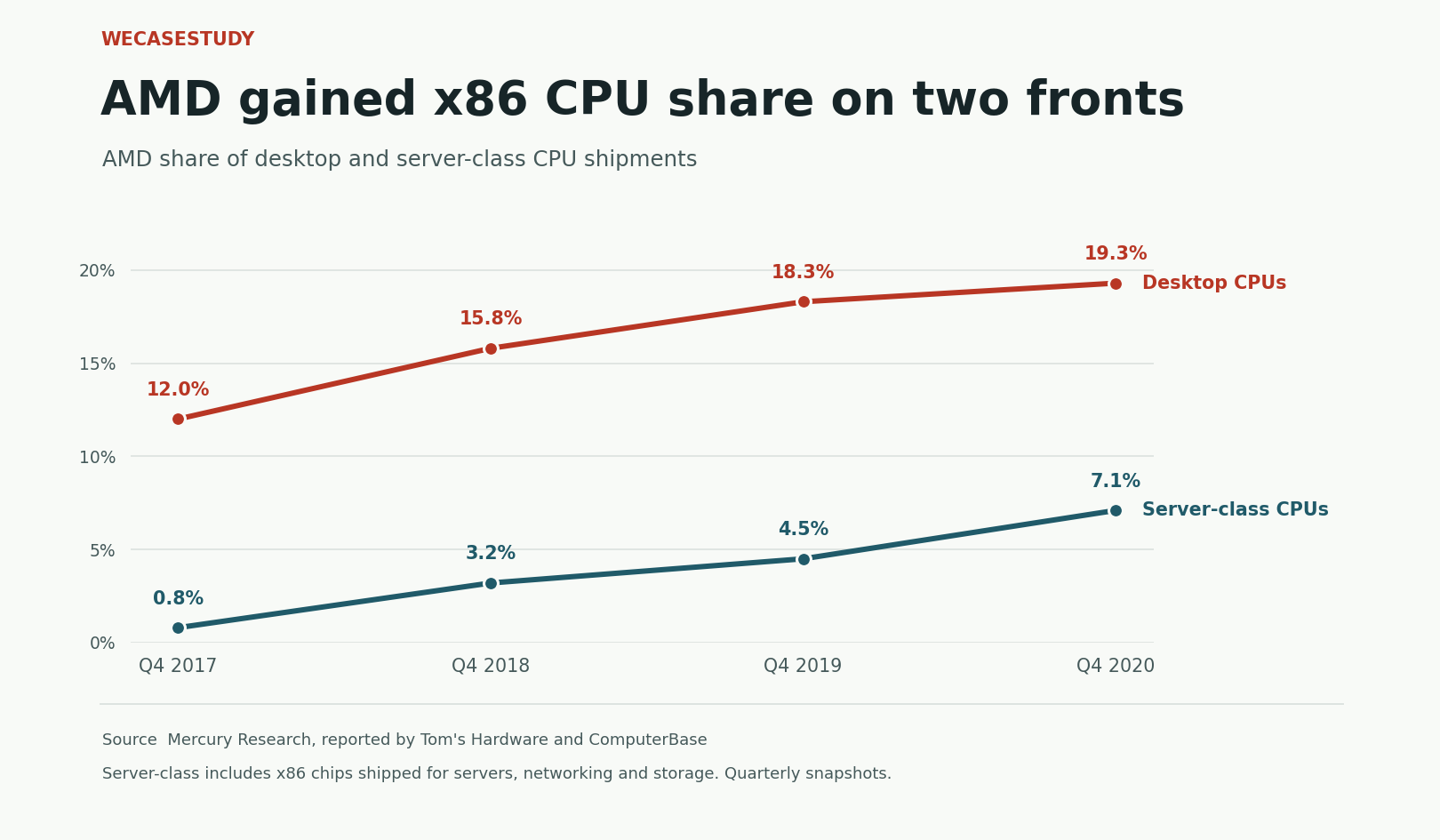
AMD gained ground against Intel in desktops and servers
AMD's share of x86 desktop CPU shipments rose from 12.0% in Q4 2017 to 19.3% in Q4 2020, a gain of 7.3 percentage points. Its share of x86 server-class CPU shipments rose from 0.8% to 7.1%, up 6.3 points. Those are independent Mercury Research estimates published by Tom's Hardware, with the 2017 and 2018 figures also reported by ComputerBase. Intel remained the majority supplier in both categories. Tom's Hardware market-share tables · ComputerBase historical figures
| AMD share of x86 CPU shipments | Q4 2017 | Q4 2018 | Q4 2019 | Q4 2020 |
|---|---|---|---|---|
| Desktop CPU | 12.0% | 15.8% | 18.3% | 19.3% |
| Server-class CPU | 0.8% | 3.2% | 4.5% | 7.1% |
Source: Mercury Research, via Tom's Hardware and ComputerBase. The server-class category includes x86 chips shipped for servers, networking, and storage. The denominator is x86 processor shipments in each category. Q4 2017 follows the Ryzen and EPYC launches.
The desktop numbers give a little prelaunch context. AMD stood at 9.9% in Q4 2016, before Zen-based Ryzen went on sale. The 12.0% starting point in the chart therefore already includes Ryzen's first year on the market. Mercury Research via Tom's Hardware · Ryzen launch
The annual snapshots also hide a divergence. Between Q3 and Q4 2020, desktop share fell from 20.1% to 19.3% while server-class share rose from 6.6% to 7.1%. The two businesses could draw on the same architecture while gaining or surrendering share on different schedules. A single company-wide share figure would have hidden that result. Quarterly Mercury Research tables
Leadership Analysis
Su has described semiconductor decisions as taking three to five years to have their full effect. She set high-performance computing as the direction while AMD's R&D budget was shrinking, from $1.07 billion in 2014 to $947 million in 2015. The strategic choice was which work to protect through years of development, even as legacy products weakened. Lisa Su's Stanford interview · 2015 annual report · 2015 analyst day
In 2016, AMD used proceeds from equity and convertible notes to retire roughly $796 million in term debt and repay $226 million on its asset-based credit line. Existing shareholders absorbed dilution, and the convertible notes could cause more. AMD gained enough breathing room to launch into markets where adoption might lag by several quarters. The management experience worth studying is that combination of portfolio focus and financial room to wait. AMD Q3 2016 CFO commentary
This is also a way to evaluate leadership without giving one executive credit for every engineering result. Su's decisions can be seen in which work AMD funded, which businesses it exited, and how it financed the interval before adoption. The process and packaging advances depended on AMD's engineering teams and foundry partners. Commercial success depended on reviewers, system partners, and customers deciding the products were worth adopting. That division of work is part of the case. Lisa Su's Stanford interview · AMD engineers' IEEE paper · Google Cloud deployment
Financial Analysis
| Fiscal year | Revenue | GAAP net income or loss | What the figures capture |
|---|---|---|---|
| 2015 | $3.991B | −$660M | A PC downturn, legacy product weakness, and restructuring. |
| 2016 | $4.319B | −$498M | Included a $340M charge tied to the GlobalFoundries agreement amendment. |
| 2017 | $5.253B | −$33M | AMD posted $127M of operating income on the later reporting basis. |
| 2018 | $6.475B | $337M | The first full-year GAAP net profit in this restated series. |
| 2019 | $6.731B | $341M | Operating income rose to $631M. |
| 2020 | $9.763B | $2.490B | Operating income reached $1.369B. A $1.3B tax benefit boosted net income. |
AMD's 2019 annual report supplies the retrospectively adjusted 2016 and 2017 figures under its revised revenue-recognition accounting. AMD's 2020 annual report supplies the 2020 figures. AMD's original 2017 earnings release reported $43 million in 2017 GAAP net income and $179 million in non-GAAP net income.
The 2017 accounting change moved some revenue and expenses between periods, including amounts tied to custom orders, distributor sales, and development and licensing agreements. AMD's adoption reconciliation shows operating income of $204 million as originally reported and $127 million on the revised basis. The change had no effect on cash flow. That makes fiscal 2017 the operating inflection in either presentation and 2018 the first annual GAAP net profit in the series above. AMD 2017 annual report and ASC 606 reconciliation · AMD 2019 annual report
The 2019 segments illustrate why an early turnaround can be hard to see. Enterprise, Embedded and Semi-Custom revenue fell 14% as weaker semi-custom sales outweighed higher EPYC sales. Meanwhile, Computing and Graphics reported a 22% increase in average selling price and a 4% rise in shipments. AMD attributed the higher selling price mainly to a richer client mix driven by Ryzen demand. One leg of the turnaround appeared as a shift inside a growing segment. The other grew inside a shrinking one. AMD 2019 annual report
Operating cash flow rose from $493 million in 2019 to $1.071 billion in 2020, and gross margin rose from 43% to 45%. Both improved in a year when a tax benefit boosted reported net income. AMD said Ryzen and EPYC sold at above-average gross margins in 2020. Console and graphics sales also contributed to the company-wide results. AMD 2020 annual report
Innovation Strategy
Rome separated compute from the circuitry that connects it to the rest of the machine. The design let AMD reserve leading-edge manufacturing capacity for the compute dies and adjust their number by configuration. The trade-off was more work in packaging, interconnect, and validation. The decision makes economic sense when reuse and manufacturing flexibility outweigh those additional costs across the product family. AMD architecture disclosure · AMD engineers' IEEE paper
Customer Strategy
AWS priced selected AMD-backed EC2 instance families 10% below their existing equivalents. A prospective buyer could copy one workload into a new instance, measure it, and switch back. With the same instance count and other costs held constant, the lower hourly rate would be fully offset if the job ran about 11.1% longer. The relevant buying metric was the cost of completing the same work within the same service requirements. AWS announcement
A model managers can reuse is expected lifetime savings from switching − migration and testing costs − expected disruption costs. Specify a rollback path and agree on the workload and success metric before the pilot. The buyer can then quantify the benefit and approve a smaller commitment.
The same logic clarifies what a cloud launch can prove. An instance listing establishes availability. A pilot establishes whether the chip can do a particular customer's job. Repeated production use shows that the performance and operating economics justify the effort of keeping the deployment. As the stages progress, the buyer's commitment rises and the evidence gets stronger. AWS announcement · Google Cloud deployment
Original Strategic Insights From the AMD Turnaround
1. Shared Core, Separate Buying Tests
Hidden insight. AMD reused the core but validated the surrounding system separately. The more engineering products share, the more deliberate each sales team must be about proving why its version deserves to exist. Apply it. Write one pass/fail purchase test for each segment. Share the components that meet both tests and fund separate demonstrations for the requirements that differ. Ryzen launch · EPYC specifications · AMD engineers' IEEE paper
2. Product Mix Improved Before Volume Recovered
Hidden insight. In 2017, AMD reported a 47% rise in average selling price and 2% growth in unit shipments for Computing and Graphics, attributing the shift primarily to newer Ryzen desktop processors and Radeon GPUs. AMD could undercut an Intel premium SKU while getting paid more across its own portfolio. Apply it. Track average selling price and units by product tier, then check gross margin separately. That shows whether buyers are moving up your range and whether the shift pays. AMD 2017 annual report · Intel processor specifications
3. The Replaceable First Deployment
Hidden insight. An existing customer could test EPYC within an AWS account. That made a smaller first order commercially valuable because it reduced the budget and risk a team had to approve. Apply it. Let buyers start with one workload that has a baseline and a rollback path. Track time to first production use and the fraction of trials that expand. AWS announcement
4. Own the Layer That Earns Its Keep
Hidden insight. Leaving complete server systems gave AMD fewer layers to support and allowed systems partners to earn their own margin on EPYC deployments. A smaller role in the value chain could improve distribution. Apply it. Map who makes money at each layer. Keep ownership where your differentiation pays for the fixed costs and give partners a clear reason to sell the rest. AMD 2015 annual report · EPYC partner ecosystem
5. Upgrade the Bottleneck, Keep the Rest
Hidden insight. Rome put the compute cores on TSMC's 7nm process while leaving I/O on a mature process. Older technology in one part of a product can free advanced capacity for the part that improves performance. Apply it. Rank subsystems by the customer value an upgrade delivers. Compare that gain with the added manufacturing, integration, and testing costs. Zen 2 disclosure · AMD engineers' IEEE paper
6. Finance the Gap to Customer Adoption
Hidden insight. AMD reduced its cash interest in 2016, before EPYC shipped in 2017 or appeared on AWS in 2018. A launch can go to plan while the customer still takes another budget cycle to adopt. Apply it. Budget through launch, qualification, and the first repeat order. Stress-test a scenario where the product ships on time and a large buyer needs an extra year to commit. 2016 CFO commentary · EPYC launch · AWS announcement
7. The Second Generation Sells the Roadmap
Hidden insight. Rome's higher core count and Google's production use gave buyers evidence that EPYC would continue to advance. That increases the expected value of the work customers put into validating and supporting a platform. Apply it. Identify which improvement would justify the buyer's next deployment, then reserve capacity for that release before you scale the first. EPYC first-generation launch · Rome launch · Google Cloud
How the Advantages Reinforced One Another
A shared core supported two offers. Independent tests and customer deployments made it easier for the next buyer to evaluate them. When those purchases improved margins and operating cash flow, AMD gained more room to invest in the next release. The loop depended on improving performance where customers could measure it and keeping the next revision on schedule. AMD 2017 annual report · Google Cloud deployment · AMD 2020 annual report
What Most People Get Wrong
“AMD won by being cheap.” The 1800X changed what AMD buyers could get at a given price. Higher realized selling prices in Computing and Graphics show how different that was from a discount on an aging product line. Ryzen launch · AMD 2017 annual report
“Intel's delays explain the comeback.” AMD's desktop share had already reached 18.3% by Q4 2019, before Intel's July 2020 disclosure. Timing helped extend an advance that was already visible in shipments. Mercury Research via Tom's Hardware · Intel Q2 2020 results
“Ryzen came first, then AMD decided to try servers.” The launches were three months apart, and AMD had targeted both markets in its 2015 roadmap. The gap appeared in buyer adoption and distribution. 2015 analyst day · Ryzen launch · EPYC launch
“The turnaround was a chiplet story.” The first Zen products already gave buyers competitive reasons to switch. Rome's later separation of compute and I/O helped AMD extend those gains across configurations. 2015 analyst day · Zen 2 architecture disclosure
The Transferable Business Playbook
| Step | Decision | Test before committing more resources |
|---|---|---|
| Protect the long-lead work | Choose a capability that can improve more than one offer. | Can the business fund it through qualification and repeat use? 2015 analyst day · 2016 CFO commentary |
| Pick a comparison customers can verify | Compare the strongest use case and the most likely objection. | Can someone outside your company reproduce the result? Independent Ryzen testing |
| Give partners a reason to sell it | Let the channel own deployment where it has an advantage. | Which paid offering can the partner build around your product? EPYC partner ecosystem · AWS announcement |
| Track price and units separately | Isolate mix, shipments, and gross margin. | Are buyers moving into higher-value products, and does the mix improve profit? 2017 annual report · 2020 annual report |
| Commit to the follow-up | Pick an improvement that changes the next buying decision. | Will early customers qualify it again? Rome launch · Google Cloud deployment |
Lessons for Entrepreneurs
Separate the loss from the liquidity decision. Compare available cash with maturities and the cost of the next product milestone. 2015 annual report
Budget for the buyer's timeline. Put product launch and first production use on separate dates. EPYC launch · AWS announcement
Price a financing decision in full. Compare shareholder dilution with the cash interest avoided. 2016 CFO commentary
Protect a business that buys time. Identify which customer relationships can support the portfolio during the rebuild. 2015 annual report
Check what segment data bundles together. Avoid using a combined profit figure as a proxy for any one product. 2019 annual report
Give the roadmap a measurable claim. Name the target customer and a product improvement before asking for patience. 2015 analyst day
Repair the most frequent performance weakness. Favor changes buyers will notice in routine use. AnandTech testing
Validate architectural reuse. List what the second product can inherit and what still requires its own team. AMD engineers' IEEE paper
Make a review reproducible. Give independent testers a workload, comparison product, and price. Ryzen launch · TechSpot testing
Test a workload that may favor the incumbent. Use the outcome to identify who should buy first. Gaming follow-up
Anchor pricing to the buyer's next-best option. Compare against whichever alternative performs the same job. Intel specifications · Ryzen launch
Track whether customers move up the range. Read selling price alongside units when measuring the relaunch. 2017 annual report
Compare the whole system. Test whether one machine can meet the memory and connectivity requirements of two. EPYC launch
Check what software charges for. Model per-core and per-socket licenses separately in a server savings estimate. EPYC platform specifications
Start in a channel customers already use. Reduce how much purchasing and deployment work the first test requires. AWS announcement
Agree on a rollback procedure. Make the buyer's first production workload small enough to reverse. AWS announcement
Ask for production evidence. Look for a real deployment when judging whether a partner has adopted your product. Google Cloud
Leave partners enough margin to act. Identify how each partner earns money by deploying your component. EPYC partner ecosystem
Review failures by layer. After exiting a product, assess whether the company can compete by supplying one part of it. 2015 annual report · EPYC launch
Put expensive technology where it changes results. Estimate gains per subsystem before upgrading the entire design. Zen 2 disclosure
Account for added interfaces. Include packaging, integration, and validation before claiming that modularity lowers cost. Chiplet design paper
Put an expiry date on a competitive comparison. Update the offer when the incumbent changes the spec or price that made yours stand out. Intel desktop launch
Read operating performance alongside net income. Check cash flow when a tax benefit materially changes the headline. 2020 annual report
Reconcile the reporting basis. Put originally reported and restated results in context before identifying a turnaround year. Original FY 2017 results · 2019 annual report
Use release two to test retention. Measure which first-generation customers qualify and buy the next product. First EPYC launch · Rome launch
Future Outlook
In November 2026 AMD announced general availability of its sixth-generation EPYC SP7 processors based on Zen 6. It also reported third-quarter Data Center revenue of $8.5 billion, up 97% year over year, citing both EPYC CPUs and Instinct accelerators. The segment figure captures both businesses. Client revenue reached $2.9 billion, up 7%, driven by Ryzen mobile processors. AMD Q3 2026 results · 6th Gen EPYC availability
The next test is where an EPYC host improves the cost of running an AI workload. More CPU capacity could matter for workload orchestration, tool use, or data preparation. In other deployments the limiting factors may be accelerators, networking, or memory. With cloud providers offering alternatives such as AWS Graviton, the strongest evidence will be workload results that identify the CPU's contribution and customers that repeat the purchase. 6th Gen EPYC availability · AWS Graviton introduction
Final Takeaways
Concentrate R&D on a capability that improves multiple products.
Give each market its own test for why the product deserves to sell.
Track realized price and mix before counting on higher unit volumes.
Treat financial runway as part of product execution.
Use low-commitment trials to let cautious buyers test a credible switch.
Keep partners in the parts of the value chain where they can accelerate adoption.
Assign the most expensive technology to the part of the system that benefits from it.
Evaluate savings at the workload or whole-system level.
Use the second generation to show that customers can rely on the roadmap.
Judge the turnaround with operating results, cash flow, and consistent accounting.
Frequently Asked Questions
How did Lisa Su turn AMD around?
Su focused AMD on high-performance computing, protected the Zen CPU roadmap, and used the shared design to launch Ryzen for PCs and EPYC for servers. She also led AMD through changes in which businesses it operated and how it financed the wait for new products and customers. Lisa Su's Stanford interview · AMD 2015 analyst day · 2016 CFO commentary
What is the difference between Zen, Ryzen, and EPYC?
Zen is the CPU core architecture. Ryzen is AMD's client processor brand, including desktop and mobile chips. EPYC is its server processor brand. Ryzen and EPYC use generations of Zen cores in products built around different system requirements. Ryzen launch · EPYC launch · AMD engineers' IEEE paper
When did AMD return to profitability?
AMD recorded operating profit in fiscal 2017 on the later reporting basis. AMD reported $43 million in 2017 GAAP net income at the time. After applying its updated revenue-recognition standard, it showed a $33 million net loss for 2017 and a $337 million net profit for 2018. Original results · AMD 2019 annual report
Why was EPYC important to the AMD turnaround?
EPYC gave AMD a reason to compete in server purchases again. Its combination of CPU cores, memory channels, and I/O lanes let buyers consider alternative system configurations. AWS lowered the barrier to testing EPYC-backed compute, and Google's second-generation deployment helped establish production credibility. EPYC launch · AWS announcement · Google Cloud
How much x86 CPU market share did AMD gain after Ryzen and EPYC launched?
From Q4 2017 to Q4 2020, AMD gained 7.3 percentage points in desktop x86 CPU shipment share and 6.3 points in server-class x86 CPU shipment share. Those gains took AMD to 19.3% and 7.1%, respectively, in categories where Intel still held the majority. Mercury Research via Tom's Hardware