Propaganda Techniques: Real Examples and How to Spot Them
Discover how propaganda techniques turn promotion into apparent public opinion, from staged Telegram AMA questions to real cases in social media, crypto, politics and everyday life, and learn how to spot them.


Propaganda techniques shape beliefs and behavior through selective information, repetition, emotional appeals, borrowed authority and social pressure. The familiar seven are bandwagon, testimonial, transfer, plain folks, card stacking, glittering generalities and name-calling. Their power often comes from making a conclusion feel established before its evidence has been examined.
The First Time I Heard “Shilling” Sold as a Service
Peyman Khosravani shared the following first-person recollection. His account has been edited for clarity.
I first heard the word shilling while working with a consultancy team helping a crypto project. We were creating a Telegram campaign involving several ask-me-anything sessions, or AMAs, with the project's founder.
I remember this as a time when Bitcoin was still below $2,000. As we arranged the campaign, channel owners kept asking whether I wanted a shilling service.
I already knew that coordinated promotion happened. What surprised me was discovering that, in crypto, it was something offered as a service.
The offer was for a group of people to participate in the AMA and ask questions. Those questions could be the ones we wanted the founder to answer, or could steer the discussion toward supporting the project and highlighting what made it distinctive.
The offer made me notice something I had not previously thought of as a product: participation in the conversation itself.
This account describes the service Peyman recalls being offered. It does not establish that he purchased it, that a particular AMA used it, or that it changed anyone's beliefs. The price reference describes his recollection of the period, not an independently established date.
Is that propaganda on a small scale?
Potentially, yes. More precisely, it describes an offer to manufacture apparent audience interest. If organized participants appear to be independent members of the public, it becomes covert shilling and can contribute to astroturfing. A coordinated effort to steer interpretation through that false appearance can reasonably be analyzed as small-scale manipulative propaganda.
Propaganda techniques do not require a mass audience. The important questions are whether the coordination is disclosed, whether the questions create a misleading impression and whether genuine scrutiny remains possible.
Compare two illustrative questions:
Open inquiry: “What evidence supports your claim that the project is distinctive?”
A question carrying its own endorsement: “Why is your project so much more advanced than the alternatives?”
The second embeds a conclusion inside a question. If several apparently independent participants do this, observers may mistake the staged premise for an audience consensus. That is an interpretation of the mechanism, not a measured outcome of Peyman's experience.
There is an honest version of preparation: collect common questions, label team-submitted questions and use a moderator to organize the discussion. The problem arises when preparation is presented as independent public endorsement.
A question can function as an advertisement—even when its punctuation makes it look like scrutiny.
The documented cases below show how that information problem changes form across marketing, finance, politics and daily life.
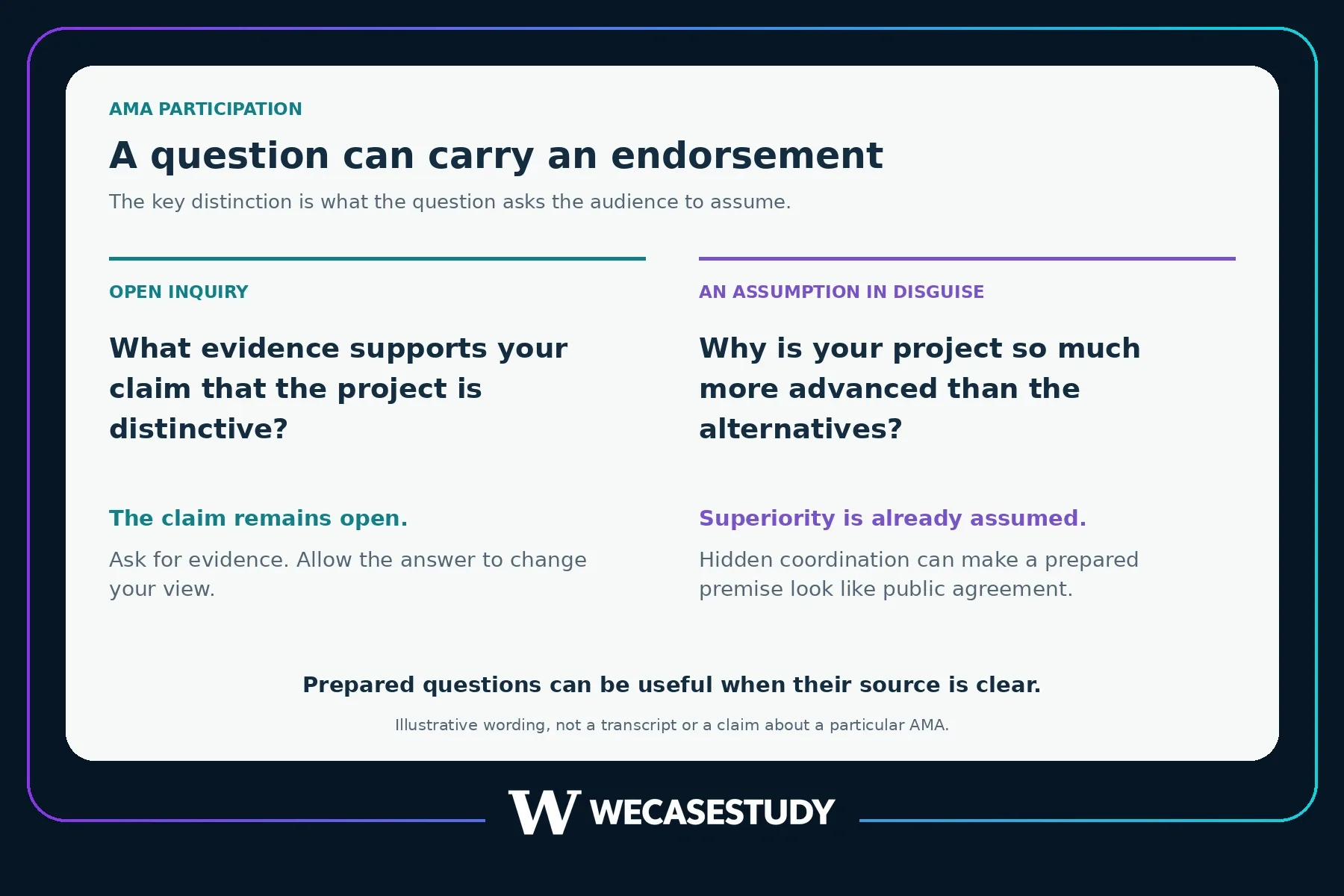 Illustrative questions: the second embeds an endorsement in its premise. This is not a transcript of Peyman’s experience.
What Is Propaganda? Distinguish Persuasion From Deception
Propaganda is organized communication intended to shape understanding and behavior in service of a cause or sponsor. Definitions differ over whether deception is essential to the term. This guide focuses on manipulative propaganda: communication that steers people while obscuring material evidence, interests or alternatives.
Truthful facts can support a misleading picture. A real benefit can hide a larger cost; a genuine testimonial can be unrepresentative. Emotion alone proves neither deception nor accuracy.
| Term | What distinguishes it |
|---|---|
| Open persuasion | The advocate, position and reasons are visible. |
| Disclosed promotion | The audience can inspect a relevant commercial relationship. |
| Misinformation | False information is shared, without necessarily intending deception. |
| Disinformation | False information is deliberately circulated to mislead. |
| Shilling | Interested promotion is presented as independent enthusiasm. |
| Astroturfing | Organized support is presented as spontaneous grassroots activity. |
Shilling describes a participant's role; astroturfing describes the appearance of a wider movement. Neither requires every participant to be fake or insincere. A paid influencer whose relationship and claims are represented honestly is not automatically a shill.
How Propaganda Techniques Begin and Spread
Propaganda often begins with a real concern and incomplete information: financial insecurity, fear, grievance or a desire to belong. A campaign connects that opening to a preferred explanation and action. The concern may be legitimate without verifying the solution.
One useful audit sequence is:
Identify the concern the message speaks to.
Extract the explanation offered for that concern.
Trace the authority and sources supporting it.
Examine the pressure to agree or act.
Ask what could change the conclusion.
This is an editorial model, not an inevitable lifecycle. Audiences can reject campaigns, expose sources and revise their views.
The Seven Classic Propaganda Techniques, With Practical Examples
These propaganda techniques overlap, so one message may use several at once. The classifications below are our analysis, rather than labels assigned by regulators.
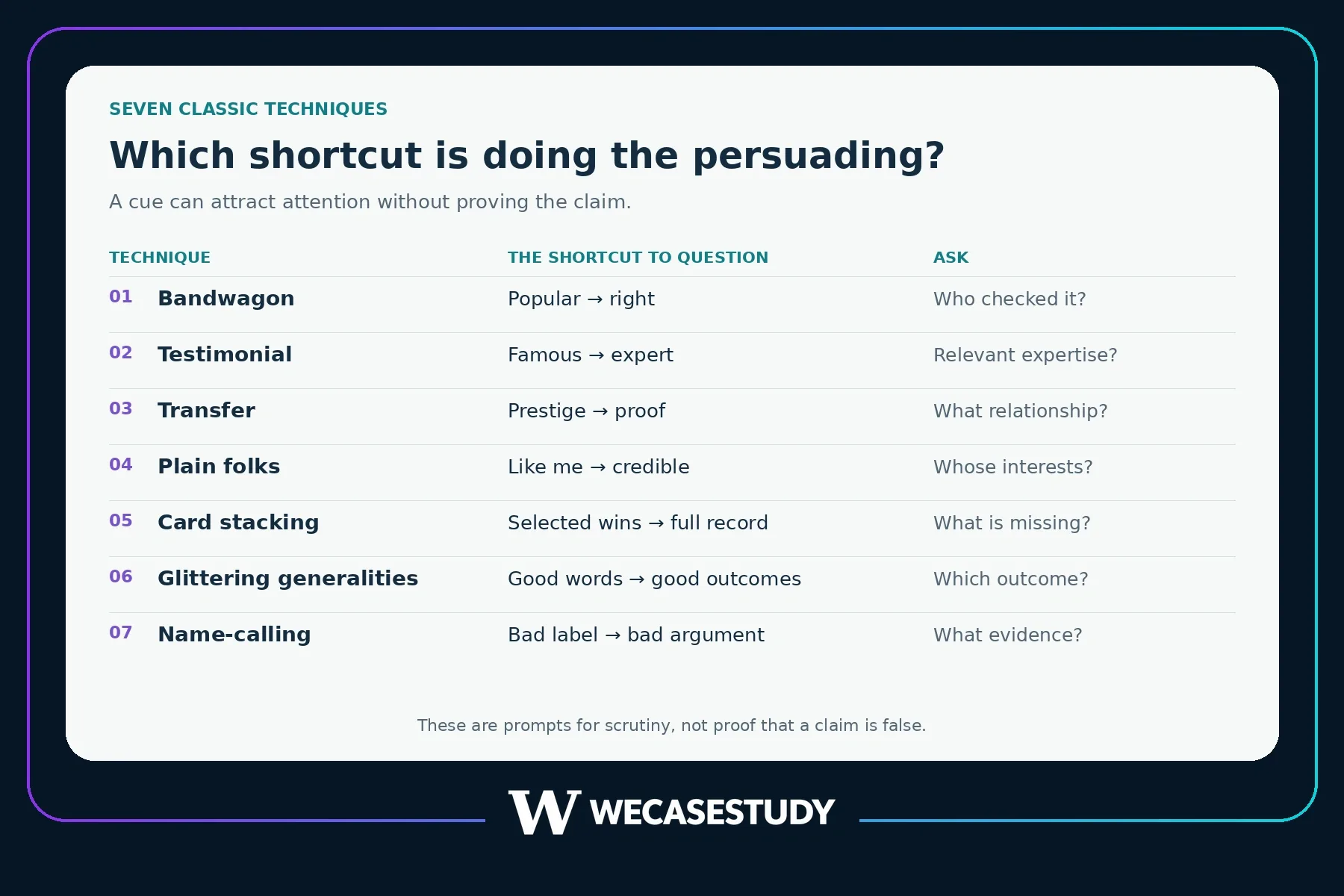 A quick reference to the seven classic techniques. The case sections explain the evidence and limits of each example.
1. Bandwagon propaganda: everyone seems to agree
Popularity can establish adoption, not suitability. In the Devumi case discussed below, the FTC alleged sales of fake followers and other influence signals. FTC case record The manipulation begins when an audience treats the visible crowd as evidence of independent approval.
Check: are you counting customers, registrations or followers—and what did they actually evaluate?
2. Testimonial propaganda: approval travels beyond expertise
A genuine experience can be useful without being typical. A celebrity's investment endorsement does not supply financial analysis. The Kardashian case below illustrates why the relationship behind an endorsement matters. SEC order
Check: what does this person know about this particular claim, and what would remain of the argument without their name?
3. Transfer propaganda: borrowed prestige completes the argument
Camel's doctor advertisements associated cigarettes with medical authority. Stanford archive Even an accurate survey of doctors' brand preferences would not establish safety. The question quietly changes from what professionals use to what scientific evidence proves.
Check: does the symbol establish endorsement, expertise or merely association? A startup using a major company's software is not necessarily its partner.
4. Plain folks propaganda: an interested speaker performs independence
The FTC's Sunday Riley case concerned employees reviewing their employer's products without disclosing that relationship. FTC order A customer-like voice can feel relatable while concealing a materially different role.
Check: separate shared background from evidence. Understanding your frustration does not establish that someone's solution works.
5. Card stacking propaganda: the missing comparison changes the result
Volkswagen's “Clean Diesel” campaign promoted environmental performance while defeat devices masked high emissions in government testing, according to the FTC's 2016 complaint. A subsequent partial settlement addressed affected 2.0-liter vehicles. FTC settlement record
The underlying conduct went beyond ordinary selective advertising. As an analytical example, it shows why favorable evidence loses its meaning when the conditions producing it are concealed.
Check: does the test represent ordinary use? For trading records or testimonials, demand the denominator, failures, costs and selection rule.
6. Glittering generalities: an attractive word carries an extra promise
“Natural,” “freedom” and “innovation” can express real properties or values. Trouble begins when their positive associations supply an unstated conclusion. In 2016, the FTC ruled that California Naturel falsely advertised sunscreen as “all natural.” FTC decision
Two checks are necessary: is the composition claim accurate, and what does it establish? Even a truthful natural-origin claim would not by itself establish safety or effectiveness. The case illustrates the gap between an appealing label and the evidence a reader may infer from it.
7. Name-calling propaganda: condemnation arrives before judgment
In 1937, the Nazi regime displayed confiscated modern artworks in its “Degenerate Art” exhibition. The US Holocaust Memorial Museum documents mocking slogans and deliberately unflattering presentation. museum record
The label supplied a verdict before visitors evaluated individual works. That is an interpretation of the documented display, not evidence that every visitor accepted its message.
Check: restate the disputed claim without the insulting label. Does an argument remain?
For product comparisons such as OpenAI versus Anthropic, the same discipline means setting evaluation criteria before allowing popularity or branding to settle the choice.
Why Propaganda Techniques Work: Four Evidence Problems
Familiarity can influence perceived truth
Fazio and colleagues’ 2015 experiments found that repetition increased perceived truth even for some statements participants had the knowledge to reject. Available knowledge did not always determine the judgment. The finding does not mean repetition invariably defeats knowledge or that audiences believe anything repeated often enough. Fazio and colleagues
Practical implication: when a claim feels familiar, ask where you learned it. Remembering a sentence is different from remembering evidence for it.
Public agreement can differ from private judgment
Asch’s conformity experiments, first reported in 1951, examined people judging line lengths in the presence of a deliberately incorrect majority. His 1955 account reported errors below 1% under ordinary conditions and agreement with the wrong majority on 36.8% of critical selections. About one-quarter of participants never yielded. Asch’s original account
The unit matters: 36.8% of selections does not mean 36.8% of people permanently believed a lie. The experiment did not demonstrate a self-sustaining propaganda movement after its organizers departed.
In practice, people may express agreement because of social pressure, even without better evidence.
A visible rating can influence later ratings
In Muchnik, Aral and Taylor’s 2013 randomized online experiment, an initial positive rating increased the likelihood of a subsequent positive rating by 32%; final ratings were 25% higher on average. The effect depended on context. ratings experiment
This finding helps explain propaganda techniques that rely on visible ratings. It provides causal evidence within the studied system. It does not establish a universal increase in sales, political support or token prices. For readers, the implication is to inspect the underlying contribution before allowing its score to determine its credibility.
Different voices can depend on the same evidence
Suppose one company announcement appears in a press release, three sponsored articles, five creator videos and a community thread. There are ten presentations, but there may still be only one source of evidence.
This is a source-dependence problem, separate from repetition or conformity. Multiple investigations can provide independent support. Multiple copies of one claim cannot provide the same support.
The practical rule is simple: count independent evidence origins before counting agreeing voices. This is an editorial diagnostic, not a validated numerical scoring system.
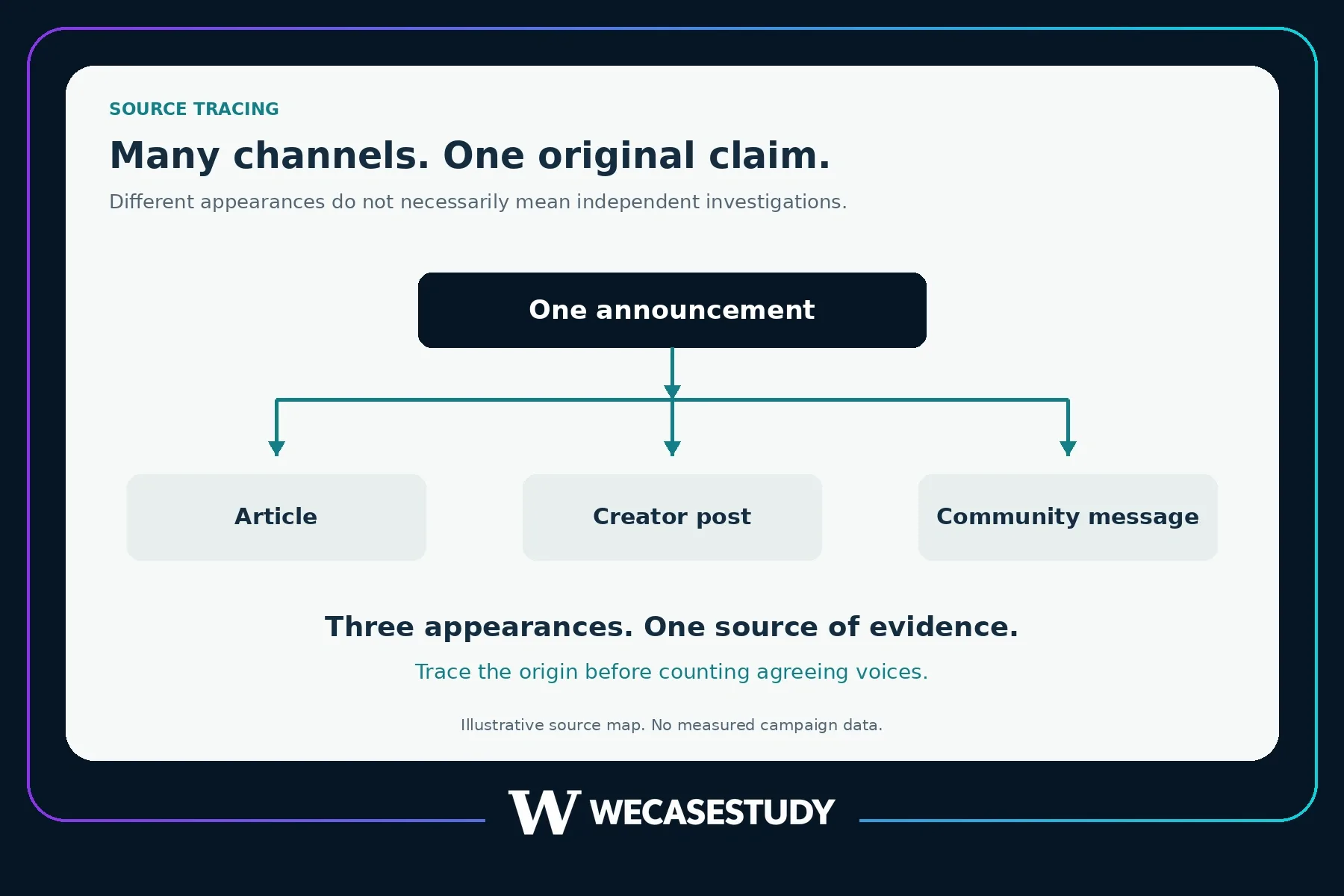 Illustrative source map: several appearances can trace to one original claim. Count independent evidence before counting agreeing voices.
Additional techniques that often appear online
| Technique | What it does | What to check |
|---|---|---|
| Astroturfing | Presents organized support as an independent movement | The organizer, relevant relationships and identity of the accounts. |
| Source laundering | Repackages one origin as several apparent confirmations | Follow citations backward until you reach the original evidence. |
| False urgency | Makes verification feel more costly than immediate action | The real reason for the deadline and the scope of the constraint. |
| False dichotomy | Removes reasonable alternatives from the decision | Whether waiting, qualifying a position or choosing another option remains possible. |
| Scapegoating | Blames a person or group instead of establishing causation | Evidence connecting the alleged cause to the observed problem. |
These propaganda techniques are warning patterns, not automatic verdicts. Real deadlines, coordinated advocacy and criticism of identifiable wrongdoing can all be legitimate.
Historical Propaganda Techniques: Shilling Before Social Media
Stock promotion in the 1920s and 1930s: financial commentary with an interested sponsor
The US Senate’s 1934 Stock Exchange Practices report documented market pools that combined coordinated trading with favorable publicity. It described subsidized writers and promotional sheets presented as reputable financial information. 1934 Senate report
One publisher, David M. Lion, received stock options for publicity. He paid radio commentator William J. McMahon $250 a week to promote stocks associated with pool operations; McMahon was introduced as an economist and research-institute president. The record also describes payments to newspaper writers in cash or stock options.
The link between these propaganda techniques and modern shilling is the mismatch between the audience’s apparent information source and the source’s economic role. What sounds like independent analysis may be part of an interested distribution effort.
What to check today: compensation, ownership and evidence production separately. A publisher can have a financial interest without fabricating every fact. The issue is whether readers can assess that interest and verify the recommendation.
Camel’s doctor advertising: medical imagery without a health trial
Stanford’s tobacco-advertising archive preserves Camel advertisements, including a 1946 example, built around the claim that more doctors smoked the brand than any other cigarette. The archive explains how idealized physician imagery associated the product with medical authority. Stanford archive
That illustrates two techniques working together: a testimonial-like popularity claim and transfer of medical prestige. Even a perfectly representative survey of doctors’ brand preferences would not establish that smoking was safe.
These propaganda techniques can work by changing the question. “Which brand do some professionals use?” becomes “What does medical evidence establish about harm?” The evidence needed for those questions is different.
What to check today: whether an expert’s presence supports the actual claim. A clinician’s appearance, a white coat or an endorsement does not replace a relevant study.
The tobacco industry’s 1954 statement: uncertainty became the message
The UCSF archive preserves the January 4, 1954 advertisement A Frank Statement to Cigarette Smokers. A US Justice Department account of the later tobacco litigation describes the industry’s coordinated position: disputed causation, reassurances about harm and calls for further research. 1954 advertisement; DOJ record
The mechanism differs from an outright promise of safety. Maintaining an impression of unresolved uncertainty can delay a decision even when a campaign does not persuade someone that the product is beneficial.
These propaganda techniques suggest a useful distinction: some campaigns seek belief; others seek enough doubt to postpone action. That is our interpretation of the documented strategy, not a claim that requests for further research are inherently deceptive.
What to check today: whether uncertainty is being described proportionately. Which findings are contested, which are well established, and does the sponsor acknowledge both? “More research is possible” does not mean “all current conclusions are equally uncertain.”
Propaganda Techniques in Social Media Marketing
Lord & Taylor: 50 creators did not mean 50 independent discoveries
According to the FTC’s complaint, Lord & Taylor paid 50 fashion influencers between $1,000 and $4,000 each, supplied a dress and approved posts for a March 2015 campaign. The posts did not disclose the compensation. Paid Nylon material also lacked disclosure. FTC complaint; final order
The FTC reported 11.4 million users reached, 328,000 engagements and a subsequent sellout. Those figures describe campaign activity and an observed commercial outcome; they do not isolate the incremental effect of nondisclosure. The case was resolved through a consent order.
These propaganda techniques exploit the appearance of independence. Different faces and styling choices can make one coordinated campaign look like many separate discoveries. Visual variety does not establish evidential variety.
Reader’s test: choose three endorsements and inspect their disclosures and original claims. Are you seeing separate product evaluations or several executions of one brief?
Marketer’s application: coordinate a launch openly. Let creators demonstrate genuine experiences and limitations, disclose the relationship and preserve the distinction between paid reach and independent validation.
Devumi: the appearance of influence became something to purchase
The FTC alleged that Devumi sold fake indicators of social influence, including followers, subscribers and views. Its complaint described more than 58,000 orders for fake Twitter followers. A final court order was entered in October 2019. FTC case record
Propaganda techniques built on audience size exploit a common screening device: buyers, journalists and potential partners use it to decide whose work deserves attention. Inflating that signal can therefore affect decisions beyond the immediate platform.
An analytical feedback loop is possible: inflated metrics attract an opportunity, and the opportunity later becomes an apparently legitimate credibility signal. The case record does not establish how often that entire sequence occurred.
Reader’s test: assess the claim before the account. Does the source show methods, relevant expertise, original evidence and corrections? None of these is guaranteed by a follower count.
Marketer’s application: report qualified outcomes rather than treating raw engagement as proof of influence. Explain what a view, lead, customer or retained user means in your reporting.
Sunday Riley: the seller entered the customer-review channel
The FTC alleged that Sunday Riley Skincare managers and employees posted product reviews using fake accounts and failed to disclose their employment. The agency approved a final consent agreement in November 2020. FTC order
Reader’s test: read detailed positive and negative reviews, inspect dates and look for verifiable experience. Similar language is a reason to investigate, not proof that a reviewer is fake.
Marketer’s application: request honest feedback without prescribing sentiment. When publishing a customer result, explain selection, context and any relevant incentive.
Crypto Shilling: Three Different Conflicts Hidden Inside “Enthusiasm”
Crypto shilling is often used loosely to describe enthusiastic promotion. A more precise investigation distinguishes payment for publicity, ownership of an asset, plans to sell and rewards for recruitment. These interests are related but not interchangeable.
Kardashian and EthereumMax: “#AD” did not disclose the whole relationship
The SEC’s 2022 order states that Kim Kardashian’s June 2021 EthereumMax post included #AD. It also found that she had received $250,000 through an intermediary without disclosing that EthereumMax paid her or the amount. She settled without admitting or denying the findings, agreeing to pay $1.26 million in penalties, disgorgement and interest. SEC order
That is more instructive than describing the post simply as an unlabeled advertisement. The securities anti-touting requirements at issue concerned compensation details, not just recognition that some promotion occurred.
When judging propaganda techniques, keep two questions apart: “This is an ad” and “Here is the source and scale of the promoter’s financial incentive” answer different questions. The case should not be generalized into a finding that all celebrity endorsements are fraud or all crypto assets have the same legal status.
What to check: remove the celebrity from the argument. What evidence remains about the asset’s purpose, economics and risks? Familiarity with a person’s public image does not establish the suitability of their investment promotion.
McAfee and Watson: a long-term recommendation can conceal a short-term exit
The SEC alleged that John McAfee and Jimmy Gale Watson participated in undisclosed ICO promotion and a separate accumulation-and-sale scheme. Its July 2022 release records a final consent judgment against Watson and dismissal of claims against McAfee following notice of his death. SEC record
These propaganda techniques can hide a conflict over timing. The audience may interpret an endorsement as a reason to hold an asset while the promoter intends to sell into the attention it generates.
What to check: payment and ownership separately. A statement that someone was not paid by a project does not answer whether they already hold its asset or benefit from new demand. A rising chart does not resolve either question.
OneCoin: recruitment turned believers into distribution
In September 2023, OneCoin co-founder Karl Sebastian Greenwood was sentenced to 20 years in prison. The Justice Department described a fraudulent cryptocurrency sold through a global multilevel-marketing network; millions of victims invested more than $4 billion. Participants received commissions for recruiting others. DOJ sentencing record
This case adds a financial motive to propaganda techniques: repeating the story could itself produce income. A supporter might be sincere, financially interested or both. The court record does not reveal every participant’s private beliefs.
What to check: distinguish outside demand for a useful service from payments associated with recruiting new participants. Ask how the system earns and distributes money, rather than accepting a large community as proof of underlying value.
Political Propaganda Techniques: Identity and Information Control
Political propaganda is communication organized to shape political beliefs or conduct. Its mechanisms can include truthful advocacy, selective framing, deception, identity pressure and suppression of alternatives. The historical examples below differ greatly in purpose, severity and context; a shared mechanism does not make them morally equivalent.
The Four Minute Men: national messaging delivered by local voices
During World War I, the US Committee on Public Information recruited local residents to deliver short, vetted speeches supporting war measures, including Liberty Loan drives. The Library of Congress records participation by more than 75,000 citizens. Movie theaters were an early venue, using the interval between reels. Library of Congress
These propaganda techniques joined centrally prepared messages with familiar local speakers. A national campaign entered spaces audiences already visited, carried by people they might recognize.
This is a documented government persuasion program, not a finding that every speech contained false information or that audiences were unaware of its government connection.
What to check: who prepared the message and which role the speaker is performing. A neighbor’s sincerity does not make a centrally supplied argument an independent investigation. Equally, coordination alone does not establish deception.
Nazi propaganda: persuasion worked alongside exclusion and repression
The US Holocaust Memorial Museum documents the Nazi regime’s use of press, radio and newsreels to cultivate fears and justify political measures. It also describes a stage-managed response portraying the November 1938 violence against Jews as spontaneous public outrage while minimizing its destruction. Holocaust Memorial Museum
These records show why propaganda techniques involve more than slogans. Propaganda operated within an information environment shaped by state power, persecution and restrictions on dissent. A familiar message could be repeated while alternative accounts became harder or more dangerous to access.
What to check: which voices are absent, and why. Apparent consensus has a different meaning when people cannot safely disagree. The absence of public objections cannot be assumed to demonstrate private agreement.
Operation Denver: a fabricated explanation acquired scientific packaging
The Wilson Center publishes archival documents on the KGB and Stasi campaign falsely attributing HIV’s origin to US biological-weapons activity. A September 1985 KGB communication and later cooperation records document efforts to circulate the claim. Wilson Center documents
The source history contains a useful correction: the Stasi’s documented codename was Denver. “Infektion,” frequently repeated in popular accounts, is not the name the historians found in the relevant files. The surviving record also leaves uncertainties about particular participants’ relationships and knowledge.
These propaganda techniques show how technical language and repetition across countries can give an unsupported origin story the appearance of independent scientific development. Investigating the distribution record and investigating the biological claim are separate tasks.
What to check: whether cited publications contain new evidence or restate an earlier accusation. Then examine methods and relevant research independently. A citation chain can establish where a story traveled without establishing that the story is true.
The Internet Research Agency: a community identity could conceal its operator
The US Senate Intelligence Committee’s 2019 report examined Russian Internet Research Agency activity across social platforms using data supplied by the companies. Congressional releases document accounts designed to impersonate US news entities and political or social groups. Senate report
Authentic concerns and real users could become part of that distribution. A person sharing a post would not necessarily know who created the account or whether its apparent identity was genuine.
What to check: a page’s origin, identity, source links and changes in behavior. Agreement with a cause does not authenticate the page speaking for it.
The existence of the operation does not establish that every divisive account was connected to it. Reach, engagement and election outcomes are also different measures; exposure figures alone do not establish how many votes changed.
Propaganda Techniques in Everyday Life
Many ordinary commercial examples are more precisely described as deceptive persuasion or misleading design. The link to propaganda techniques is the same substitution: a cue that should prompt investigation is allowed to complete the decision.
Hotel booking: “people are looking” leaves out the denominator
In February 2019, the UK Competition and Markets Authority secured commitments from six hotel-booking businesses after investigating concerns including pressure selling, discount claims, commission-influenced rankings and hidden charges. CMA record
One example concerned messages about other people viewing a hotel without making clear that they might be looking for different dates. A statement can therefore be literally related to real activity yet imply competition for a room that the activity does not establish.
Everyday check: identify the scope. “Only two rooms left” may mean two at that price through that website, rather than two across the hotel. Ask which dates, room type, price and channel the claim describes.
Business lesson: accurate scarcity information helps a customer plan. Ambiguous scarcity information can push a decision by withholding the context needed to interpret it.
Shopping reviews: customer language can carry purchased promotion
In its 2019 Cure Encapsulations case, the FTC challenged allegations that a supplement marketer purchased fake Amazon reviews alongside making unsupported product claims. The company and its owner settled the allegations. FTC case
Everyday check: compare product claims with evidence appropriate to those claims. Customer stories cannot establish a medical outcome merely by being numerous or detailed. Review wording and timing can raise questions, but neither provides a reliable automatic fake-review detector.
Business lesson: genuine negative feedback has informational value. Suppressing it can conceal product problems from both future buyers and the company trying to improve the product.
Hotel towel messages: social proof can help, but effects vary
Goldstein, Cialdini and Griskevicius’s 2008 hotel experiments examined messages encouraging towel reuse. In one comparison, reuse was 44.1% with a descriptive social-norm appeal versus 35.1% with an environmental appeal: a nine-percentage-point difference, not a nine-percent relative increase. original towel study
A 2014 replication and extension in German hotels did not find that descriptive-norm messages outperformed the standard appeal; proximity effects were inconsistent. replication study
This is evidence about social influence, not proof of a deceptive campaign. It also illustrates why famous behavioral findings should not become universal marketing promises.
Everyday check: a statement about what other people do is a behavioral cue. It does not independently prove what is best for you.
Business lesson: use only truthful, appropriately scoped numbers. Test whether they improve customer understanding and outcomes in your setting. Do not copy a research stimulus as though its percentage describes your own customers.
Workplace meetings and family messages: the same checks at smaller scale
These two examples show how propaganda techniques can appear in small groups. They are illustrative applications, not additional documented cases.
At work, a manager says, “Everyone supports the launch,” before collecting independent feedback. Later speakers may feel that raising an objection would reopen a settled issue. A useful design response is to collect individual assessments before discussion and ask what evidence would justify delaying launch.
In a family chat, several relatives forward the same screenshot. Multiple trusted senders can make the information feel corroborated even if every version traces to one anonymous post. Ask for the original record and date, then check outside the chat.
Neither situation automatically establishes propaganda. They show how source dependence and social pressure can arise without a professional campaign.
Using Propaganda Techniques Responsibly in Marketing
A responsible use of propaganda techniques makes a supported benefit easy to understand, remember and verify. The audience should finish better informed, including about the sponsor and the product's limits.
A documented positive example: the ALS Ice Bucket Challenge
In 2014, participants publicly posted videos of themselves taking an ice-water challenge and invited others to participate. The ALS Association reports that the campaign generated $115 million for its national office that year. Its published financial explanation describes how the windfall expanded research and care-service spending. ALS Association financial account
The visible action made participation easy to recognize and reproduce. Invitations connected one person's contribution to another's. Those are our interpretations of its distribution design; the fundraising record does not isolate the causal contribution of each mechanism.
This is a comparison with overt social participation, not an allegation of covert shilling. Its lesson is that public enthusiasm can carry an openly identifiable cause without pretending to be independent product research. The measured outcome was money raised, not proof that every viewer became better informed or that a particular medical outcome followed.
A practical playbook for an honest product campaign
| Step | What to do | What to preserve |
|---|---|---|
| Define | State one specific customer problem and benefit | A claim narrow enough to test. |
| Demonstrate | Publish a reproducible example | Settings, comparison method and limitations. |
| Disclose | Identify paid, affiliate or employment relationships | Context visible with the endorsement. |
| Invite | Ask customers to show genuine experiences | Freedom to report mixed or negative outcomes. |
| Repeat | Adapt the demonstration into useful formats | A clear common source, rather than apparent separate discoveries. |
| Measure | Track qualified use, retention and complaints | Customer outcomes alongside reach. |
FTC guidance emphasizes understandable disclosures placed with the endorsement and claims grounded in genuine experience. FTC disclosure guide A disclosure does not substantiate the claim; it tells the reader how to interpret the relationship.
For an editing tool, show the original clip, output, settings and manual corrections. If ten clips were tested, report ten—not “all video types.” A creator can explain the sponsor relationship and still reach a mixed conclusion.
For an AMA, label team-submitted questions, disclose paid moderators or advocates, explain how questions were selected and preserve serious unanswered questions. Prepared answers can improve clarity; hidden prepared enthusiasm distorts what the audience thinks the room believes.
Our SULT community-first marketing case study offers an adjacent discussion of community as a feedback channel. The useful test is whether participation helps a business hear objections and improve its offer.
For publishers, a sponsored article and syndicated copies remain related distribution. Their presence on several domains does not turn one interested source into independent support.
A Five-Minute Check for Propaganda Techniques
This time limit for checking propaganda techniques is a practical prompt, not a claim that every important investigation takes five minutes. If the evidence cannot be checked quickly, preserve the uncertainty and allow more time before acting.
Minute 1: Translate the message into one checkable claim
Write what must be true for the requested action to make sense. Separate observed facts, predictions and interpretations.
“This product is gaining attention” is an observation about distribution. “It will meet my needs” is a different claim. Do not allow the first to carry the second without examination.
Minute 2: Leave the persuasive environment
Open sources outside the campaign’s page, comment thread or group. Research on lateral reading examines this practice of investigating an unfamiliar source elsewhere on the open web. lateral-reading research
Look for the original organization, full document, date and surrounding context. A screenshot should lead you to a record; it should not replace one.
Minute 3: Map the evidence origins and incentives
For each important source, record whether it produced original evidence, repeated another claim or sold a related product. Record payment, ownership and employment where established. Leave unknown fields unknown.
Three repeating publishers can support the conclusion that a story circulated widely. They cannot necessarily support its factual conclusion.
Minute 4: Restore the missing comparison
Look for excluded failures, costs, time periods and alternatives. Ask what the strongest contrary evidence shows.
If a campaign reports satisfied customers, ask how they were selected. For growth claims, inspect the baseline. If it promises safety, identify which risks were actually evaluated.
Minute 5: Choose an action proportionate to the evidence
Use the following record rather than a numerical “propaganda score”:
| Claim | Original evidence | Relevant interests | Missing context | Current conclusion |
|---|---|---|---|---|
| A major company is a partner | Seek that company’s confirmation | Record known sponsorship or ownership | Precise relationship and date | Supported, contradicted or unconfirmed |
| Many customers succeeded | Request the full sample and method | Selection and referral incentives | Failures, costs and follow-up period | Typicality established or not established |
| A community independently agrees | Inspect original arguments and sources | Shared organizer or financial exposure | Number of independent evidence origins | Independence established or unresolved |
This record is an editorial aid, not a validated fraud classifier. Its purpose is to keep your conclusion no stronger than the evidence.
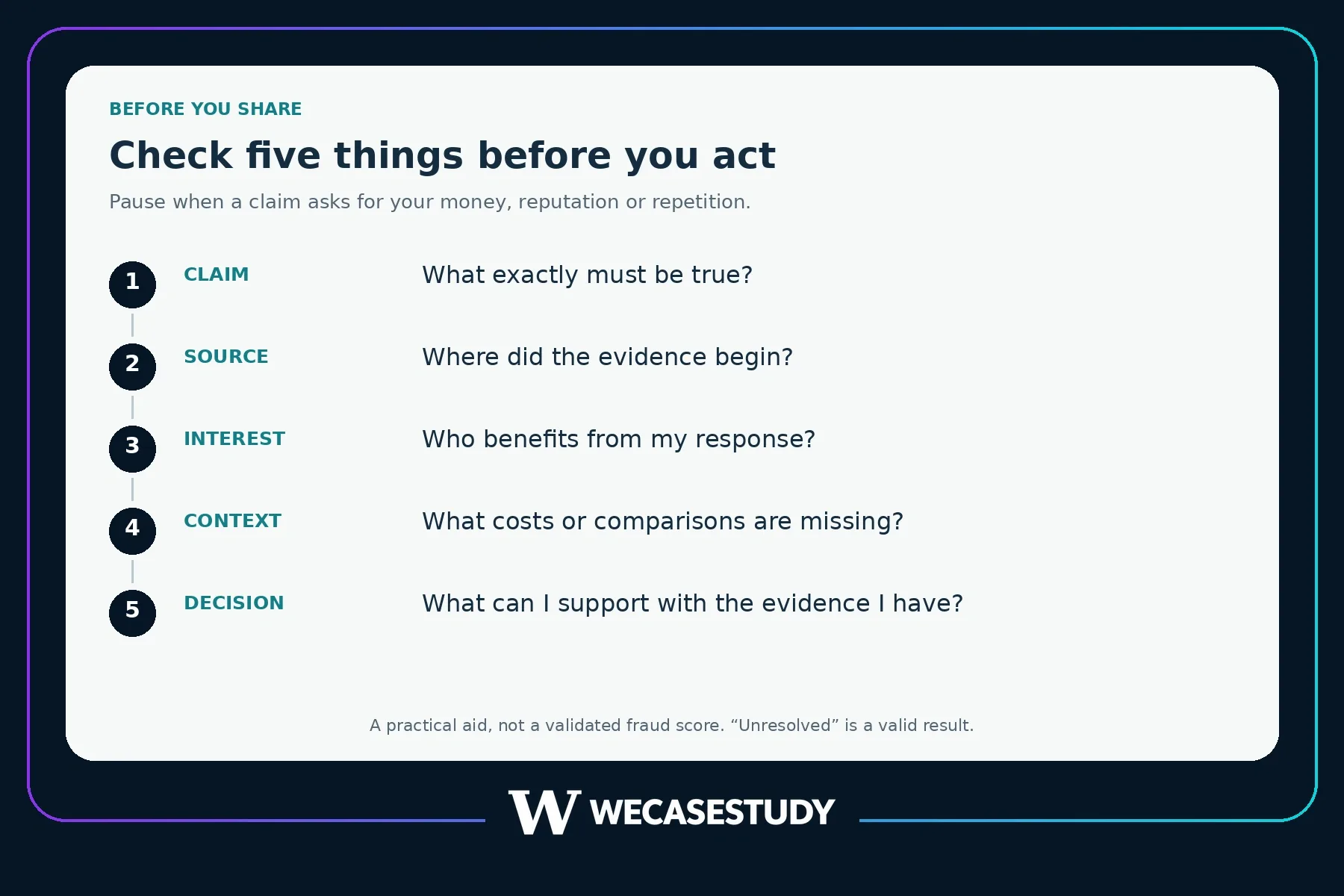 Use this as a decision aid rather than a numerical propaganda or fraud score.
Why a Story Can Survive Its Original Promoters
A claim shaped by propaganda techniques can gain new carriers because repeating it serves several purposes: protecting a financial hope, maintaining group membership, preserving a public commitment or giving a simple explanation for uncertainty.
Those are possible mechanisms, not a claim that every supporter has the same motive. Persistence must be demonstrated in the particular case.
The misinformation literature describes continued influence after correction and methods for reducing it. A retraction can leave an explanatory gap: if the first story was wrong, what actually explains the observed events? misinformation review
To counter these propaganda techniques, a useful correction supplies a better-supported account, identifies what changed and reaches the people who encountered the original message. Quiet deletion may leave their understanding untouched.
The statement “a planted lie always outlives its planters” is memorable but indefensible as a general rule. Some campaigns collapse. Some audiences never privately accepted the claim. Others revise their judgment. The evidence supports vulnerability and resistance, rather than inevitable surrender.
What Most People Get Wrong
| Assumption | Better interpretation |
|---|---|
| Propaganda must be entirely false. | Selection and omission can make accurate facts misleading. |
| Many sources mean independent confirmation. | Inspect where their evidence began. |
| Real supporters prove authentic origins. | Sincere people can circulate a staged or mistaken claim. |
| Disclosure fixes the claim. | It reveals an interest; it does not provide substantiation. |
| Recognizing a technique proves falsehood. | A badly argued claim can still be true. |
| Knowledge makes me immune. | Expertise helps, but does not replace checking attractive claims. |
Preparation can help. Roozenbeek and colleagues' 2022 research tested short videos explaining manipulation techniques across seven preregistered studies, including a YouTube field study. It found improvements in recognition and information discernment—not permanent immunity. inoculation study
Before You Repeat the Claim
When a message earns your money, your reputation or your repetition, you help carry it to the next person. That makes verification useful even when you are not the final buyer or decision-maker.
Ask where its evidence began, what it excludes and what would change your mind. Then ask the same questions when the message agrees with you.
Evidence and Research Method
The personal account describes a service offered to Peyman, not a verified account of its use or results. Named cases draw on the original records linked in the text. We distinguish allegations, settlements and judgments, and label hypothetical examples. Our checklists are practical aids, not tested fraud scores. See our Editorial Policy for the site’s approach to sourcing and corrections.
Frequently Asked Questions
What are the seven propaganda techniques?
The familiar seven propaganda techniques are bandwagon, testimonial, transfer, plain folks, card stacking, glittering generalities and name-calling. These labels overlap, and modern campaigns may also use repetition, false urgency, scapegoating, astroturfing and source laundering.
What is a real example of bandwagon propaganda?
Devumi’s fake-influence case illustrates how apparent popularity can be manufactured. The FTC alleged sales of fake followers and other engagement signals. A large audience can encourage attention, but it does not establish expertise or the truth of a particular claim.
What is the difference between shilling and influencer marketing?
Influencer marketing describes a distribution relationship. Shilling describes interested promotion presented as independent enthusiasm. A clearly disclosed sponsorship with genuine experience differs from a concealed commercial relationship, although disclosed claims still require support.
What is card stacking in everyday life?
It is selective presentation that hides context needed to interpret a claim: showcasing successful customers without the full sample, reporting winning trades without losses or comparing prices using different conditions. Ask for the denominator, comparison rule and missing costs.
Does every emotional political message involve manipulation?
No: emotion can communicate a legitimate concern without manipulating the audience. Examine who is speaking, which claims the evidence supports, which alternatives are missing and whether people can question the message freely.
How do you identify propaganda on social media?
State the claim precisely, trace it to original evidence, investigate relevant incentives and compare independent accounts. Treat engagement and apparent agreement as signals to interpret, rather than substitutes for verification. Leave unsupported claims labeled unconfirmed instead of inventing certainty.
Can propaganda techniques improve marketing?
Understanding attention, memory, authority and social influence can improve communication. Use substantiated claims, genuine testimonials, visible commercial relationships and truthful scarcity. The standard is whether customers can make a better-informed decision after seeing the campaign.