Pocket FM Case Study: The $500 Million AI Entertainment Machine—and the Strategy Behind Its Explosive Growth
Discover how Pocket FM used AI-assisted storytelling, ad testing, localization and episode unlocking to scale to a reported $500 million annualized revenue run rate—and the business risks behind that growth.

WeCaseStudy.com | Business Strategy, AI Innovation, Marketing & Growth | Updated November 2026
How an Indian audio startup reinvented entertainment production, turned storytelling into a customer acquisition engine, and challenged the economics of traditional media—with lessons for founders, investors, marketers, and AI-native businesses.
REVENUE RUN RATE
$500M
September 2026
AI CONTENT PRODUCTION
99%
Of newly produced content
CREATOR ECOSYSTEM
550K+
Company-reported creators
CONTENT PRODUCTION COST
~80×
Reported reduction
Company-reported figures, September 2026. AI production includes human involvement; the financial metric is an annualized revenue run rate, not audited annual revenue.
Introduction: The Six-Month Gamble That Could Have Destroyed Pocket FM
In mid-2024, Pocket FM had a problem most startups would envy.
The Indian audio entertainment company had reached approximately $200 million in annualized revenue and was growing around 50% year over year, according to co-founder and CEO Rohan Nayak.
Customers were spending extraordinary amounts of time listening to serialized fiction. The company had established a successful business model around short episodes, emotional cliffhangers, and small payments to unlock more entertainment.
Its product worked. Its audience was growing. Its business model was generating revenue.
Yet management decided to overhaul the system responsible for creating its content.
Instead of gradually increasing the number of professional writers, voice actors, and production teams, Pocket FM made a radical commitment to AI-assisted creation.
The result was initially disastrous for growth.
For approximately six months, revenue growth stalled. The transition disrupted a business that had previously been expanding rapidly.
Nayak later acknowledged how difficult the decision had been.
Then the economics began to change.
AI reduced reported production costs dramatically. Independent creators could generate stories faster. The company could test far more concepts, distribute successful ones into additional countries, and produce advertising material from its growing catalog.
By September 2026, Pocket Entertainment—the parent of Pocket FM and its newer video platform Pocket Saga—reported that it had surpassed a $500 million annualized revenue run rate.
But one of the most revealing developments happened outside audio.
Pocket FM had previously experimented with live-action vertical video through Pocket TV. That initiative failed to achieve the retention and economics management wanted, and the company shut it down in 2026.
Soon afterward, it launched Pocket Saga, a new microdrama application using AI-generated video and existing storytelling intellectual property.
By September, Pocket Saga had reached approximately $15 million in annualized revenue run rate, according to management—not $15 million of revenue earned over its first three months.
The story raises a question with implications far beyond entertainment:
Why did AI create such extraordinary commercial leverage at Pocket FM when thousands of other companies have access to similar technology?
The answer is not simply that the company learned to produce content cheaply.
Pocket FM built a connected system where creative production, experimentation, marketing, audience behavior, cultural adaptation, and monetization reinforce one another.
This case study investigates how that system works, where its economics are strongest, where the evidence is incomplete, and which strategic principles entrepreneurs can transfer into their own businesses.
1. Executive Summary
Pocket FM's rise was built on five strategic decisions that addressed different constraints on growth.
| Strategic decision | What it changed | Why it mattered |
|---|---|---|
| AI advertising production | Approximately 17,500 ad variations per month | Faster creative testing and scalable customer acquisition |
| Cultural localization | Stories adapted for local expectations, not just translated | Higher relevance and improved retention in new markets |
| Continuous listening and discovery | Nonpaying listeners can move into other available stories | More opportunities for engagement and future monetization |
| Internally funded ventures | New initiatives receive approximately $1M and 12–18 months to prove viability | Disciplined experimentation beyond the original product |
| AI-assisted content production | Vastly expanded production capacity at lower cost | More opportunities to identify commercially successful stories |
These mechanisms are grounded in Nayak's September 2026 account, although the independently verified contribution of each tactic to revenue growth remains unknown.
The analysis leads to five overarching conclusions.
First, Pocket FM's early success came from finding a compelling mobile entertainment format—not from AI. The technology accelerated a model that had already shown demand.
Second, the business's most important asset may be its ability to identify and distribute successful stories. Cheaper production becomes valuable when a company knows what audiences want and can profitably reach them.
Third, Pocket FM has linked marketing directly to its product. Popular stories generate advertising concepts, advertisements acquire new listeners, and listener behavior informs subsequent creative decisions.
Fourth, its international and video strategies demonstrate that a successful story can be developed into multiple commercial products. The original narrative becomes a reusable intellectual property asset.
Fifth, the case reveals substantial risks. Content oversupply, competition for audience attention, creator economics, platform fees, and dependence on paid advertising could weaken the advantages of low-cost production.
Our central thesis: Pocket FM's emerging advantage is not an AI content factory. It is a commercially integrated system for discovering, distributing, and monetizing entertainment intellectual property at scale.
To understand that advantage, we need to examine the business that existed before the AI transformation.
2. Company Background: The Product Came Before the Technology
Pocket FM was founded in Bengaluru, India, in 2018 by Rohan Nayak, Nishanth KS, and Prateek Dixit.
The founders entered a market dominated by established entertainment formats: music streaming, podcasts, radio, and audiobooks.
Instead of attempting to beat those competitors at their own products, Pocket FM eventually developed a different proposition.
Its core product became serialized audio drama: fictional stories released through short episodes, typically eight to twelve minutes long, with plots designed to encourage continued listening.
The company did not discover this model immediately.
According to Nayak, its team experimented with approximately ten content formats over its first two to three years before arriving at audio drama.
After the format change, the company's reported average daily listening time increased from approximately 25 minutes to more than 150 minutes. This is an executive-reported before-and-after comparison rather than a controlled causal experiment.
That experimentation contains the first important lesson of this case.
Pocket FM did not build an AI content factory and then search for an audience. It discovered a behavior people already valued and later used AI to serve that demand more efficiently.
Consider My Vampire System, one of the company's best-known series.
In a September 2026 investigation, Forbes reported that it had accumulated more than 1.5 billion plays across more than 4,000 episodes. Forbes estimated that the title had generated nearly $90 million in gross revenue over its lifetime.
That $90 million is a journalist's estimate, not a disclosed title-level revenue figure. But it demonstrates the potential scale of a single successful serialized story.
Why one story matters
Unlike a standalone audiobook, a successful serialized story can sustain listening and monetization across hundreds or thousands of episodes.
Its audience can also provide signals for advertising, localization, and future adaptations.
The important difference is not the length of the story alone.
It is the relationship between episode structure, recurring engagement, and the ability to monetize that engagement over time.
3. Industry Context: Pocket FM Created a Different Entertainment Economic Model
Traditional entertainment often concentrates financial risk into a relatively small number of expensive productions.
Studios invest in filming before knowing how viewers will respond. Publishers finance books before final demand is established. Streaming platforms commission series that must attract subscribers or justify their production costs across large audiences.
Pocket FM's model increasingly separates creative experimentation from expensive production commitments.
It can introduce new concepts at relatively low cost, observe listener behavior, and devote greater attention to stories demonstrating commercial potential.
This is not entirely new. Digital games, online fiction, and webcomics have long used iterative releases and behavioral data.
What is distinctive is Pocket FM's combination of serialized audio, mobile-first distribution, episode-level payments, and AI-supported production.
The broader market opportunity
The rise of microdrama platforms shows that short serialized storytelling is attracting substantial consumer expenditure beyond audio.
According to Sensor Tower, short-drama applications generated approximately $750 million in global in-app purchase revenue during the first quarter of 2026, up 20% year over year.
DramaBox and ReelShort each generated close to $140 million in estimated in-app revenue during that quarter. The category also recorded more than 850 million estimated downloads.
This suggests that Pocket FM is competing in a much larger structural shift: entertainment increasingly designed around mobile attention, short consumption sessions, recurring narrative tension, and flexible payment mechanisms.
The competition is not merely over which company can produce the best audio drama.
It is over which company can most efficiently convert consumers' limited attention into long-term entertainment relationships.
Pocket FM versus traditional streaming
| Dimension | Traditional premium streaming | Pocket FM model |
|---|---|---|
| Production decisions | Often large upfront commitments | Many relatively inexpensive experiments |
| Consumption | Full films, episodes, or programs | Short serialized audio chapters |
| Monetization | Usually subscriptions and sometimes advertising | Episode unlocking, advertising, optional subscriptions |
| Content discovery | Recommendations, search, brand promotion | Recommendations, story-specific advertising, continuous listening |
| International expansion | Dubbing, subtitling, original local production | AI-supported cultural adaptation |
| Primary economic risk | High production costs and subscriber churn | Customer acquisition costs, attention concentration, creator economics |
The comparison is directional, not absolute. Netflix and other streamers also test content and use behavioral data, while Pocket FM still incurs meaningful production and marketing expenses.
The real strategic distinction is the degree to which Pocket FM can modify its supply of entertainment in response to observed demand.
4. Strategic Timeline: From Format Discovery to AI-Native Production
| Period | Major development | Why it changed the business |
|---|---|---|
| 2018 | Pocket FM founded | Began experimenting with mobile audio entertainment |
| 2018–2021 | Multiple formats tested | Discovery of serialized audio drama |
| 2022–2023 | Expansion of episode-based monetization and international distribution | Greater ability to commercialize listening behavior |
| March 2024 | $103 million Series D financing at a reported $750 million valuation | Capital for expansion and technology development |
| June 2024 | ElevenLabs partnership announced | Faster text-to-speech production |
| Mid-2024 onward | Major transition toward AI-supported creation | Short-term growth disruption; long-term production scaling |
| 2025 | CoPilot writing and localization capabilities expanded | More accessible production and international adaptation |
| 2026 | Sherpa research and creator tools developed | Greater integration of narrative planning, editing, and quality evaluation |
| 2026 | Pocket TV shut down; Pocket Saga launched | Shift from an unsuccessful live-action video approach to AI-generated microdrama |
| September 2026 | $500 million annualized group revenue milestone | Evidence of substantial commercial scale |
Sources:
The timeline reveals that Pocket FM did not adopt AI in a single step.
Text-to-speech automation, creator tools, story adaptation, quality evaluation, advertising production, and cross-format expansion developed across overlapping periods.
This matters for understanding causation: the company's recent revenue growth cannot credibly be attributed to one technology rollout in isolation.
5. Growth Strategy: Turning Successful Stories Into Customer Acquisition Machines
Pocket FM's advertising strategy begins with a simple observation.
A person who is curious about the ending of a story may be easier to acquire than a person who has merely been shown a generic advertisement for an entertainment app.
The company therefore markets particular stories rather than relying exclusively on the appeal of its platform.
How the AI advertising system works
Nayak described a production process in which AI identifies the most emotionally compelling moments from successful shows, develops scripts, and creates numerous advertising variations.
The marketing material often takes the form of a short video trailer, approximately 90 seconds long, designed to attract attention and end at a moment of unresolved tension.
The company says it can produce up to 1,000 advertising variations from an individual show and approximately 17,500 advertisements per month.
Creative performance is evaluated against benchmarks including a 2.5% click-through rate and a 55% three-second viewing rate. Underperforming creatives can be passed to a creative director for revisions.
The process is much more sophisticated than asking AI to generate several advertisements.
It connects three sources of information:
Stories that have already demonstrated listener engagement.
Advertising performance across different hooks and creative treatments.
Downstream customer behavior after installation.
The strongest version of this strategy optimizes the complete acquisition journey, not just the first click.
The mathematics behind the claimed CAC breakthrough
Nayak reported that increasing CTR from 2% to 2.25% was associated with approximately a 30% reduction in customer acquisition cost.
That deserves closer examination.
Suppose an advertiser pays $12 per thousand impressions.
| Metric | Original campaign | Improved CTR alone |
|---|---|---|
| Impressions | 1,000 | 1,000 |
| Advertising cost | $12 | $12 |
| Click-through rate | 2.00% | 2.25% |
| Clicks | 20 | 22.5 |
| Cost per click | $0.60 | $0.53 |
| CPC reduction | — | 11.1% |
A 12.5% relative improvement in CTR reduces cost per click by approximately 11.1%, assuming the same CPM.
It does not automatically reduce customer acquisition cost by 30%.
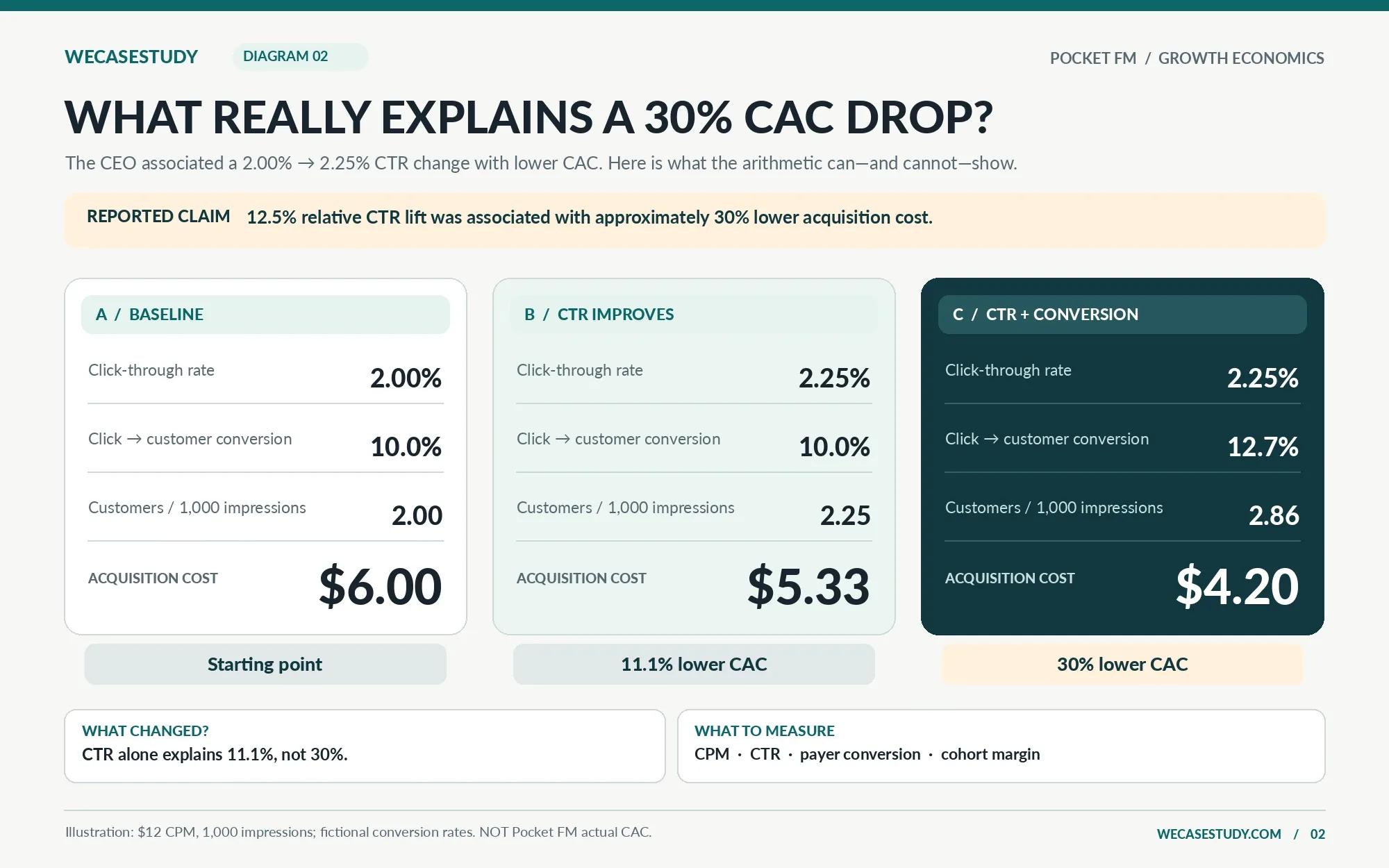
To understand how the larger benefit might arise, we need to examine the rest of the conversion funnel.
Illustrative acquisition economics
Click-through rate
2.25%
Click-to-customer conversion
12.7%
Customers per 1,000 impressions
2.86
Cost per acquired customer
$4.20
Baseline: 2% CTR and 10% click-to-customer conversion produce a $6.00 CAC. The initial settings above reduce CAC to approximately $4.20—a 30% improvement.
Interactive hypothetical model. Fixed CPM of $12; no attribution to Pocket FM's actual advertising accounts. Adjust the sliders to see why downstream conversion matters.
The model demonstrates why the CEO's reported result is mathematically possible without proving the exact mechanism behind it.
Better creative can potentially attract more relevant users, improve conversion rates, influence advertising platform optimization, and change traffic allocation.
But those effects need to be measured.
Why this matters at scale
Nayak also reported increasing Pocket FM's user acquisition budget by roughly seven to eight times without materially increasing CAC.
That would be commercially significant because acquisition efficiency often deteriorates as advertising budgets expand.
A company buying a small amount of traffic can focus on its easiest-to-convert audience. To increase expenditure substantially, it usually needs to reach less responsive users.
Pocket FM's large creative-testing system is designed to continually discover new combinations of stories, audience segments, and advertising messages that help sustain acquisition performance.
The lesson for founders is not to generate 17,500 advertisements.
It is to establish a process capable of generating validated customer-acquisition improvements repeatedly.
6. Marketing Strategy: Make the Product Itself the Advertisement
The most distinctive aspect of Pocket FM's marketing is that its advertisements resemble the experience consumers are buying.
A conventional streaming advertisement might promote a broad catalog, famous performers, or a recognizable entertainment brand.
Pocket FM can begin in the middle of a dramatic conflict.
Imagine an advertisement opening with a wealthy executive discovering that the new employee she publicly humiliated owns a controlling stake in her company.
Within seconds, the viewer understands the conflict.
The advertisement escalates the tension, reveals another complication, and ends before the resolution.
The consumer is invited to install the app to find out what happens.
This example is illustrative, not a documented Pocket FM campaign.
The underlying psychology
The strategy uses narrative curiosity and unresolved questions.
A viewer who wants to know what happens next has already developed a reason to continue.
The advertisement does not need to persuade someone that listening to audio drama is generally worthwhile.
It only needs to establish that one particular story is worth continuing.
This produces a potentially valuable form of alignment between marketing and product experience.
The creative promise and the product are closely related.
However, the system also contains a risk.
An exaggerated advertisement can achieve high CTR while producing disappointed users who abandon the story after installation.
The correct acquisition metric must therefore include post-install behavior.
A useful approach is to measure:
Creative contribution = Cohort contribution profit - Acquisition spending
A creative with lower CTR but stronger retention could ultimately be worth more than a sensational advertisement generating cheaper installs.
Pocket FM's model illustrates why high-performing consumer businesses need to connect creative experimentation with cohort economics.
7. Business Model: Monetizing the Urge to Continue
Pocket FM's revenue model combines free listening, advertising-supported unlocking, coin purchases, and optional subscriptions.
Its official September 2026 documentation states that users generally receive up to 30 minutes of free unlocking per series per day. Newly started series can receive additional temporary allowances.
Listeners can access certain other episodes by watching advertisements or using earned coins.
Paid coins are used to unlock episodes immediately, obtain early access, or access concluding episodes where free allowances do not apply. The precise options depend on the market and account.
Why microtransactions can work better than a subscription
A subscription asks a consumer to commit to an ongoing relationship with the service.
A microtransaction can ask a much narrower question:
Would you pay a small amount to continue this particular story right now?
The user is deciding whether to purchase a specific piece of entertainment at a moment of high interest.
This does not guarantee lower total spending. Indeed, highly engaged users may ultimately spend considerably more than they would on a conventional subscription.
The strategic advantage is that monetization can be linked directly to individual moments of demonstrated demand.
The business-model equation
Pocket FM's economics can be represented conceptually as:
R = R_paid unlocks + R_advertising + R_other
According to September 2026 management disclosures, approximately $415 million of its annualized revenue run rate came from paid episode unlocking, while approximately $85 million came from advertising.
Reported annualized revenue composition
Paid unlocking: 83%
Advertising: 17%
The lesson is not that advertisements are unimportant because they represent the smaller share of revenue.
Advertising creates another way to monetize a listener who does not want to spend money immediately.
That can improve the total economic value of the customer relationship.
The customer-protection trade-off
This model needs careful safeguards.
When consumers continuously unlock episodes, spending can become difficult to track.
Pocket FM's documentation distinguishes between autoplay, which may take a listener to another available series, and auto-unlock, which can spend coins to open paid episodes.
The distinction needs to remain understandable and controllable.
A successful monetization system should not depend on consumers misunderstanding when they are being charged.
8. Customer Strategy: Solving the Invisible Discovery Problem
Pocket FM's most underrated product innovation addresses a problem created by the audio format itself.
In a video application, users normally look at their screens.
They can see recommendations, thumbnails, and previews.
In an audio application, a listener often selects a story, locks the phone, and continues listening while doing something else.
The application may therefore have very little opportunity to show new recommendations.
This creates a discovery problem.
A company can produce thousands of excellent stories, but that inventory has limited economic value if listeners cannot discover them.
Pocket FM's solution
Nayak described a system that introduces another story when a listener has exhausted available free minutes and declines to pay for the next episode.
The user can continue listening without manually searching for something new.
This transforms an interrupted listening experience into a discovery opportunity.
It also creates a connection between two strategic problems: retention and catalog utilization.
A listener who moves from one story to another may remain active longer, encounter additional advertisements, develop interest in a new title, and potentially become a paying customer later.
The feature's exact incremental impact has not been publicly established through a disclosed controlled experiment.
Nevertheless, its strategic logic is compelling.
Why a refusal to pay is not necessarily a lost customer
Consumers have different reasons for declining payment.
Some are price-sensitive. Some prefer advertisements. Some are not sufficiently interested in the current story. Others may pay at a later point.
Treating these users identically can lead to unnecessary abandonment.
The objective should be to preserve valuable engagement without sacrificing transparency or consumer choice.
This principle applies well beyond entertainment.
An education platform can recommend a free introductory course when a user rejects a premium program.
A SaaS product can offer a suitable free workflow after a user reaches a usage limit.
An ecommerce platform can recommend a lower-cost alternative instead of simply ending the buying journey.
The common principle is to design a useful next step when immediate conversion does not occur.
9. International Growth: Localization Is Not Translation
Pocket FM has found that language translation alone can fail to preserve the emotional effectiveness of a story.
A narrative contains cultural assumptions that may not be obvious to its original audience.
Names, family structures, social expectations, humor, class relationships, and institutional references affect how people understand character motivations.
A literal translation can preserve the words while weakening the experience.
Pocket FM therefore uses AI to adapt the cultural setting of successful stories while attempting to preserve their underlying narrative structure.
The company refers to this as localization rather than translation.
A real reported result
Nayak described a U.S. show that was adapted for German listeners.
The culturally localized version reportedly produced 50% higher retention than the translated version.
This was a company-reported comparison for a particular title. The sample size, experimental methodology, and precise retention definition were not disclosed publicly, so the result should not be generalized to every market.
How the localization system works
Pocket FM's Sherpa localization tools are designed to adapt idioms, character names, cultural references, and the social context of scenes while retaining the story's core plot.
The company's published workflow also includes creator review before publication.
The model can be understood as separating a story into two layers.
The narrative structure contains the central conflict, character objectives, consequences, and emotional progression.
The cultural presentation contains details that make those events believable and relatable to a particular audience.
The opportunity lies in adapting the second layer without damaging the first.
What Pocket FM reported internationally
| Market | Reported expansion milestone | Time to reach milestone |
|---|---|---|
| United States | $25M in revenue, according to the CEO's expansion account | 19 months |
| Germany | $21M+ annualized run rate | 11 months |
| France | $10M+ annualized run rate | 3 months |
These figures are executive-reported milestones and do not establish comparable profitability or identical measurement windows.
There is another significant implication.
A successful story can reach several language markets without the company commissioning a completely new narrative for each one.
This increases the potential economic value of original intellectual property.
But it also demands strong quality controls. Cultural mistakes can damage retention, and automated adaptation does not replace the need for local knowledge.
10. Biggest Failures and Recoveries: The Lessons Hidden in Pocket TV
Pocket FM's decision to shut down Pocket TV is one of the most valuable parts of this case.
It also complicates the convenient narrative that the company succeeds whenever it uses AI.
Pocket TV was an earlier attempt to move into video microdrama.
The underlying hypothesis was reasonable: a company that already understood serialized storytelling might be able to extend that expertise into the fast-growing video market.
But the economics were different.
Live-action video required more expensive production and did not produce the retention performance management wanted.
In 2026, Pocket FM shut down Pocket TV.
Forbes reported Nayak's criticism of parts of the microdrama industry's dependence on aggressive acquisition budgets and difficult-to-cancel payment systems.
Why the failure matters
Pocket TV demonstrates that a successful content format is not automatically transferable to a new medium.
Audio and video have different production costs, audience expectations, distribution mechanics, and quality requirements.
A story that works in audio may require substantial changes to become compelling video.
Pocket Saga was a different attempt to solve that problem.
Rather than relying on traditional live-action production, the company used AI-generated video and selected successful stories from its existing catalog.
By September 2026, Pocket Saga had reached approximately $15 million in annualized revenue run rate, according to management.
This is evidence of early commercial traction, not proof of long-term profitability.
The strategic interpretation
Pocket FM's video history demonstrates an important distinction between persistence and strategic flexibility.
Management did not necessarily abandon the belief that serialized video could become attractive.
It abandoned an implementation that had not produced acceptable results and tested a different cost structure.
That is a stronger lesson than simply telling entrepreneurs to persevere.
Persist with a valuable customer problem when the evidence supports it; change the operating model when the economics do not work.
11. Biggest Successes: Building an Entertainment System Rather Than a Library
By September 2026, Pocket FM reported more than 770,000 audio series and a creator network exceeding 550,000 people.
It also reported 96 titles with more than $1 million in lifetime revenue, including 13 above $10 million.
These figures indicate substantial content production and a meaningful population of commercially successful titles.
The crucial achievement, however, is the connection between five capabilities.
First, Pocket FM can attract creators and generate a large supply of story concepts.
Second, it can use audience behavior to identify promising content.
Third, it can produce and adapt that content relatively inexpensively.
Fourth, it can market successful stories through creative experimentation.
Fifth, it can monetize listeners through multiple access mechanisms.
Each capability becomes more valuable when connected to the others.
A large catalog without distribution would not be enough.
Low-cost production without quality control would not be enough.
Advertising expertise without compelling products would not be enough.
The system matters more than its individual components.
12. Financial Analysis: How Valuable Is Pocket FM's Growth?
The headline revenue figures are impressive, but they do not tell us whether Pocket FM's economics are sustainable.
The most important distinction is between revenue growth, unit economics, and profit.
What the financial evidence establishes
| Metric | Reported figure | Source and interpretation |
|---|---|---|
| FY2024 revenue | ₹1,052 crore | Historical company-reported revenue |
| FY2024 net loss | ₹165 crore | Historical reported loss |
| FY2025 revenue | ₹1,768 crore | Up approximately 68% year over year |
| September 2025 annualized run rate | ~$250M | Retrospective management figure |
| April 2026 annualized run rate | ~$430M | Reported milestone |
| September 2026 annualized run rate | ~$500M | Current monthly revenue annualized |
| September 2026 EBITDA | Positive, according to management | Detailed margin not disclosed |
Sources: Moneycontrol, TechCrunch, and company announcements.
Pocket Entertainment's Reported Annualized Revenue Run Rate
USD millions. Reported management snapshots, not recognized yearly revenue.
| Period | Revenue run rate |
|---|---|
| Sep 2025 | $250M |
| Apr 2026 | $430M |
| Sep 2026 | $500M |
Reported run-rate milestones. Note that the company press announcement cites 70% year-over-year growth, whereas Nayak's retrospective $250M-to-$500M comparison implies approximately 100%. The reference periods or calculation bases have not been fully reconciled publicly.
A September 2026 Forbes investigation estimated approximately $400 million in revenue over the preceding twelve months. That estimate is valuable because it attempts to measure historical revenue rather than simply annualizing a recent month.
Forbes also reported company-provided production-cost comparisons of approximately $2,000 per hour in 2024 versus $30 per hour under the newer production system.
That would represent a reduction of about 98.5%, although the public reporting does not establish a fully standardized, independently audited cost comparison.
The hidden financial trade-off: Content versus customer acquisition
Reducing production costs improves the economics of content creation.
But it does not necessarily reduce the cost of attracting audiences.
Pocket FM's chief executive has said the company spent more than $100 million on user acquisition while developing its advertising strategy.
This is a revealing figure.
A company that dramatically reduces content costs may still need to spend heavily on advertising because consumer attention remains scarce.
Lower content costs can create more potential products.
They cannot guarantee that anyone will discover those products.
The profit implications therefore depend on whether a larger catalog improves customer retention and revenue enough to justify acquisition spending.
A transparent unit-economics model
Because Pocket FM has not disclosed a complete cohort-level financial model, the following example uses explicitly hypothetical inputs.
It is designed to demonstrate the economics, not estimate Pocket FM's actual customer lifetime value.
Assume an entertainment app acquires 10,000 users.
Hypothetical unit-economics assumptions
| Metric | Assumption |
|---|---|
| Newly acquired users | 10,000 |
| Initial paying conversion | 12% |
| Monthly gross revenue per active payer | $18 |
| Contribution margin after variable costs | 55% |
| Lifetime advertising contribution per acquired user | $0.80 |
| Acquisition cost per user | $6 |
Illustrative assumptions only. Contribution margin is assumed to include payment fees, content-related variable expenses, and delivery costs.
Each active payer would contribute:
$18 × 55% = $9.90
If we assume a constant monthly probability of remaining a paying customer, a simple undiscounted lifetime contribution model is:
LTV_payer=$9.90 / (1 − r)
Where r is the assumed monthly payer-retention rate.
The model produces the following results:
| Assumed monthly payer retention | 75% | 85% | 90% |
|---|---|---|---|
| Lifetime contribution per payer | $39.60 | $66.00 | $99.00 |
| Paid contribution per acquired user | $4.75 | $7.92 | $11.88 |
| Plus advertising contribution | $0.80 | $0.80 | $0.80 |
| Total lifetime contribution per acquired user | $5.55 | $8.72 | $12.68 |
| Less $6 acquisition cost | −$0.45 | +$2.72 | +$6.68 |
The model assumes constant retention, no discounting, unchanged payer conversion, and no additional purchase paths. Real cohorts are more complicated.
Yet it demonstrates an important principle.
A business can move from unattractive to highly attractive acquisition economics without changing the price of its product or the cost of acquiring customers.
Better retention can be sufficient.
Why Pocket FM's retention figures matter
Pocket FM reported an increase in 12-month revenue retention from 44% to 76% over approximately two years.
This is a notable improvement, but the published metric must not be confused with the hypothetical monthly payer-retention rates above.
The company has not published enough detail to recreate its full revenue-retention calculation or isolate the contribution of AI-generated content.
Nevertheless, the direction matters.
If a larger catalog helps audiences discover additional stories and continue spending over longer periods, customer lifetime value can improve considerably.
That would allow Pocket FM to support higher acquisition spending while preserving acceptable economics.
The financial questions investors should still ask
Before treating Pocket FM's economics as definitively superior, investors should request the following information:
Contribution margin after app-store and payment-processing fees.
Customer acquisition cost by market, channel, and acquisition cohort.
Monthly revenue retention by paying-customer cohort.
Median and average creator earnings, including distribution concentration.
Gross revenue per new title relative to its full production and distribution cost.
Marginal acquisition cost as advertising expenditure increases.
Free-cash-flow conversion and profit by product and geography.
The reported results establish strong commercial momentum.
They do not yet allow an outside analyst to construct a complete, independently verified profitability model.
13. Competitive Analysis: Why Pocket FM Cannot Rely on AI Alone
Pocket FM does not operate in an empty market.
It faces direct competitors in audio entertainment, emerging competitors in microdrama, and broader competition for consumers' entertainment spending.
The most relevant strategic rivals are not necessarily the largest streaming services.
They are companies capable of reproducing the same combination of serialized storytelling, frequent production, aggressive acquisition, and mobile monetization.
Competitor comparison
| Company | Primary business | Relevant competitive capability | Strategic threat to Pocket FM |
|---|---|---|---|
| Kuku FM / Kuku TV | Audio and vertical microdrama | Regional audience knowledge, AI-assisted production, monetization | Direct competition across audio and video in India |
| ReelShort | Mobile microdrama | Established U.S. video demand and acquisition systems | Competition for mobile drama spending |
| DramaBox | Mobile microdrama | Large catalog and international video monetization | Competition in video and localized fiction |
| Audible | Audiobooks and audio entertainment | Brand, distribution, established consumer relationships | Alternative audio subscription spending |
| Netflix | Premium video entertainment | Content brands, global distribution, recommendation systems | Broad competition for entertainment time |
Kuku: The closest structural warning
Kuku Technologies operates across audio and microdrama through products including Kuku FM and Kuku TV.
In October 2026, Business Standard reported that its FY2026 net revenue reached ₹1,484 crore, compared with ₹242 crore in FY2025, based on regulatory filings.
It also reported a ₹182 crore net profit after tax for FY2026 and significant investment in an AI-assisted production operation.
Kuku's figures are historical financial-year results, not directly comparable to Pocket FM's annualized run rate.
But they establish something strategically important.
Pocket FM is not alone in applying AI to rapidly produced mobile entertainment.
The underlying production advantages can spread throughout the industry.
ReelShort and DramaBox: The video challenge
Sensor Tower estimated that ReelShort and DramaBox each generated close to $140 million in global in-app revenue during the first quarter of 2026.
Their businesses demonstrate that serialized mobile video can sustain substantial customer expenditure.
But they also highlight a different competitive environment.
Video production creates more visual expectations than audio. Audiences may be more sensitive to artificial-looking actors, inconsistent characters, or unnatural movement.
Pocket Saga's AI-based production advantage therefore has to be tested against the actual quality and engagement of competing video experiences.
Its lower cost is not sufficient by itself.
The strategic comparison that matters
Consider three hypothetical entertainment businesses.
| Company A | Company B | Company C | |
|---|---|---|---|
| Content production | Cheap and scalable | Expensive and selective | Cheap and scalable |
| Audience distribution | Weak | Strong | Strong |
| Behavioral data | Limited | Extensive | Extensive |
| Monetization | Unproven | Established | Established |
| Primary constraint | Finding an audience | Producing enough content efficiently | Maintaining quality and marginal returns |
Pocket FM increasingly resembles Company C.
That is why its growth cannot be explained solely by access to generative AI.
A competitor with inexpensive production but weak distribution still needs to solve customer acquisition, retention, and monetization.
A competitor with excellent distribution but expensive production may struggle to serve enough audience niches.
The valuable combination is having both—and learning how to operate them together.
Does Pocket FM have a durable moat?
Its apparent advantages include a large creator network, extensive IP, customer behavior data, international operating experience, and tightly integrated production and marketing processes.
But these advantages are not automatically permanent.
AI makes it cheaper for rivals to create competing content.
Advertising platforms can raise the cost of reaching audiences.
Successful creators can distribute their work elsewhere.
And audiences can switch entertainment applications with relatively little effort.
Pocket FM's competitive advantage is therefore strongest when its capabilities reinforce one another faster than competitors can reproduce the entire system.
14. Leadership Analysis: The Difference Between Conviction and Stubbornness
Rohan Nayak's leadership decisions reveal three important characteristics.
1. Willingness to question a successful model
The company did not pursue AI because its traditional model had completely failed.
It pursued AI while the business was growing.
That is strategically significant.
Established businesses often delay major changes because existing operations are profitable.
But protecting a functioning system can be dangerous when the underlying economics of the industry are changing.
Pocket FM took the opposite risk: disrupting a successful system before a competitor forced it to change.
2. A preference for measurable audience behavior
Pocket FM's operating philosophy emphasizes observing what listeners consume, where they stop listening, what they purchase, and which content attracts new audiences.
This gives management a relatively direct way to evaluate creative decisions.
But behavioral data is not a complete measure of artistic quality.
Content designed exclusively around immediate engagement can become formulaic, repetitive, or overly sensational.
The strongest leadership challenge is balancing measurable audience response with the creative originality needed to sustain long-term differentiation.
3. Treating failure as evidence, not a permanent verdict
The Pocket TV shutdown is important here.
Management did not continue funding the same production model indefinitely.
It tested a different approach through Pocket Saga.
That shows strategic flexibility—provided future decisions continue to be governed by economic evidence rather than excitement about AI capabilities.
The leadership risk
Nayak has described an ambition to dramatically expand the number of commercially successful stories.
That ambition can motivate a powerful organization.
It can also encourage excessive production volume if managers begin rewarding output more heavily than quality-adjusted returns.
The next leadership test will be whether Pocket FM can maintain creative differentiation as its catalog grows.
15. Innovation Strategy: From AI Tools to a Proprietary Production System
Pocket FM's AI strategy has moved beyond using generic writing assistants.
The company has developed systems aimed at narrative continuity, editing, cultural adaptation, audio production, and quality evaluation.
Its Sherpa platform describes AI agents for planning long story arcs, evaluating drafts, tracking characters, and maintaining narrative consistency.
This is important because long-form fiction creates challenges that ordinary text generation does not solve reliably.
A story running for hundreds of episodes requires consistent characters, relationships, motivations, past events, and future plot development.
Mistakes can weaken the listener's understanding and engagement.
A system that remembers narrative history and evaluates new episodes against it can potentially improve production efficiency without relying entirely on manual coordination.
Why company-specific tools matter
The raw ability to generate text is increasingly commoditized.
A system trained or configured around long-running narrative requirements may be more valuable because it solves problems specific to Pocket FM's product.
This shifts the strategic objective from owning an AI model to owning an effective production workflow.
The distinction matters.
A company can obtain language-generation capability from third parties.
It is harder to reproduce years of accumulated production experience, editing rules, narrative evaluation, creator workflows, and customer-behavior feedback.
That does not prove Pocket FM's internal technology is superior to competitors' systems.
It explains why software integration and domain expertise could create an advantage beyond access to the underlying models.
16. Original Strategic Insights: Eight Frameworks From the Pocket FM Case
The following eight frameworks are independent WeCaseStudy analytical concepts developed from the evidence.
They are intended to explain business mechanisms, not imply that Pocket FM officially uses these names or has independently validated every proposed relationship.
Framework 1: The Validated-Story Gradient
Principle: As production becomes cheaper, the main economic challenge shifts from creating candidates to identifying valuable winners.
Traditional content production limits how many new concepts a company can afford to test.
AI changes that constraint.
Pocket FM reportedly produces approximately 2.5 million hours of AI-supported content annually and has generated dozens of million-dollar titles.
But more output is only valuable when enough of it generates profitable customer engagement.
A useful model is:
E(H)=N × p
Where N represents concepts tested and p represents the probability of meeting a defined success threshold.
Suppose a company tests 100 concepts with a 2% success probability.
It expects two successful concepts.
If automation allows 1,000 experiments, the expected number rises to twenty—provided the hit probability remains unchanged.
That is the catch.
A larger number of weaker concepts could reduce the hit rate.
The managerial objective must therefore be successful concepts per dollar of total experimentation cost, not total content volume.
How to apply it: Use inexpensive pilots, landing pages, product prototypes, or limited releases to validate demand before committing substantial capital.
Framework 2: The Product-Matched Acquisition System
Principle: Marketing becomes more efficient when the advertisement demonstrates the exact experience that attracts and retains customers.
Pocket FM's ads are based on emotionally compelling story moments.
The audience is exposed to the same kind of narrative experience it will find after installation.
This can improve alignment between what users expect and what they actually receive.
The risk is that creative optimization becomes detached from product satisfaction.
If click-through rates increase but customer retention falls, the system is not necessarily improving.
How to apply it: Build acquisition campaigns around proven use cases, customer outcomes, product demonstrations, or content moments. Evaluate performance through downstream contribution profit.
Framework 3: The Quiet-Screen Discovery Problem
Principle: Products consumed with minimal visual interaction require discovery systems embedded in the experience itself.
Pocket FM's listeners frequently engage while their phones are locked.
That reduces the usefulness of conventional recommendation interfaces.
The company's cross-series listening approach addresses this by placing discovery within the audio journey.
This is a form of experience-native recommendation.
It differs from simply displaying more suggestions on a screen.
How to apply it: Identify situations in which customers cannot or do not want to navigate your interface. Create relevant, optional next steps that work within the user's existing activity.
The principle can apply to audio learning, automotive interfaces, voice assistants, and hands-free software.
Framework 4: The Story-Spine Portability Model
Principle: Successful products can enter new markets more efficiently when their essential value is separated from culturally dependent presentation.
Pocket FM attempts to preserve the dramatic structure of stories while adapting local details.
This creates a reusable narrative asset.
Its reported German retention comparison offers supporting evidence, although the outcome should not be assumed universal.
How to apply it: Before entering a new market, identify the elements of your product that must remain consistent and those that should change.
For software, the invariant layer may be the underlying workflow. For education, it may be a learning objective. For entertainment, it may be the narrative conflict.
Localize the experience without weakening the underlying value.
Framework 5: The Deferred-Revenue Relationship
Principle: An immediate refusal to purchase may still lead to economic value when the customer relationship can continue.
Pocket FM's alternative free-listening paths demonstrate the concept.
The business does not need every listener to pay during every session.
Continued engagement can create advertising revenue, new discovery, and later purchase opportunities.
A useful strategic comparison is:
Δ LTV = LTV_continued experience - LTV_forced exit
The company should only implement the alternative path when the incremental lifetime value justifies its cost and does not undermine consent or customer satisfaction.
How to apply it: Test relevant free alternatives, educational resources, lower-cost products, or different payment options when customers decline a transaction.
Do not assume that keeping someone active indefinitely is valuable. Measure incremental contribution and satisfaction.
Framework 6: The IP Format-Option Ladder
Principle: A successful intellectual property asset can create additional commercial opportunities when its audience appeal is validated before entering a new format.
Pocket FM's expansion from audio into AI-generated video illustrates this approach.
A successful audio series supplies evidence that some audiences find a particular narrative compelling.
That does not guarantee a video adaptation will succeed, but it can reduce uncertainty around story selection.
Validated audio story
Demand signals, engagement data, recognizable IP
New languages
Cultural adaptations
AI video
Microdrama adaptations
Publishing
Potential future licensing
Long-form media
Potential future adaptation
Analytical model. The lower branches are possibilities, not claims that each format is currently operating successfully.
How to apply it: Identify successful original assets and evaluate adjacent formats according to incremental production cost, addressable audience, revenue potential, and rights ownership.
The objective is not maximum adaptation. It is economically attractive reuse.
Framework 7: The Rebuild-Valley Budget
Principle: Transforming a successful business may require financing a temporary loss of operational performance.
Pocket FM's six-month reported growth plateau demonstrates why technology transformation must be treated as an investment project rather than a software installation.
The company had to disrupt production processes before realizing the full benefits of its new model.
A useful transformation budget includes the expected cost of technology, workforce retraining, quality failures, customer disruption, and delayed revenue.
V=B-(C_i+C_d+C_r)
Where:
B= discounted future business benefits.C_i= implementation and integration costs.C_d= disruption costs.C_r= risk-adjusted downside costs.
How to apply it: Define operational runway, quality thresholds, fallback procedures, and explicit continuation decisions before replacing critical business systems.
Transformation should be ambitious but not financially unconstrained.
Framework 8: The Audience-Signal Compounder
Principle: AI creates more durable value when customer feedback continuously improves production, discovery, and monetization decisions.
Pocket FM has accumulated extensive information about which stories people consume and where engagement weakens.
The company uses audience signals in creative production and evaluation processes.
This can create a feedback cycle.
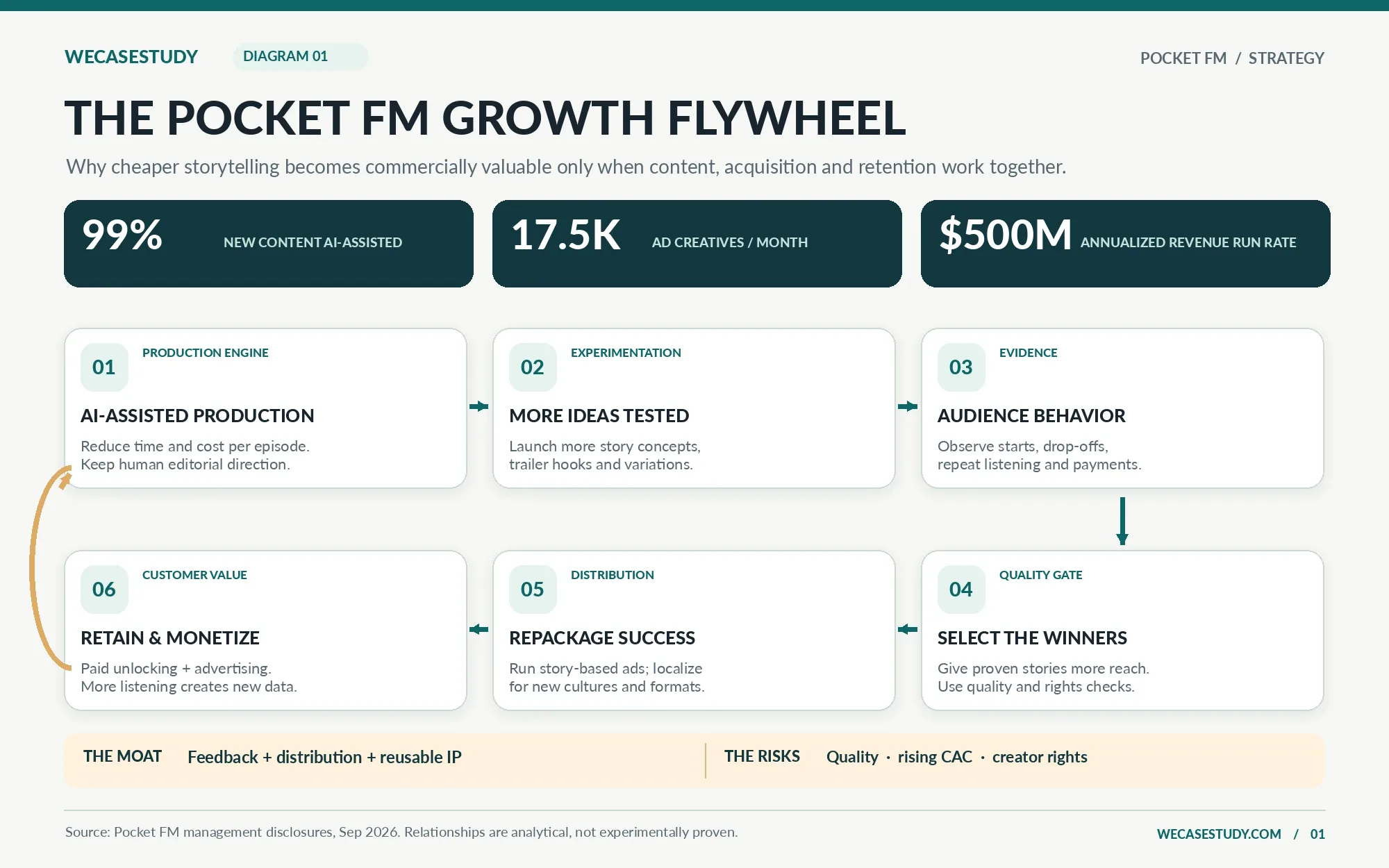
Pocket FM's potential growth flywheel
Lower AI-assisted production cost
More affordable experimentation
More stories and creative variants tested
Greater opportunity to identify audience demand
Better-performing stories and marketing
Potentially improved discovery and acquisition
More engagement, monetization, and feedback
Additional evidence to guide the next experiments
Learning can inform the next production cycle
Original WeCaseStudy model. The individual mechanisms are supported by management disclosures; the complete causal flywheel has not been independently proven.
The fundamental competitive advantage is not the amount of data collected.
It is how effectively that data improves decisions.
How to apply it: Connect product analytics, customer feedback, marketing performance, and production workflows. Evaluate whether each cycle produces a measurable improvement rather than simply more activity.
Eight counterintuitive insights
These frameworks lead to conclusions that are not obvious from Pocket FM's growth figures.
| Counterintuitive observation | Strategic implication |
|---|---|
| Cheaper content can make distribution more valuable | The bottleneck shifts from production toward audience attention |
| More content can increase acquisition costs | Additional titles need discoverability and marketing support |
| A failed paywall conversion can still improve lifetime value | Continuing the relationship may be economically rational |
| More AI does not necessarily mean fewer creators | Lower barriers can expand participation, even while changing earnings distribution |
| A failed video product can strengthen a later launch | It can reveal which cost structures and engagement assumptions do not work |
| A high CTR can coexist with poor customer economics | Downstream retention and contribution profit determine real acquisition value |
| Successful international expansion can increase creator value | One story may generate income across several markets |
| The strongest AI moat may sit outside the model | Distribution, customer insight, IP rights, and operational integration can be harder to replicate |
The common theme is that automation changes the location of competitive advantage.
A company that once competed through production capability may increasingly compete through judgment, attention, and economic coordination.
17. What Most People Get Wrong
“Pocket FM grew because it replaced writers with AI.”
This is incomplete.
The company already had a commercially successful product before the transition.
Human creators continue to contribute story ideas and editorial direction. AI has increasingly taken over or accelerated different production tasks.
“The company achieved $500 million in annual revenue.”
The headline refers to an annualized revenue run rate.
It is not the same as $500 million of realized historical revenue, contracted recurring revenue, profit, or valuation.
“The more AI stories a company produces, the more successful it becomes.”
Production scale increases opportunities to discover successful titles.
But commercial outcomes still depend on story quality, recommendation systems, audience demand, and monetization.
“Pocket FM's 17,500 ads explain its customer acquisition advantage.”
Creative volume alone is not enough.
The real advantage may come from extracting ideas from proven stories, improving hooks, measuring performance, and connecting creative decisions to downstream customer value.
“Localization simply means better machine translation.”
Pocket FM's approach attempts to adapt culturally relevant elements of a story, not just convert words between languages.
Its German test suggests that this distinction can affect retention.
“Pocket Saga immediately proved AI video was profitable.”
Pocket Saga demonstrated reported early revenue traction.
That is different from independently verified profitability.
The earlier Pocket TV failure shows why production cost, retention, and consumer behavior must be evaluated together.
“AI has removed the risks of entertainment production.”
AI has reduced certain production constraints, but the business remains exposed to advertising economics, intellectual property rights, platform dependence, and creator relationships.
“Pocket FM's success proves everyone should automate everything.”
The opposite conclusion is more useful.
Pocket FM first discovered a product experience that attracted audiences.
Automation became valuable because the company could deploy it within a system that already generated economic demand.
18. The Transferable Business Playbook
The Pocket FM case can be converted into a practical operating model for founders and managers.
The objective is not to imitate serialized audio drama.
It is to apply the same sequence of decisions to another business.
Phase 1: Identify what customers already value
Before adopting AI, establish the strongest existing customer behavior.
For a SaaS company, this may be a workflow users repeat frequently.
For an educational business, it may be a particular learning format.
For a publisher, it may be content that reliably attracts and retains readers.
Do not automate production until you understand what creates value.
Phase 2: Identify the binding growth constraint
Determine whether the business is limited by production capacity, distribution, acquisition cost, conversion, retention, or monetization.
The constraint determines the appropriate investment.
If your problem is insufficient audience demand, generating more content may make the problem worse.
If demand is strong but production is expensive, automation may create considerable leverage.
Phase 3: Build controlled experimentation
Create inexpensive versions of new products, content, or advertisements.
Use predefined success thresholds.
Measure the quality of results rather than the number of experiments completed.
Pocket FM's reported advertising and content-production systems illustrate the value of making testing an operational capability.
Phase 4: Remove unnecessary customer dead ends
Examine moments when customers stop using a product because they decline payment, reach a usage limit, or cannot find another relevant option.
Test whether an alternative experience creates genuine value.
Include customer satisfaction and consent in the evaluation.
Phase 5: Expand validated assets
Once a product demonstrates repeatable demand, evaluate whether its core value can be delivered through another language, region, audience, or format.
Avoid assuming that success transfers automatically.
Phase 6: Reinvest based on contribution economics
Increase expenditure only when experiments demonstrate acceptable marginal returns.
The objective is a sustainable system in which learning improves future decisions.
A practical 90-day action plan
| Period | Workstream | Measurable deliverable |
|---|---|---|
| Days 1–15 | Identify the highest-value customer behavior | Baseline engagement, conversion, and retention metrics |
| Days 16–30 | Diagnose the primary growth bottleneck | Quantified constraint and improvement hypothesis |
| Days 31–45 | Build a small AI-supported experiment | 10–30 test variants with quality checks |
| Days 46–60 | Improve discovery or monetization | Controlled test with downstream outcome metrics |
| Days 61–75 | Test reuse or localization of a validated asset | Performance comparison against the original |
| Days 76–90 | Evaluate unit economics | Scale, revise, or discontinue decision |
The process is intentionally smaller than Pocket FM's operation.
A company should earn the right to scale experimentation by demonstrating that its experiments produce useful decisions.
19. Lessons for Entrepreneurs: 30 Practical Principles
Pocket FM's evolution provides lessons across product development, marketing, finance, and organizational strategy.
Product and customer behavior
Find the behavior before scaling the technology. Pocket FM spent years testing formats before settling on serialized audio.
Design around how customers actually use a product. Audio's hands-free nature required a different discovery approach.
Create recurring reasons to return. Daily unlocking supports repeat engagement.
Do not confuse a payment refusal with permanent rejection. Customers may still value another experience.
Measure engagement beyond the first session. Long-term retention can transform customer economics.
Protect customer choice. Frictionless experiences should not create hidden financial obligations.
Marketing and distribution
Use the product itself as advertising evidence. Demonstrate the experiences that attract real customers.
Experiment with different hooks. The opening moments of an advertisement can influence acquisition performance.
Connect creative performance to conversion. CTR is only one stage of the funnel.
Evaluate marginal CAC as budgets rise. Average acquisition efficiency can conceal declining incremental returns.
Use human judgment where automation performs poorly. Pocket FM's creative workflow includes intervention for weak advertisements.
Build reusable marketing processes. An effective system is more valuable than one successful campaign.
AI and production
Automate genuine constraints. Efficiency matters most where capacity limits growth.
Measure successful output, not total output. More content is useful only when commercially valuable.
Preserve critical human expertise. Editorial judgment and creative direction remain important.
Anticipate transition costs. Major operating-model changes can temporarily weaken performance.
Build domain-specific workflows. General AI capabilities become more useful when integrated into real production processes.
Use customer feedback cautiously. Engagement is valuable evidence but not a complete definition of quality.
Localization and intellectual property
Adapt cultural context, not just words. Literal translation can weaken the intended customer experience.
Validate new markets economically. Revenue milestones should be assessed alongside acquisition and operating costs.
Reuse proven assets thoughtfully. Successful IP may support multiple products or formats.
Protect rights and ownership. Cross-format monetization depends on clear contracts.
Test format economics separately. Pocket TV and Pocket Saga demonstrate that different production approaches can produce different outcomes.
Treat localization as product development. Market-specific relevance should be tested rather than assumed.
Management and strategy
Challenge successful operating models before they become constraints. Growth can mask structural weaknesses.
Give new ideas defined budgets and evaluation periods. Internal innovation should have measurable objectives.
Discontinue weak implementations. Persistence should not mean repeating the same unsuccessful economics.
Protect creator relationships. Platform efficiency depends on sustainable participation from valuable contributors.
Distinguish company claims from proven outcomes. Financial discipline requires consistent definitions and transparent measurement.
Build reinforcing capabilities. Long-term advantage emerges when production, distribution, learning, and monetization strengthen one another.
20. Future Outlook: What Could Break the Pocket FM Model?
Pocket FM's growth thesis depends on three conditions continuing to hold.
First, AI-supported production must remain sufficiently attractive to creators and audiences.
Second, the company must continue acquiring and retaining listeners at sustainable costs.
Third, it must convert its growing intellectual property library into commercially valuable content without overwhelming discovery systems.
The opportunity is substantial.
Media Partners Asia estimates that the microdrama market outside China could reach approximately $3.6 billion in 2026, with further growth projected in subsequent years. These are market-model estimates rather than guaranteed outcomes.
But increased market size also attracts competitors.
The strongest challenge may come from companies combining comparable AI production costs with better acquisition economics or stronger original IP.
Three scenarios
Optimistic scenario: Pocket FM maintains high retention, extends successful IP across markets and formats, and improves monetization faster than acquisition costs rise.
In this situation, the integrated production and distribution system becomes more economically powerful.
Base scenario: Production costs remain low, but competitors replicate similar tools and increase the cost of attracting audiences.
Growth continues, but competitive pressure reduces the benefits of automation.
Downside scenario: Content oversupply weakens discovery, customer acquisition becomes more expensive, and creator or consumer trust deteriorates.
The company then faces a difficult situation: producing content is inexpensive, but delivering profitable entertainment experiences becomes increasingly difficult.
The most important leading indicators
Investors and operators should focus on:
Cohort-level revenue retention.
Marginal customer acquisition cost.
Revenue and contribution margin per new title.
Repeat consumption across different series.
Creator retention and earnings distribution.
Profitability of localized and video adaptations.
Customer complaints concerning billing and content quality.
These indicators would reveal whether Pocket FM is strengthening its underlying economic system or merely expanding its operational activity.
21. Final Takeaways: Ten Strategic Lessons
AI creates the greatest value when it removes a proven business constraint.
Customer demand should guide automation, not follow it.
A large catalog matters only when audiences can discover valuable content.
Marketing becomes more powerful when it demonstrates the product experience.
Retention can change acquisition economics as profoundly as cheaper advertising.
A failed conversion does not necessarily mean a lost customer.
Localization is an investment in cultural relevance, not merely language conversion.
Successful intellectual property can become a portfolio of commercial opportunities.
Competitive advantage comes from connected capabilities, not access to AI models alone.
The ultimate measure of an AI transformation is sustainable economic value—not the amount of work automated.
Conclusion: Pocket FM's Real Competitive Advantage Is Not AI
Pocket FM's story is often presented as evidence that generative AI can radically reduce entertainment production costs.
That is true, but incomplete.
Cheap content production was an enabling condition.
The company's growth came from combining that capability with a product people wanted, a monetization system suited to serialized entertainment, a sophisticated advertising operation, international adaptation, and extensive customer-behavior feedback.
Its earlier experiments established demand.
Its AI transformation increased production capacity.
Its marketing system connected successful stories to new audiences.
Its retention and monetization mechanisms created opportunities to turn attention into revenue.
And its expansion into video introduced new possibilities for monetizing successful intellectual property.
The company still faces substantial uncertainties. Competitors are adopting similar tools, the video market is increasingly crowded, and neither long-term profitability nor the sustainability of creator economics can be established from the public figures alone.
Nevertheless, the strategic lesson is powerful.
The businesses that benefit most from AI will not necessarily be those that automate the largest number of tasks. They may be those that redesign their entire operating systems so that each improvement in production, distribution, customer experience, and learning makes the others more valuable.
That is the deeper Pocket FM case study.
Frequently Asked Questions
What is Pocket FM's business model?
Pocket FM distributes serialized audio dramas through a freemium model. Users receive free listening allowances and can access additional content through advertisements, earned or purchased coins, and optional subscriptions in supported markets.
How much revenue does Pocket FM generate?
In September 2026, parent company Pocket Entertainment announced a revenue run rate exceeding $500 million annually. This metric annualizes recent monthly revenue and is not the same as recognized annual revenue.
Is Pocket FM profitable?
Management reported positive EBITDA in September 2026. Independent reporting also discussed improving profitability, but complete audited financial statements and detailed current margins were not publicly available for this analysis.
Does Pocket FM use AI to create its stories?
Yes. Management stated that AI is involved in producing 99% of new content. Human creators remain involved in creative direction, story concepts, and editorial decisions.
What is Pocket Saga?
Pocket Saga is Pocket Entertainment's AI-generated microdrama application. It adapts serialized storytelling into mobile-first video, including adaptations of existing Pocket FM intellectual property.
What makes Pocket FM different from Audible?
Pocket FM focuses on episodic fiction, daily unlocking, and granular monetization. Audible is primarily associated with audiobooks and membership-based access to spoken-word entertainment.
Can another company copy Pocket FM's AI strategy?
Competitors can replicate individual technologies and tactics. Reproducing its complete system of creators, content, audience data, acquisition processes, localization, and monetization may be more difficult.
What is the biggest lesson from Pocket FM?
AI adoption is most valuable when it improves an already validated customer experience and connects to a sustainable commercial model.
Recommended Publication Visuals
For WeCaseStudy, I recommend six purposeful visuals:
| Visual | Purpose | Placement |
|---|---|---|
| Featured cover | Establish Pocket FM's world of audio entertainment and AI without overwhelming text | Article opening |
| Growth timeline | Explain the journey from format discovery to the $500M run-rate milestone | Strategic Timeline |
| Advertising economics diagram | Show why improved CTR alone cannot explain a 30% CAC reduction | Growth Strategy |
| Consumer listening journey | Explain free access, paid unlocking, and automatic discovery | Customer Strategy |
| Unit-economics sensitivity chart | Demonstrate how retention affects acquisition profitability | Financial Analysis |
| Growth flywheel infographic | Explain the relationship between AI production, successful stories, advertising, retention, and learning | Original Strategic Insights |
The interactive financial illustration and growth flywheel above provide the analytical basis for the two most valuable original graphics.
Sources and Editorial Research Notes
The following sources support the principal historical and operating claims. Company-reported figures and independent estimates have been distinguished throughout.
| Source | What it establishes |
|---|---|
| Rohan Nayak's growth strategy account, September 2026 | Advertising processes, creative benchmarks, acquisition expansion |
| Archived version of the CEO's five-strategy account | Localization, retention, internal ventures, AI pivot |
| TechCrunch, September 10, 2026 | Revenue composition, production and retention metrics, Pocket Saga |
| Pocket Entertainment press announcement | Corporate revenue and operating milestones |
| Forbes investigation, September 2026 | Production-cost reporting, creator economics, Pocket TV failure |
| Moneycontrol, FY2025 financial reporting | Historical revenue and profit context |
| TechCrunch, August 2025 | CoPilot, creator tools, localization and production strategy |
| Pocket FM Sherpa | AI story-planning, editing, evaluation, and localization technology |
| Sensor Tower's 2026 short-drama market research | Market growth, competitor rankings, app-revenue estimates |
| Business Standard, Kuku Technologies financial results | Competitive financial and AI-production developments |
| Rest of World investigation, July 2024 | AI voice technology, licensing disputes, creator concerns |
Research limitations: This analysis uses publicly accessible information available through November 2026. No internal Pocket FM advertising accounts, proprietary retention cohorts, audited September 2026 financial statements, or complete production-cost records were independently examined. Original frameworks, calculations, and counterfactual scenarios are presented as independent analysis rather than company-confirmed findings.
SEO publication settings
SEO title: Pocket FM Case Study: Inside Its $500M AI Growth Strategy
H1: Pocket FM Case Study: The $500 Million AI Entertainment Machine—and the Strategy Behind Its Explosive Growth
Suggested slug: pocket-fm-case-study
Primary keyword: Pocket FM case study
Meta description: Explore Pocket FM's $500M AI growth strategy, business model, marketing economics, content production, retention, competitors and lessons for founders.
Suggested categories: Business Strategy, Innovation, Marketing
Suggested author credit: WeCaseStudy Editorial Research