How a Solo Founder Built an AI Video Clipper to 1,700 Users (And Fixed a Broken Checkout)
Anthony Papoti built an AI video clipper for podcasters. Streamers, a Brazilian YouTube tutorial, and a checkout that people abandoned showed him where the business had room to grow.

On November 13, 2026, Anthony Papoti pasted a six-hour, 31-minute Twitch stream into Katto. The first ten vertical clips were ready 11 minutes and 44 seconds later. Until the previous day, Katto would have rejected the link because the video exceeded its 90-minute ceiling. Katto’s stream release notes
The job shows how far Katto had moved from its original market. Papoti, a French web developer living in Japan, had pictured English-speaking podcasters and YouTubers. The largest groups of people signing up were in India and Brazil. Three days before the Twitch test, a Brazilian creator had published a tutorial showing how to clip live streams with Katto. In the days that followed, sign-ups moved from a range of 10–24 a day to 46–63, according to Papoti’s figures.
Executive Summary
Katto is a bootstrapped AI video clipper that finds highlights in long videos, reformats them for vertical feeds, adds captions, and can publish or schedule the result. By November 15, 2026, 1,702 accounts had registered, and 1,272 distinct users had submitted 2,063 videos. Papoti built it alongside his day job, with no employees or outside funding. The evidence in this case comes from a founder interview with WeCaseStudy and dated public records. The usage and checkout figures come from the founder and exclude his test accounts.
Katto gained traction by solving three practical problems that show up between recording and publishing. It gave creators a quota they could map to their production calendar. It redesigned processing around people bringing hours of footage. And when international demand outpaced checkout adoption, it added ways to pay for a few videos without a recurring commitment. Those choices explain what the product became. They leave the biggest business question open. Can Katto turn occasional clipping into a profitable weekly habit?
The Company and the Market It Entered
Papoti made his first commit on March 7, 2026. Within two weeks, Katto could take a YouTube link, transcribe it with word-level timing, rank potential moments, crop the best ones to vertical, and burn in captions. Payments were wired on March 22. A browser editor followed on April 1, ahead of the first outside users that summer. By November 15, Papoti had logged 1,834 commits, according to the project history he shared. The more revealing milestone was how early he could test a full job with an actual video. Katto’s press kit describes it as a bootstrapped company run by a solo founder.
Clipping was already a competitive category. OpusClip advertised AI clipping, captions, editing, and publishing on paid monthly plans. StreamLadder’s ClipGPT advertised analysis of Twitch recordings up to ten hours. A viewer could find the same headline features elsewhere. What Katto could compete on was the experience of finishing a particular job. Would the platform accept the recording? Would the creator know the quota cost before running it? Would the resulting clip need another edit? OpusClip pricing · StreamLadder Twitch support
Strategic Timeline
| Period | What Katto shipped or learned |
|---|---|
| March–April 2026 | Built the first link-to-clip workflow, connected payments, and added a browser editor. |
| July | Began recording outside sign-ups, added speaker detection, one-click publishing to seven platforms including YouTube, TikTok, and Instagram, and a ten-language interface. |
| August–September | Launched a REST API, a command-line tool, and a hosted Model Context Protocol (MCP) server with connect guides for Claude, Cursor, and ChatGPT, then added AI dubbing. Katto was listed on the official MCP registry, and the founder reported moving core data storage to the EU. |
| October | Introduced Solo, added a Chrome extension, capped free renders at five clips per video, and displayed prices in local currencies (59, according to the founder). |
| November 1–15 | Added one-off packs, opened full Twitch and Kick recordings to paid users, and changed how clips from long streams were processed and rendered. |
Public changelog · Katto press kit
Growth and Marketing Strategy
| Sign-up period | New accounts |
|---|---|
| July | 27 |
| August | 200 |
| September | 315 |
| October | 736 |
| November 1–15 | 417 |
The reported monthly figures sum to 1,695, seven below the cumulative total of 1,702. The gap remains unreconciled. Distinct submitters (1,272) amount to about 75% of the cumulative account count, suggesting substantial first use, though cohort account and submission dates are needed to calculate a true activation rate. Similarly, the 2,063 submitted videos average 1.62 submissions per active user, a figure that could reflect either a few heavy repeat streamers or a broad cohort that returned once.
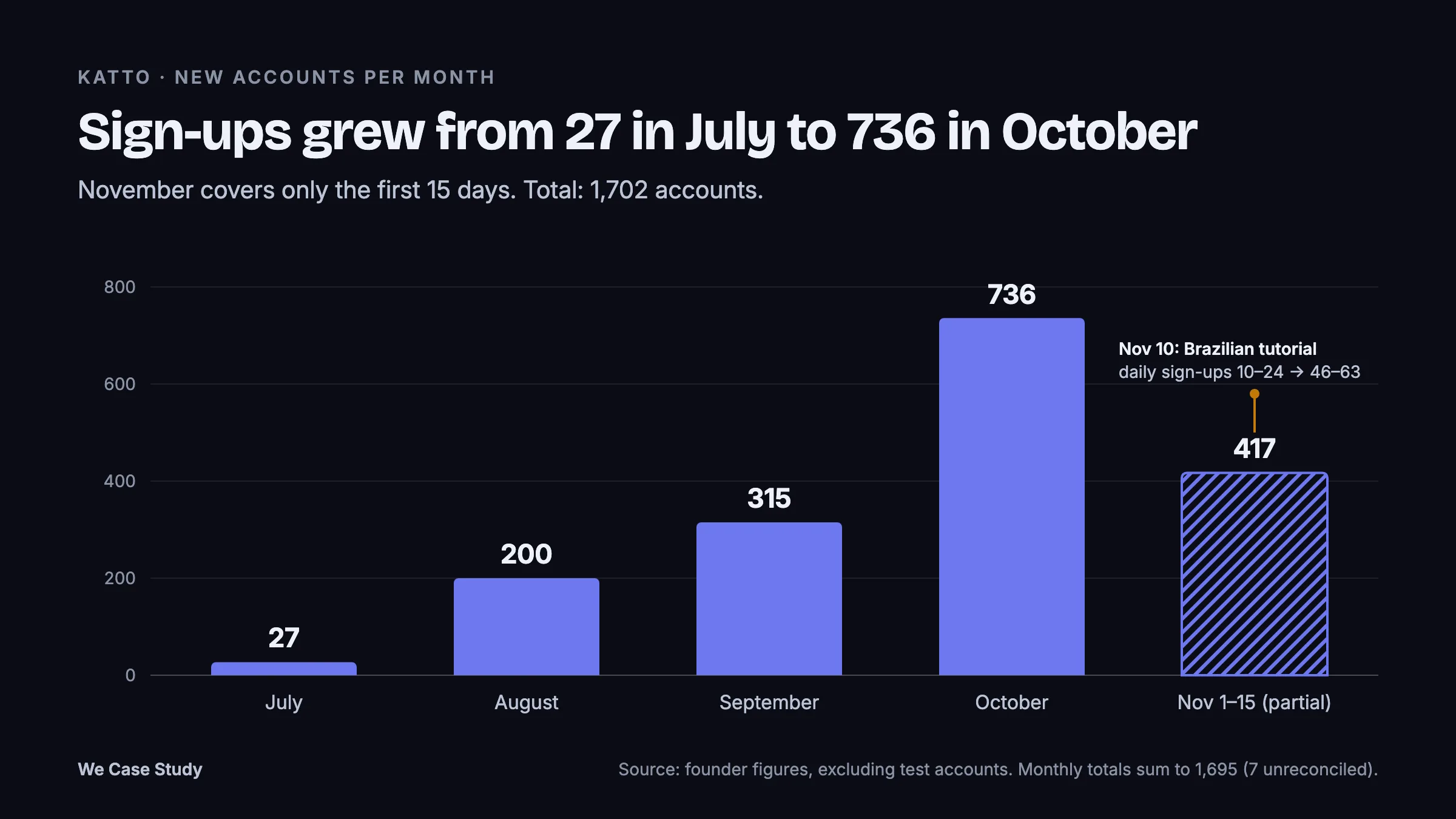
Sign-ups came from 110 countries, led by India and Brazil, followed by the United States, France, and Germany. Papoti recalls that the first users came through organic search, comparison pages, and directories, with no ad spend at that stage.
Two episodes show how Katto was discovered. On October 26, 30 of 47 new users came from chatgpt.com, mostly from India, a reminder of how much traffic now starts inside an assistant (see how ChatGPT makes money). On November 10, a Brazilian YouTuber with about 75,000 subscribers published a live-stream clipping tutorial. The sign-up jump that followed is consistent with the tutorial sending traffic. The available figures cannot isolate its incremental effect, show how many viewers submitted clips or paid, or establish the new long-term sign-up rate.
A tutorial can make a purchase easier in a way that a recommendation alone cannot. A streamer can watch someone use a familiar recording, see what happens to the webcam and gameplay, and judge whether the crop is worth posting. It answers the question a polished demo tends to skip. What will this do with footage like mine? Katto works with some creators through small fees or a program that pays 25% of referred customers’ first-year payments. The terms of the Brazilian video were undisclosed. Katto affiliate program · Related case study on SULT’s creator-led distribution
Business Model, Unit Economics, and Margin Exposure
Katto began with a €9 monthly paid plan in March, after Papoti initially considered €19. By July it charged €15 monthly or the equivalent of €12 a month billed annually for 25 sources of up to 90 minutes each. Papoti says he raised the price because he felt it understated what the product did. In October he split the offer in two. Solo made a smaller commitment available. Creator kept a quota for a heavier publishing schedule and added dubbing.
| Plan | Monthly billing | Annual billing | Standard source allowance |
|---|---|---|---|
| Free | €0 | — | 2 per month, up to 30 minutes each, 720p exports with a watermark and a five-clip cap per video |
| Solo | €8.90 | €58.80 upfront, equivalent to €4.90 per month | 10 per month, up to 60 minutes each |
| Creator | €14.90 | €142.80 upfront, equivalent to €11.90 per month | 25 per month, up to 90 minutes each, with a dubbing allowance |
These are the November 2026 euro prices. The standard cap applies to a single source. On paid plans, a special route for Twitch and Kick recordings accepts up to ten hours and uses one slot for each started 90-minute block. The six-hour, 31-minute test used five slots. Four streams of that length would use 20 of Creator’s 25 monthly slots. Katto shows the count before processing and offers the option to clip only a passage. Katto pricing · Full-stream quota rules
Two Creator subscribers paying the same price can send the same number of files and produce very different workloads. At 25 uploads, ten-minute videos add up to four hours and ten minutes of source footage. Ninety-minute videos add up to 37 hours and 30 minutes. That is nine times the runtime. While audio transcription alone is inexpensive (one separate test cost about $0.04 to transcribe the audio of a three-hour, 47-minute stream, implying roughly $0.40 to transcribe a full 37.5-hour Creator allowance), total compute costs are heavily driven by how many parallel video clips are rendered, retried, stored, or dubbed. The offer gives creators predictable quota use within the cap, while Katto absorbs the variance in downstream rendering and dubbing costs within a €14.90 monthly ceiling (€11.90 on annual billing).
Separating input limits from output limits allowed Katto to address two different bottlenecks simultaneously. Accepting longer source footage opened the product to streamers, while capping free rendering at five clips per source in October held down the cost of producing additional candidates. Even with that five-clip cap, the founder reported that free accounts represented 69% of the cloud compute bill in the November period covered by the interview. Its business impact depends on whether people still get enough useful output to return or upgrade. Revenue, paying subscriber counts, retention, and gross margins were undisclosed. The evidence supports an analysis of workload and pricing design, while Katto’s overall profitability remains an open question. Katto changelog
Biggest Failure and Recovery: The Annual Plan
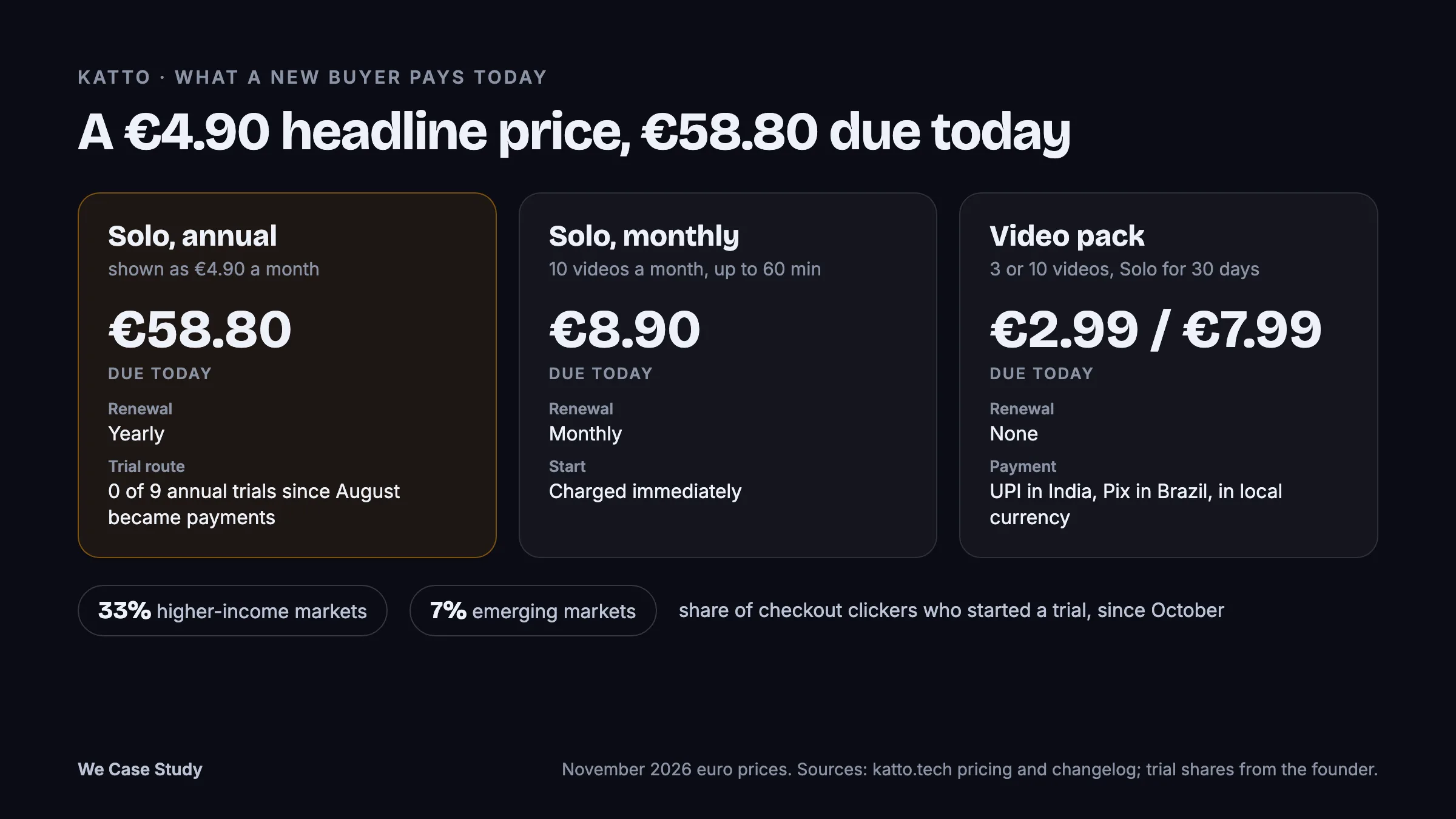
Papoti saw people click into checkout and leave before entering a card. In the founder’s figures since October, 33% of checkout clickers in higher-income countries started a trial, compared with 7% in emerging markets, where traffic was mostly mobile. Separately, zero of nine annual trials started since August had become payments by November 15. That figure covers the trial route. Solo could charge immediately. The trial count was small, and the regional figures lack raw cohort counts. Device mix, acquisition source, the upfront amount, and available payment methods could all contribute to the gap.
The annual plan had made €4.90 look like the entry price for Solo. The actual charge on that path was €58.80 upfront. Papoti’s launch postmortem describes a second problem: the payment provider was initially configured to charge the annual amount monthly, and Solo had entitlement and duration-limit defects. He caught the billing interval before anyone bought that option by making a real purchase himself. A correctly displayed price and a successful build had left the customer journey untested. Papoti’s launch postmortem
Papoti says Katto then made monthly billing the default, and the checkout now asks for a plan choice before the payment page, with the amount charged today shown on each option. Katto also introduced one-off packs of three videos for €2.99 or ten for €7.99. In India and Brazil, the checkout shows rupees or reais and offers UPI or Pix. Because displaying local currency is a technical prerequisite for surfacing UPI and Pix in Katto’s checkout, localization changed the transaction mechanism itself rather than merely translating euro prices. A pack unlocks Solo for 30 days and does not renew. A creator can pay more per video than on annual Solo while committing less money on the day of purchase. Because the checkout changes arrived close together, future results would need to distinguish the effect of local payment access from the effect of a smaller commitment. As of November 15, it was too early to judge the outcome. Checkout changes · November 10 video-pack release
Biggest Success: Making Whole Streams Practical
Early on, roughly half of Katto’s failed jobs came from free users trying videos that exceeded the plan limit. Papoti could see people arriving with footage long enough to fail the product’s rules. He could only see this demand because users tried to do the work before they left. That evidence pushed Katto toward hours-long streams.
Papoti changed the order of operations. Katto pulls audio for the entire stream, scores moments across it, then fetches video for the passages it selects. He also moved the first clips from sequential rendering to cloud workers that can render in parallel. If a cloud render fails, the job can fall back to Katto’s own server. On the same six-hour, 31-minute recording, Katto reported that rendering the first ten clips fell from 22 minutes and 24 seconds to four minutes. End-to-end time for the first batch fell from 29 minutes and 53 seconds to 11 minutes and 44 seconds. Whole-stream architecture · Same-stream rendering comparison
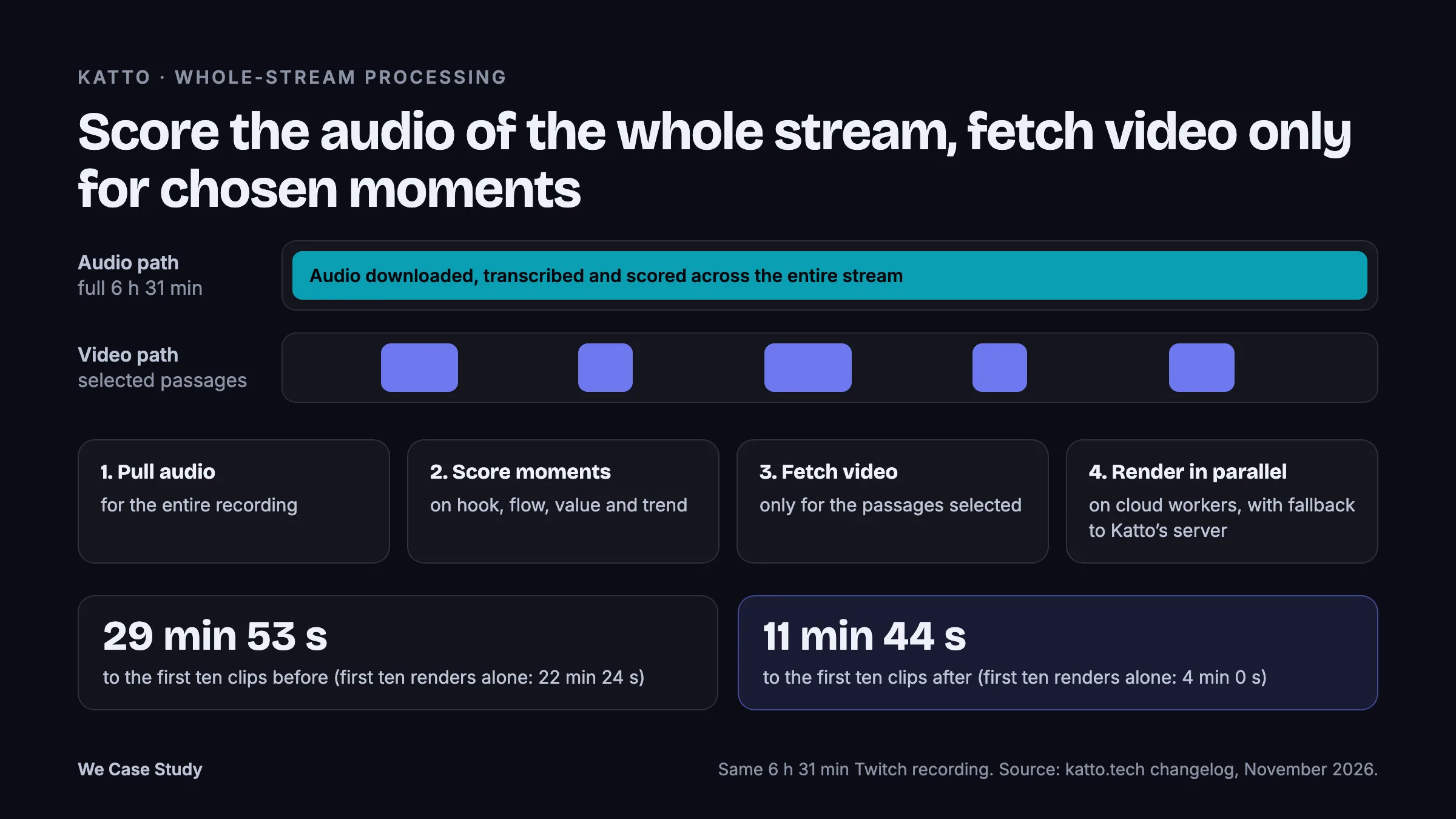
Papoti reported a drop in median processing time from 22–36 minutes in early November to roughly ten minutes from November 13 onward. By the interview cutoff that new median covered a very short period. The matched stream test gives the cleaner illustration of what parallel rendering changed. The next test is whether many users get a publishable first clip quickly across different streams, including ones where the strongest moment is visual and hard to infer from audio.
Leadership, Innovation, and Customer Strategy
Papoti covers code, infrastructure, support, marketing, and partnerships. A failed video download can interrupt his night. He uses alerts that identify the failing job and its cause, and failed jobs receive automatic quota refunds. He credits Claude Code as a pair programmer (our Claude Mods case study looks at that way of working). He also uses managed services for heavy rendering, authentication, storage, and payments, while writing his own framing logic around existing detection models. His most consequential decisions concern where he spends attention. A deeper editor, better stream handling, and an assistant integration all consume the same founder’s time.
Several product decisions came from small but unusually specific incidents. One trial user cancelled with a one-word explanation, “framing.” A side-by-side video had cropped out parts of two people’s heads, showing that a failed crop can erase the value of a correctly identified highlight. Katto changed the layout to keep both people visible. In another case, framing protected the song lyrics in a children’s cartoon while leaving the characters tiny. That prompted character-centered framing. Users also asked for clip titles to follow the language spoken in the video. Each incident disclosed an editorial judgment the tool had been making on the user’s behalf. Katto changelog
In the November product, Katto scored moments on hook, flow, value, and trend. It generated captions in 99 languages, with word-level timing in 41, and offered dubbing in 105 languages, 86 in beta. Its interface was available in 11 languages, according to Papoti. Those capabilities serve distinct needs, and dubbing breadth can exceed dependable coverage: the 86 beta languages have more limited speech-engine fallback than the 19 stable languages. A creator can want captions and titles in their own language without ever dubbing into another one. Caption quality, localized support, and a payment method the creator can use all matter before a headline language count delivers commercial value, a pattern also visible in Pocket FM’s market-by-market expansion. Katto press kit · Dubbing coverage and beta status
Katto’s Competitive Advantages and Their Limits
Katto’s strongest position is with a creator whom several small mismatches could otherwise turn away. A Brazilian streamer might bring a lengthy Kick recording, need to show a webcam and gameplay together, expect titles in Portuguese, and prefer to pay with Pix. A competing tool could match any one of those features. Winning that creator’s weekly workflow means delivering them together. A prospective advantage lies in learning the recurring edge cases across those features, such as which crop fails on local creator formats or where a mobile checkout loses ready-to-pay customers.
Katto also lets users submit jobs through its dashboard, API, command-line interface, or a hosted MCP server. MCP lets a compatible AI assistant call Katto’s tools after the user connects their account, drawing from the same monthly quota as the web app. Katto documents 29 actions, including creating jobs, editing clips, translating captions, and scheduling posts. Since mid-October, roughly 15% of videos submitted by real users came through the MCP server or the API, according to Papoti. That combined share cannot tell us how much usage came from assistants alone or whether those jobs would otherwise have entered through the dashboard. It establishes that customers used the programmatic route for actual inputs. There is no head-to-head evidence that competitors would struggle to replicate Katto’s stack or maintain a similar integration. Katto MCP documentation
Original Strategic Insights
1. Use Rejected Work to Find Your Next Market
A waitlist records interest; a rejected job records a person arriving with a real file and a task ready to run. Katto’s high share of overlength failures showed what some users wanted to do before Papoti could infer it from successful jobs. Because failure logs can overrepresent people who retry the same file, founders should group rejections by unique user, source, and limit, setting a threshold for distinct users and repeat demand before re-architecting the pipeline.
2. Price Around the Creator’s Calendar, Then Audit the Tail
A weekly show has an episode schedule, and counting uploads gives its producer an easy way to forecast quota use. In exchange, Katto takes on 9x variance in source length and output load. Put the exception and its quota cost on the screen before the user commits the job, as Katto does for unusually long streams. Then calculate monthly contribution per account = net receipts − variable processing, payment, and support costs. Comparing heavy-quota accounts against light users prevents a portfolio average from concealing an unprofitable segment that grows precisely because it gets the best deal.
3. Measure the First Publishable Clip, Not Just Processing Speed
The bottleneck that matters to a creator is the wait until there is something worth reviewing or posting. Katto showed ten clips first and continued rendering additional clips in the background. While the same-stream test proves the gain in first-batch speed, returning weak or poorly framed results sooner merely hands customers more editing work. Pair time-to-first-result with the percentage of first-batch clips that get exported or published without manual reframing.
4. Treat Unedited Output as a Distribution Asset
When a creator can show what a product does with their own footage, a tutorial answers the next viewer’s questions about compatibility, crop, and output quality. More clips that need little editing give creators more material to demonstrate, demonstrations bring viewers with similar footage, and their jobs reveal the next recurring defects. To test whether this loop compounds beyond one-off spikes like the Brazilian tutorial, tag each creator referral and track the path from first job to first published clip to 30-day return usage.
5. Separate the Advertised Price From the Upfront Commitment
Annual billing drops the advertised monthly equivalent while increasing cash due today. Conversely, a small prepaid pack lowers the upfront commitment and avoids a renewal agreement, even when it costs more per video. Katto’s checkout exit data shows why the advertised monthly amount is an incomplete measure of accessibility. Track price shown, amount due today, local payment method selected (UPI/Pix vs. card), first payment, and pack replenishment separately.
6. Track AI Discovery and AI Execution Independently
A ChatGPT recommendation can send someone to a website (acquisition source), while an MCP connector lets someone complete part of the job inside an assistant (execution surface). The 30 referrals on October 26 measure a single day of discovery, and the 15% usage share combines API and MCP execution. Tracking the two channels as a matrix over time reveals whether users who discover Katto in ChatGPT stay in the web dashboard or migrate to programmatic workflows.
7. Spend Solo Founder Time on Unhandled Work
Katto tried a virtual camera that re-aimed on each shot, but the jarring result led Papoti to choose steadier framing. He also declined X publishing at its API cost and deferred Facebook Pages given the verification burden. Every feature estimate needs a second column: how much support, debugging, and vendor maintenance will it create after launch? Pairing automatic quota refunds with job-specific failure alerts reduced both customer friction and midnight diagnosis time.
What Most People Get Wrong About AI SaaS Growth
| Common Assumption | What Actually Happened at Katto | Operational Lesson |
|---|---|---|
| The cheapest advertised plan is the easiest purchase. | Solo’s €4.90 monthly equivalent required €58.80 upfront on day one, while the higher-priced Creator tier could open with a trial. | Print the exact charge due today beside the monthly equivalent and test live billing intervals with a real card. |
| Users abandon checkout because a payment fails. | Many prospective customers exited before typing a card number, especially in mobile-heavy emerging markets (7% trial starts vs. 33% in higher-income regions). | Inspect pre-card checkout friction, upfront commitment size, and local currency triggers that unlock methods like UPI and Pix. |
| Raising the duration cap is what makes long streams work. | Simply raising the 90-minute cap would have choked the old pipeline. Audio-first scoring and parallel cloud rendering cut first-batch wait times from 29:53 to 11:44. | Search and score with a lighter input (audio) across the full file, then fetch and render heavy media (video) only for selected moments. |
| AI automation means removing editorial choices. | A one-word cancellation (“framing”) over cropped heads and tiny cartoon characters showed that finding a highlight is useless if the crop fails. | Expose interpretable scoring axes (hook, flow, value, trend) and ship a fast browser editor alongside automated output. |
| Free tiers are cheap if per-user allowances are small. | Despite a two-video, five-clip cap, free accounts consumed 69% of Katto’s cloud compute bill in the November snapshot. | Cap output rendering independently from input length, and measure how much conversion learning that compute spend actually buys. |
| Organic and AI referral spikes equal durable distribution. | Search, the Brazilian tutorial, and ChatGPT referrals drove sign-up jumps, while creator fees, 25% affiliate commissions, and founder hours remained real costs. | Wait for cohorts to mature past 30 days and measure repeat submissions before calling a registration spike a sustainable channel. |
Future Outlook and the 30-Day Proof Points
Papoti expects to keep his day job while continuing to build Katto and launching other SaaS projects. The next year will test whether operational automation and architectural specialization save enough time to make that portfolio approach viable. Long-stream rendering can win a creator who previously could not use the tool, and an MCP connector can bring automated jobs, but weekly return visits are required to prove Katto fits a creator’s production schedule.
Three specific metrics will determine whether Katto’s early traction converts into a durable business:
Streamer Retention: The percentage of first-time long-stream users who submit another recording within 30 days, paired with the share of first-batch clips exported or published without manual reframing.
Localized Checkout Conversion: First purchases and subsequent 30-day pack repurchases or subscription renewals segmented by region and payment rail (UPI/Pix vs. card), measured against total checkout starts.
Net Account Contribution: Monthly revenue minus variable cloud rendering, transcription, dubbing, and payment costs, paired with founder support time per active account.
Reporting note. WeCaseStudy analyzed Papoti’s written interview and his November 15, 2026 operating snapshot alongside dated product documentation, launch notes, and competitor pages. Katto supplied the internal metrics and both stream benchmarks. Customer examples are anonymized. Strategic interpretations and proposed tests are WeCaseStudy’s analysis.
Frequently Asked Questions
What does Katto do?
Katto turns long videos into short vertical clips. It ranks potential highlights, reframes the selected footage, adds captions, and lets users edit, download, publish, or schedule the results. Source footage can include podcasts, interviews, and recordings of livestreams.
Who founded Katto?
Anthony Papoti, a French web developer based in Japan, founded Katto in 2026. He built it alongside his day job and reported no outside funding or employees as of November 15, 2026.
How does Katto make money?
It sells Solo and Creator subscriptions and offers small prepaid video packs in selected markets. Standard plans include a set number of source videos subject to duration limits. Long Twitch and Kick recordings on paid plans use one quota slot per started 90 minutes.
How much does Katto cost?
In November 2026, Katto had a free plan, Solo at €8.90 a month or €58.80 a year, and Creator at €14.90 a month or €142.80 a year. One-off packs cost €2.99 for three videos or €7.99 for ten and open Solo for 30 days without renewal.
Did AI assistants drive Katto’s growth?
ChatGPT referred 30 of the 47 new users on one reported day. Separately, about 15% of user-submitted videos since mid-October arrived through MCP or the API. Those figures measure referral and execution respectively, with the latter combining assistants and other integrations. Katto’s long-term share of sign-ups or revenue from assistants is unknown.