How Does ChatGPT Make Money? Revenue Model Explained
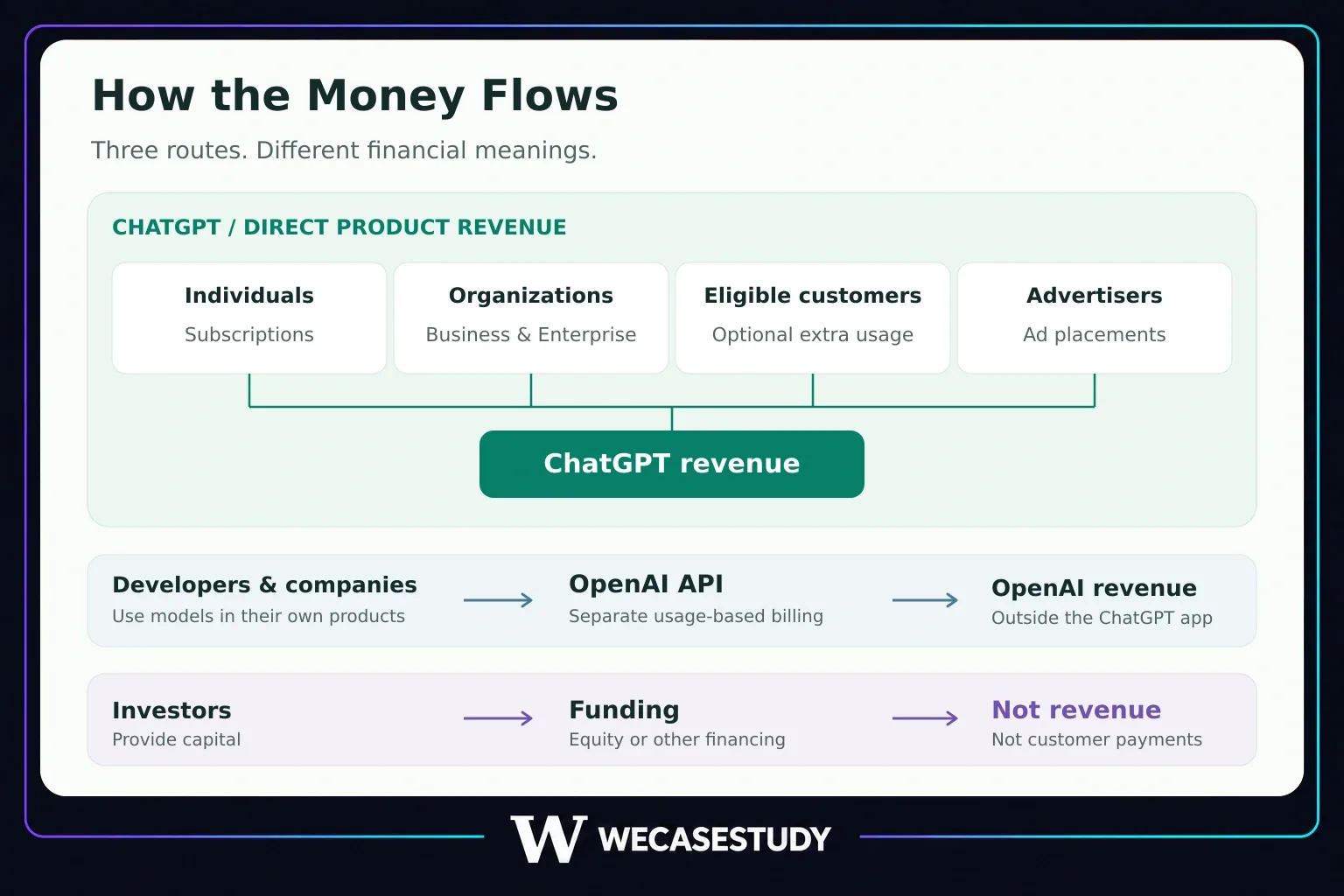
ChatGPT makes money through paid subscriptions, business and enterprise accounts, additional usage charges, and advertising. OpenAI also earns money when develo...


ChatGPT makes money through paid subscriptions, business and enterprise accounts, additional usage charges, and advertising. OpenAI also earns money when developers and companies pay to use its models through the OpenAI API.
The distinction matters: ChatGPT is a product, while OpenAI is the company behind it. Some revenue is generated directly through ChatGPT; other revenue comes from OpenAI products and services outside the ChatGPT app.
So the business model is broader than “free users versus paid subscribers.” OpenAI can monetize individual users, organizations, heavy AI users, advertisers, and developers in different ways.
Last updated 20 October 2026
How ChatGPT Makes Money at a Glance
Revenue channel | Who pays? | How it is charged | Scope |
Consumer subscriptions | Individuals | Recurring subscription | ChatGPT |
Business & Enterprise | Organizations | Seats, contracts and flexible usage | ChatGPT |
Optional extra usage | Eligible customers | Credits for supported features | ChatGPT |
Advertising | Advertisers | Paid advertising placements | ChatGPT |
API | Developers and companies | Usage-based | Broader OpenAI |
How Does OpenAI Make Money
OpenAI earns money from ChatGPT and from services outside the ChatGPT application, including its API. A person can pay for ChatGPT, while a software company can pay to embed OpenAI models in its own product. The latter company’s customers may never open ChatGPT.
A company-wide OpenAI revenue figure cannot be attributed entirely to ChatGPT subscriptions. The distinction matters when comparing headlines, estimating market share or discussing profitability.
Related Post:
Paid ChatGPT Subscriptions Create Recurring Revenue
Subscriptions are the most visible part of ChatGPT's monetization model.
OpenAI offers free access alongside several paid plans intended for users with different levels of usage and willingness to pay. Current ChatGPT plans.
As of this review, OpenAI lists Free, Go, Plus and Pro among its individual plans. Plus is listed at US$20 per month. Pro has three monthly USD tiers: US$100, US$200 and US$500. OpenAI’s current documentation says new Pro 200 subscriptions are available again. Prices, allowances and regional availability should be checked before purchasing. Plus pricing. Pro tiers and subscription availability.
A casual user may be satisfied with free access. Someone who uses ChatGPT every day may be willing to pay for higher limits or additional capabilities. A professional who depends heavily on AI can have a much higher willingness to pay.
A possible upgrade path is free access, followed by a paid individual plan and then a higher-capacity tier. This is a business-model interpretation, not evidence that most customers follow that path.
Why Does ChatGPT Have a Free Version
Free access can function as a distribution channel. Our interpretation is that trying useful tasks at no subscription cost can build familiarity and create opportunities for later upgrades or workplace adoption.
Those outcomes are possibilities to measure, rather than established conversion results. A user who never upgrades can still use an eligible ad-supported experience.
The sources reviewed do not establish a reliable overall free-to-paid conversion rate or the average economic value of a free ChatGPT account. Having a large audience therefore does not establish that each free user is profitable.
ChatGPT Business and Enterprise Monetize Workplace Usage
Consumer plans monetize individuals. ChatGPT Business and Enterprise can monetize AI adoption across organizations.
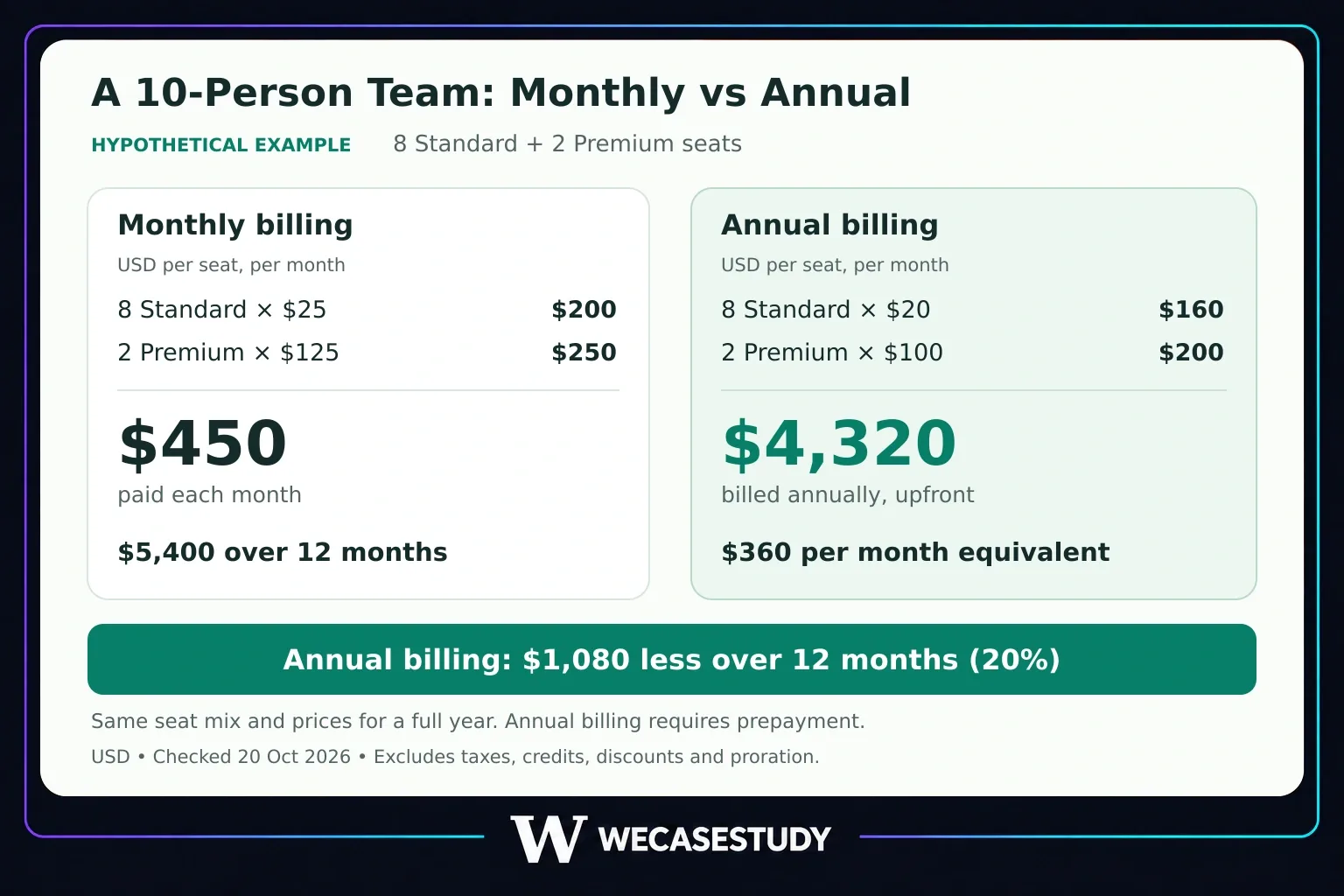
For most countries, OpenAI’s listed USD Business prices are US$25 per Standard seat per month on monthly billing, or US$20 per month billed annually. Premium is US$125 monthly, or US$100 per month billed annually. Business requires at least two paid seats and allows a mix of the two types. Enterprise terms are sales-led; the Business rate card should not be treated as an Enterprise quote. Business overview.
Why Would a Company Pay When Employees Can Use ChatGPT for Free
Business products package access with a managed workspace, administration and billing controls. The purchasing decision shifts from what one person can do with a chatbot to how an organization can deploy and manage it. Workspace features.
An individual may purchase one subscription. An organization can deploy multiple seats, while larger deployments may require an Enterprise arrangement. Expansion is a possible commercial outcome, not proof that a particular customer will buy more seats.
A Reproducible Team Cost Example
Consider a hypothetical ten-person team buying eight Standard seats and two Premium seats at the listed USD Business prices. Assume a full billing period, no taxes, discounts, proration or additional credits. This is a pricing calculation, not an observed customer outcome.
Monthly billing: 8 × US$25 + 2 × US$125 = US$450 per month. Keeping that mix for twelve months would cost US$5,400.
Annual billing: (8 × US$20 + 2 × US$100) × 12 = US$4,320 billed annually, equivalent to US$360 per month. The difference is US$1,080 across twelve months, assuming unchanged prices and seat needs.
Ten Standard seats on monthly billing would instead cost US$250 per month. Upgrading two of them to Premium adds US$200 monthly. That is worth evaluating against the work those two people can actually complete, rather than giving every employee the highest tier.
To repeat the calculation, multiply seats of each type by their unit prices and add optional usage separately. Annual prepayment is a cash commitment; it is not revenue recognized all at once merely because it is paid upfront. Seat prices and billing rules.
Additional Usage Creates a Second Payment Mechanism
AI usage can differ dramatically between customers.
One person might send several short prompts each day. Another might run large research tasks, coding workflows, document analysis, agent tasks, or other compute-intensive work.
A single unlimited flat subscription does not necessarily fit both usage profiles efficiently.
OpenAI offers workspace credits for eligible Business, Enterprise and Edu usage. It also offers personal-plan credits for supported features, depending on the account and plan. These are additions to included usage, not a promise of unlimited access to every model or tool. Workspace flexible pricing. Personal-plan credit eligibility.
The commercial structure combines a recurring subscription with optional additional consumption. It lets a customer buy more eligible usage without necessarily changing the whole plan.
Our interpretation is that seats can provide a recurring baseline while extra consumption creates expansion opportunities. Buyers face a corresponding tradeoff: more flexibility can make the final monthly bill less predictable.
How ChatGPT Advertising Makes Money
Advertising adds another payer: an advertiser can fund eligible exposure while a user accesses the product.
On 31 August 2026, OpenAI announced that ChatGPT Ads had reached US$1 billion in annualized revenue run rate in less than 200 days after launch. This is a company-reported milestone. OpenAI’s dated announcement.
An annualized run rate extends a current revenue pace over a year. It is not the same as revenue already earned during a completed year, audited annual revenue or advertising profit.
OpenAI says ads may appear for eligible Free and Go users in supported regions. Plus, Pro, Business, Enterprise and Edu accounts are ad-free. Ads are labeled separately from answers. Ad eligibility and presentation.
Commercially, this creates a different relationship from a subscription: an advertiser is buying access to an eligible audience. Whether that revenue covers the cost of serving that audience requires cost data.
Does ChatGPT Sell Your Conversations to Advertisers
OpenAI says it does not sell user data to advertisers or give them access to private chats and memories. Advertisers receive aggregated performance reporting. Context from the current conversation, and selected broader signals when personalization is enabled, may help select ads. Messages a user chooses to send directly to an advertiser are visible to that advertiser. Advertising privacy policy.
The distinction is between using context internally for ad selection and exposing the conversation to an advertiser. This article reports OpenAI’s stated policy; it does not independently audit its advertising systems.
How the OpenAI API Makes Money
The OpenAI API is another important source of OpenAI revenue, but it should not automatically be described as ChatGPT revenue.
Developers and companies can use OpenAI models inside their own software, internal systems, automations, and AI products.
API customers pay for programmable access. The pricing documentation lists rates for input and output tokens, with differences by model and processing mode; tools, storage and other services can carry additional charges. API pricing.
ChatGPT packages an application for users. The API gives developers building blocks for their own software. OpenAI’s billing guidance treats API charges separately from a ChatGPT subscription. Separate API billing.
Consider an accounting-software company that adds AI document analysis to its own product.
Its customers may never open ChatGPT. The accounting company can still pay OpenAI whenever its software uses OpenAI models.
Funding Is Not Revenue
Revenue, funding, valuation, and profit describe different financial concepts.
Term | Meaning |
Revenue | Money earned from customers and advertisers |
Funding | Capital supplied by investors |
Valuation | An estimate of what the company is worth |
Profit | Revenue remaining after expenses |
If an investor puts $10 billion into a company, the company has raised $10 billion. It has not earned $10 billion from customers.
Where Microsoft Fits In
Microsoft is an investor and commercial partner. Equity ownership is separate from customer revenue.
At the close of the October 2025 recapitalization, OpenAI disclosed Microsoft’s stake at roughly 27% of OpenAI Group and described continued control by the OpenAI Foundation. That is a dated ownership disclosure, not a verified current cap table after every later financing. OpenAI’s structure disclosure.
Is ChatGPT Profitable
Generating revenue and earning a profit are different achievements. The official sources reviewed do not provide a standalone ChatGPT income statement sufficient to establish its net profit margin.
A reliable assessment would need product revenue and consistently allocated costs, including serving compute, model development, staffing, support and infrastructure. A positive contribution margin on usage would not, by itself, establish net profit after all costs.
For example, a company can collect more subscription revenue while spending even more on capacity and research. It can also receive cash from investors while reporting an operating loss. Neither observation, by itself, resolves the profitability of one product.
The defensible conclusion is that the disclosed monetization channels show how money is earned, while ChatGPT’s exact standalone profitability remains unestablished by the sources reviewed.
Why AI Economics Depend on Usage
Each prompt, generated answer, image, research workflow, coding task, or agent run can require computing resources.
This creates a commercial tension: a customer receiving more value may also consume more infrastructure. Our interpretation is that differentiated plans and usage charges help address that variation, but the pricing structure alone does not prove successful cost recovery.
The question to test is whether revenue grows faster than the cost of delivering useful, reliable work. More interactions are valuable only if the resulting revenue and retention justify their cost.
How the Revenue Streams Fit Together
WeCaseStudy’s analytical framework treats these as parallel routes to revenue, rather than one compulsory sequence.
Individuals can subscribe; organizations can buy managed access; eligible customers can purchase additional usage; advertisers can fund exposure; and developers can pay for API consumption. One organization may buy several of these independently.
The potential advantage is commercial diversification. The tradeoff is managing several buyer relationships, billing systems and expectations. The API is not a final upgrade step that every ChatGPT user is expected to reach.
Which Payment Route Fits Your Use Case
Start with the task you need to complete, then choose the purchasing route. These are decision steps based on the model above, rather than results from a performance test.
For occasional personal use, try a representative task on Free. Consider a paid individual plan only when a specific limit or capability regularly blocks useful work.
For frequent professional use, record the limits you hit and the time spent correcting outputs. Compare the extra plan cost with the value of work completed after verification.
For a team, decide whether centralized controls and workspace management are required. Start with the appropriate mix of seats, check adoption and upgrade heavy users when their needs justify it.
For a product or automation, evaluate the API as a separate budget. Estimate token, tool and storage consumption per successful task, including retries, before projecting margins.
For advertising, verify market eligibility and test a capped campaign against a defined business outcome. Exposure and clicks are intermediate metrics; the relevant result is incremental customer value after advertising cost.
A Simple Value Check
A hypothetical US$20 monthly subscription breaks even at 40 minutes of usable time saved if that time is worth US$30 per hour. The arithmetic is US$20 ÷ US$30 × 60 = 40 minutes. Include prompt writing, fact-checking and corrections in the time measurement. This does not establish that ChatGPT will save that time or that saved time will become cash income.
What the Evidence Establishes
The cited documentation establishes the available charging mechanisms, listed plan terms and OpenAI’s own advertising milestone. It does not establish the share of total revenue from each channel, overall conversion, acquisition cost, retention impact or standalone ChatGPT profit.
To test the strategy, we would want revenue and serving cost by customer cohort, paid retention, workspace seat utilization, additional-usage purchases and advertiser renewal. Multiple payment options demonstrate flexibility; these measurements would show whether that flexibility produces durable economics.
What Businesses Can Learn From ChatGPT’s Model
The transferable lesson is to align charging with the value customers receive and the cost of serving them. Copying a frontier AI company’s price list would not establish a sustainable model for a smaller business.
Segment by a real customer need. Offer a higher tier when a distinct group needs more capacity, control or a different service level. Measure whether the added revenue exceeds the cost of the extra service; more tiers can also confuse buyers.
Give free access a measurable role. Track activation, repeat use and conversion by cohort, alongside cost per active user. This is useful when a free experience can demonstrate value cheaply; it is less attractive when every trial consumes expensive resources without repeat use.
Use consumption pricing where serving costs vary materially. Make limits and overage controls visible, then monitor margin and surprise-bill complaints. Metering can protect economics while making procurement harder, so predictable budgets remain part of the product.
Measure expansion separately from success. More seats or credit purchases can increase revenue, but retention, useful completed work and customer outcomes help determine whether that expansion is durable.
Frequently Asked Questions
Is ChatGPT Plus OpenAI’s Main Source of Revenue
The reviewed sources do not provide a complete, comparable revenue breakdown that establishes Plus as the largest channel.
A plan price, a user count or an advertising run rate alone cannot rank all revenue streams. Doing so requires figures for matching periods with consistent definitions.
Can People Make Money Using ChatGPT
ChatGPT can be used as a tool in revenue-generating work such as software development, consulting, marketing, research, and business operations.
That is a different question from how ChatGPT itself makes money, and using ChatGPT does not guarantee that a business, project, or side hustle will be profitable.
Does a ChatGPT Subscription Include API Credits
No. API billing is separate from a ChatGPT subscription. Eligible partner tools may use a plan allowance through an authorized subscription-sharing flow, but that is different from billing usage to an OpenAI API account. Official explanation. Participating tools and Plus allowances.
Can a Paid ChatGPT User Still See Ads
Yes, Go can include ads for eligible users. OpenAI lists Plus, Pro, Business, Enterprise and Edu as ad-free. Availability depends on the plan and region. Official explanation.
Does the Advertising Milestone Mean OpenAI Earned a Billion Dollars in a Year
No. The August 2026 announcement described an annualized revenue run rate. It was not a statement of completed-year advertising revenue or profit. Official explanation.
Research Method and Limitations
This is a desk-based business-model case study reviewed on 20 October 2026. It separates ChatGPT product revenue from broader OpenAI revenue, investment capital and profit.
Product terms and pricing were checked against the official pages linked beside the relevant claims. Provider announcements are attributed to OpenAI and are not treated as independent financial verification. We have not audited accounts, tested advertising delivery, measured conversion or conducted a paid-plan performance benchmark.
The team-cost example uses disclosed prices and transparent arithmetic; it is not observed customer spending. Strategic interpretations and measurement proposals are WeCaseStudy analysis. Prices, availability and allowances can change; local checkout and contract terms take precedence.