Airbnb Case Study: The Hidden Cost of a Shared Reputation
Explore Airbnb’s business model, network effects, and quality strategy—and how one bad stay could affect hosts who did nothing wrong.


A guest reserves a home. Someone else books the same dates at a higher price. The first guest is told there is a maintenance problem and must accept a different property or lose the reservation.
This sequence appears in the Justice Department’s account of a nationwide short-term rental scheme. In April 2026, Shray Goel pleaded guilty to wire fraud and Shaunik Raheja pleaded guilty to obstruction of justice. Prosecutors described double-booking, invented excuses, fabricated reviews, and replacement listings that concealed negative feedback. [1]
The record establishes concrete failures. It does not tell us how many affected travelers subsequently avoided an unrelated, dependable host.
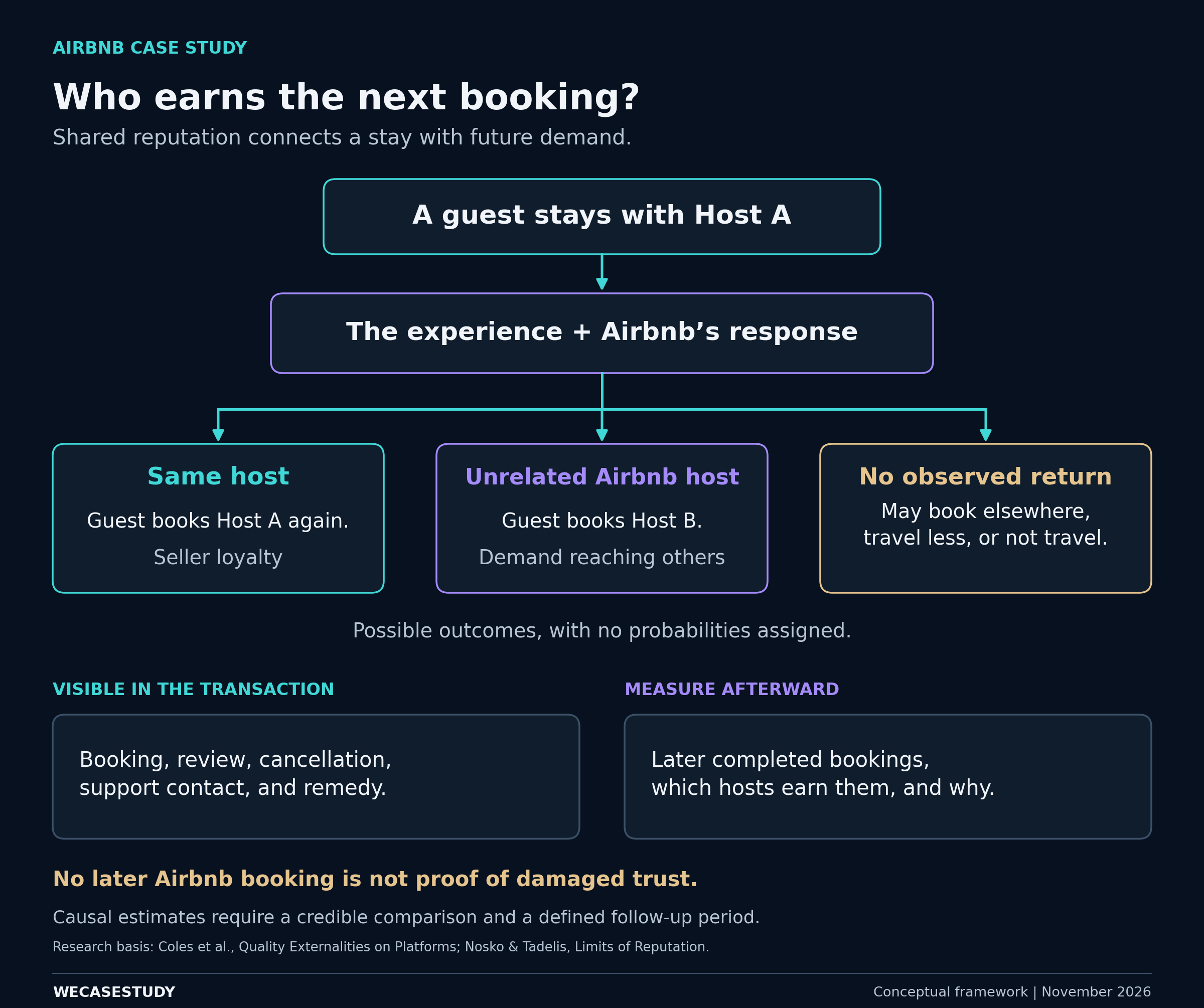
That missing transaction is the subject of this Airbnb case study. Independent hosts share a marketplace reputation: one host’s service can influence whether a guest books another host later. Research makes part of this effect measurable. Airbnb’s public quality disclosures leave its full financial cost unresolved.
The argument is that quality control can protect demand for hosts who never caused a problem. But removing supply can also destroy useful choice and livelihoods. The strategic task is to measure both effects before treating a cleaner marketplace as a more valuable one.
The strategic question: Can a platform measure the future bookings lost when one seller damages trust in everyone else?
How Airbnb’s Business Model Connects Independent Hosts
Airbnb’s business model separates the physical service from the system that sells it. Hosts provide the accommodation. Airbnb organizes discovery, booking, payments, platform rules, and support, earning service fees from transactions. [2,3]
This separation allows the marketplace to expand without purchasing every home. It also means the company promising a dependable booking cannot directly perform every cleaning, maintain every lock, or resolve every on-site problem.
Part of the business model | Who supplies it | Strategic consequence |
|---|---|---|
The home and hospitality | Independent hosts and their teams | Quality varies across properties and operators. |
Discovery and checkout | Airbnb | Ranking and presentation influence which hosts win demand. |
Fees | Collected by Airbnb under its fee structures | The platform earns from completed marketplace activity. |
The customer relationship | Shared across host and platform interactions | A failure can affect beliefs about both. |
Airbnb’s current fee page describes a transition from split fees toward a single fee deducted from host payouts. Most hosts on the single structure pay 15.5%, with exceptions. A business-model explanation built around a permanent 3% host fee would miss this change. [3]
The platform controls access to demand
A host controls important aspects of the stay. Airbnb controls important parts of how that host is found and selected, including search results, platform labels, and checkout. Neither controls the entire experience.
Our interpretation is that Airbnb centralizes the promise of a dependable transaction while distributing its delivery. A guest buying through one familiar brand may still experience thousands of operationally different businesses.
For background on the company’s history and products, see our Airbnb company profile. This analysis focuses on what that distributed delivery means for future demand.
Airbnb’s Network Effects: More Hosts, More Choice—and More Risk?
Airbnb’s network effects start with a useful exchange: suitable homes attract travelers, and potential bookings attract hosts. The value depends on whether supply fits a trip’s destination, dates, price, party size, and requirements.
A million additional homes elsewhere do little for a family that cannot find an appropriate property for one particular weekend. More supply improves the marketplace when it adds feasible choices.
Sellers also affect one another through experience
There is another connection. A stay can change a guest’s willingness to try an unfamiliar Airbnb host next time. Hosts therefore compete for current bookings while potentially creating or destroying future demand for one another.
Economists call this a reputational externality: part of one seller’s effect falls outside that seller’s own transactions. Chris Nosko and Steven Tadelis studied it using eBay data and a search-ranking experiment. Prioritizing higher-quality sellers increased subsequent purchasing without reducing immediate conversion. This was eBay evidence, not an Airbnb effect estimate. [4]
For a founder, the distinction changes the growth dashboard. Counting sellers measures participation. Counting completed transactions measures current activity. Following what customers do afterward begins to reveal whether those sellers are strengthening the marketplace.
Shared reputation means that an individual seller’s performance can affect demand for other sellers using the same platform name. The idea is established in marketplace research. The unresolved issue here is how much it explains Airbnb’s later quality decisions and their consequences.
Who Pays When One Bad Stay Damages Trust?
The guest may lose money, time, or part of a holiday. The host may lose revenue or face enforcement. Airbnb may incur support and remedy costs; its refund and rebooking policy describes assistance for qualifying reservation problems. [12]
A dependable host in another destination could also lose an opportunity if the guest becomes less willing to book through Airbnb. That host receives no complaint because there was no transaction.
What the research found
Quality Externalities on Platforms: The Case of Airbnb constructs Guest Return Propensity, or GRP: a listing-level measure based on guests’ later platform trips, with adjustments for observed differences and statistical noise. [5]
Using historical data spanning 2018, its analysis estimates that a one-standard-deviation increase in booked-listing GRP produces 0.599 additional subsequent trips against a 2.1-trip baseline: roughly 2.7 rather than 2.1, or 29% more. This is a statistical comparison between listings, not the effect of turning one bad stay into a good one. [5]
The method uses search-result variation to address selection and depends on identifying assumptions. The hosted manuscript is labeled “submitted to Management Science” and includes Airbnb-affiliated authors. It neither evaluates the later removal program nor prices one failure. [5]
Why the next booking matters more than the next review
A review describes an experience someone chose to report. A future booking reveals a later decision, although it cannot explain that decision alone.
Someone who does not return may have chosen a hotel, reduced travel, changed budget, or found no suitable home. Someone who does return may still book less frequently. Retention is therefore more informative when measured as completed activity over time, alongside prior travel patterns and available alternatives.
Our interpretation is that a host’s economic contribution extends beyond the revenue recorded against their listing. A great stay can help another host acquire a customer. A poor stay can leave part of its cost scattered across future searches that never convert.
That creates an incentive problem in both directions. A dependable host may bear the cost of better service while other hosts capture some resulting demand. A careless host may collect today’s payment while others bear some future loss. Platform investment in quality can address that gap, provided it rewards delivered value rather than differences in the customers a host happens to attract.
Why Airbnb Removed More Than 400,000 Listings
Airbnb’s February 27, 2025 Global Quality Report described an updated hosting quality system introduced in 2023. It reported removing more than 400,000 listings during April 2023–November 2024. These were listings, not necessarily distinct hosts, and the figure was a cumulative removal count rather than the net change in supply. [6]
Date or reporting period | Quality milestone |
|---|---|
2023 | Updated hosting quality system introduced. [6] |
November 2023 | Guest Favorites launched to highlight highly rated, reliable homes. [16] |
February 2025 report | More than 400,000 listings removed in the stated April 2023–November 2024 window. [6] |
Q2 2025 shareholder letter | More than 500,000 removals reported since the updated system launched. [7] |
The 400,000 figure documents an important stage of the initiative; later disclosures already exceeded it. Removal counts also measure an enforcement decision, not the number of guests harmed or the amount of demand saved.
The improvement Airbnb reported
The Global Quality Report cited an approximately 15% year-over-year reduction in quality-related customer service inquiries relative to reservation check-ins, comparing Q4 2023 with Q4 2024. This is a relative change in a contact rate, not a 15-percentage-point decline in bad stays. [6]
The later shareholder letter associated the quality work with lower issue and chargeback rates. [7] These disclosures support an operational improvement. They do not isolate what removals accomplished compared with education, product changes, or a different customer mix.
A removal can improve an average simply by excluding weaker observations. The more demanding business test asks whether customers received better stays and generated more subsequent demand after accounting for the choice that disappeared.
The leadership decision behind the count
The underlying tension was visible years earlier. In November 2019, Brian Chesky’s public employee email acknowledged abuses of trust and announced verification and guest-protection initiatives. The announcement expressed commitments; it did not establish that every promised outcome was achieved. [15]
The later quality system represents a continuing governance problem: how much operational variation can a common brand tolerate? A platform can recruit hosts quickly, but it must also decide when a seller’s access to demand becomes too costly for the wider network.
Can Reviews and Guest Favorites Protect Airbnb’s Competitive Advantage?
Guest Favorites helps travelers identify homes using ratings, reviews, and reliability information. Airbnb’s current guidance describes daily assessment, listing-level eligibility, and a requirement for at least five guest reviews. [8]
The badge can make a difficult comparison easier. It also concentrates responsibility: when the platform prominently recommends a home, the guest has another reason to associate the resulting experience with Airbnb’s judgment.
More feedback does not guarantee better decisions
Andrey Fradkin and David Holtz analyzed an Airbnb experiment incentivizing reviews of previously unreviewed listings. Additional reviews were more negative on average, but nights sold and revenue did not increase, and transaction quality for treated sellers declined. The authors connect the results to market conditions, capacity constraints, and information display. This historical experiment did not test today’s Guest Favorites system. [9]
The practical question is whether information improves the resulting match. A larger review database can leave that question unanswered.
Matt Meister and Nicholas Reinholtz’s certification research, including Airbnb Superhost status, found that certification can lower subsequent ratings by changing expectations and comparison standards. It does not establish that Guest Favorites harms retention. [10] It suggests testing whether the promise conveyed by a badge stays aligned with the experience delivered.
Hosts experience the cost of changing the signal
In a May 2024 Skift discussion, journalists reported that some hosts were disappointed because Guest Favorites seemed to eclipse their earned Superhost status. The report captures a concern about recognition; it does not prove lost bookings or identify a representative host response. [11]
Our inference is that changing quality signals can redistribute the value of work already invested in the platform. Clear criteria, explanations, and appeals matter to the suppliers expected to improve.
Airbnb Marketing Strategy: Every Stay Tests the Brand Promise
Airbnb’s annual report describes a combination of brand campaigns, communications, performance marketing, and partnerships. [2] Shared reputation connects that marketing strategy to operations: advertising can persuade someone to try Airbnb, while a stay helps determine what the name means when they plan another trip.
The unusual feature is who inherits the result. A campaign can bring a guest to Host A; a dependable stay can make Host B easier to sell next year. The marketing return is partly produced by suppliers who may never see that later booking.
A useful management test is to follow acquired customers through their first stay and later bookings. Lower acquisition cost creates limited value if poor execution reduces future contribution. Quality improvements can make the same marketing investment more productive, but that benefit must be measured.
Our SULT community-first marketing case study examines how customer participation can shape a product before launch. Airbnb raises a continuing version of the problem: what customers experience after purchase influences the demand other suppliers inherit.
Why competitors cannot copy the whole advantage with a badge
Booking.com, Vrbo, and hotel companies offer travelers competing options. [2] A rival can reproduce a label’s appearance. A useful trust signal also requires relevant histories, accurate classification, suitable available homes, and effective remedies.
The competitive advantage lies in improving those decisions consistently. Owning more data alone does not establish better judgment, and Airbnb’s scale does not make its advantage permanent.
The Tradeoff in Airbnb’s Growth Strategy: More Supply or Better Stays?
Removing a weak listing can support growth when guests find suitable alternatives and become more willing to return. It can reduce value when the excluded property has no adequate substitute, when enforcement makes a mistake, or when remaining options become unaffordable.
Two effects need separate accounting. Reallocation occurs when a guest books another Airbnb host instead. Retention improves when an intervention preserves future activity that would otherwise have disappeared. Reallocated bookings help particular hosts without necessarily increasing total demand.
What the financial results establish
Airbnb’s Q3 2026 filing, released November 5, reported approximately $4.9 billion in revenue, up 19% year over year; $27.715 billion in Gross Booking Value, up 21%; and 155 million Nights and Seats Booked, up 16%. The last metric combines accommodation nights and seats for experiences and services. [13]
These figures demonstrate scale and growth. Airbnb attributes revenue growth primarily to more check-ins and a moderate increase in average daily rate. The filing does not identify the removal program’s incremental contribution. [13]
The financial question is whether a quality intervention increases expected contribution after support, remedies, implementation costs, and lost useful supply. Revenue growth alone cannot answer it.
There is also a distribution question. An intervention may benefit the platform overall while imposing a concentrated loss on one host. Platform contribution and host earnings belong in separate accounts: combining them would obscure who bears the cost.
A documented example of who bears a platform decision
The pandemic exposed this tension under very different circumstances. In March 2020, Brian Chesky acknowledged that Airbnb had communicated expanded guest cancellation rights without consulting hosts. Airbnb announced $250 million in host support, with eligible payments set at 25% of what hosts would ordinarily receive under their cancellation policies—not 25% of every reservation’s value. [17]
This was a public-health response, not evidence about bad-stay externalities. It illustrates the governance problem: protecting guests and sustaining the platform can leave particular hosts carrying losses. The quality program should likewise be evaluated through both customer outcomes and supplier consequences.
Improvement, exclusion, and entry require different decisions
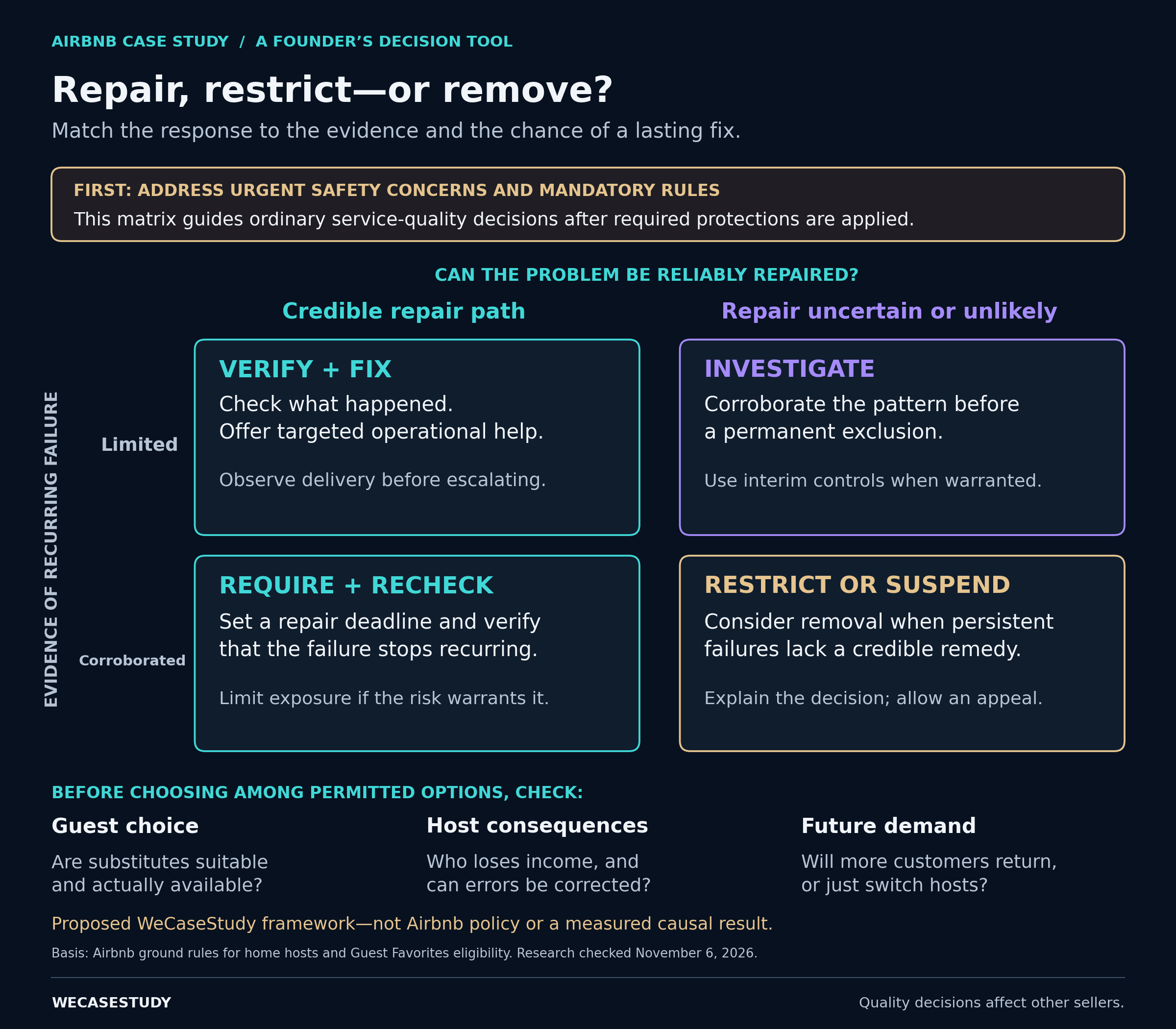
Airbnb’s ground rules describe education, warnings, suspension, removal, and appeals. [14] That range matters. A confusing check-in process may be fixable; repeated serious failures may require exclusion. Treating both problems identically would waste useful supply or expose guests to avoidable harm.
New hosts create another tension. A system that favors extensive evidence can struggle to evaluate a capable newcomer. This is a design risk to investigate, not a demonstrated defect in Airbnb’s current ranking.
For founders, the growth strategy needs two answers: how to raise the quality of existing supply and how to let reliable new supply establish itself.
What Airbnb’s Public Metrics Leave Unanswered
Research supports the existence of quality externalities. The public disclosures examined here do not provide a complete causal account of Airbnb’s later quality program.
Missing evidence | What it would help establish |
|---|---|
Subsequent booking by failure category | Whether cancellations, inaccurate descriptions, and smaller inconveniences have different consequences. |
Bookings with unrelated hosts | Where the wider marketplace gains or loses demand. |
Outcomes after different remedies | Which responses preserve future activity. |
Local alternatives after removal | Whether better average quality comes with materially worse choice. |
New-host progression and appeal outcomes | Whether enforcement preserves entry and corrects errors. |
Airbnb may analyze these questions internally. Their absence from the disclosures reviewed is a limit on outside evaluation.
What Most People Get Wrong
More listings always strengthen network effects. A listing contributes when it improves feasible choice and delivers an experience that supports continued demand.
A refund completes the recovery. It addresses the current transaction. Future behavior determines whether the customer relationship survived. Our Amazon Prime settlement analysis examines a related measurement distinction: initiating a remedy and successfully delivering its value are separate outcomes.
Better reviews settle the quality question. Reviews, operational failures, and repeat activity measure different things. The review experiment shows why improving one information metric need not improve the transaction. [9]
Quality control benefits every good host equally. Benefits can vary with location, substitutability, pricing, and changes in visibility. A better platform average can coexist with losses for particular suppliers.
Removing bad supply guarantees more growth. Exclusion must be compared with repair, reduced exposure, and the alternatives guests can actually book.
The next evidence to watch
An informative update would connect particular interventions to later completed stays, adequate local choice, and outcomes for new and established hosts. Lower contact rates and higher ratings would support that account, but neither would replace it.
The most revealing future disclosure may be how much demand dependable hosts create for other hosts—and whether the platform’s incentives recognize that contribution.
What Marketplace Founders Can Learn From This Airbnb Case Study
The following five frameworks translate the evidence into management decisions. They are our analytical tools, not proprietary Airbnb systems or experimentally validated laws.
The Transferable Business Playbook
1. The next booking test
Evaluate a seller’s current contribution alongside customers’ later activity across the platform. The evidence on reputational externalities gives a reason to examine both. [4]
Record completed transactions, servicing costs, prior customer activity, and subsequent purchases. Separate returns to the same seller from purchases from unrelated sellers. Compare similar cohorts before treating differences as seller effects.
Decision: Should this seller receive more exposure or operational help? A high-volume seller with weak adjusted repeat behavior deserves investigation. The interpretation fails if the difference comes from customer mix, limited availability, or travel frequency rather than the experience.
2. The promise gap
Measure what a badge leads customers to expect, then compare it with delivered reliability. Certification research supports examining expectation changes alongside the ratings themselves. [10]
Before changing a label, ask customers what they believe it guarantees. Afterward, track failure categories, disappointment, and subsequent activity. Compare those outcomes with customers seeing the previous presentation where experimentation is appropriate.
Decision: Is a stronger recommendation justified? Revise the promise or improve delivery if the label creates expectations the service cannot consistently meet. A higher click-through rate alone does not validate the change.
3. The removal threshold
Compare keeping, repairing, reducing exposure to, and removing a supplier. Airbnb’s enforcement options provide a concrete example of a policy with several possible responses. [14]
Estimate avoidable failures, substitute availability, lost current contribution, intervention costs, and incremental future contribution over a common horizon. Discount future amounts and use a range of plausible outcomes.
Decision: Which intervention produces the strongest durable improvement? The calculation fails if it treats transferred bookings as newly created demand or ignores suppliers that fill an otherwise unmet need. Serious safety requirements also cannot be reduced to a margin calculation.
4. The proof ladder
Give capable newcomers a route to credibility. Review requirements make evidence accumulation necessary, while the historical incentive experiment shows why generating more reviews is insufficient on its own. [8,9]
Start with accurate descriptions and operational checks. Allow suitable initial exposure, observe early delivery, and expand as dependable evidence accumulates. Track time to first booking, failure rates, progression, and erroneous exclusions against comparable new sellers.
Decision: Can the platform learn about new supply without treating a short history as poor performance? The design fails if established sellers keep receiving exposure simply because newcomers cannot generate the evidence required to compete.
5. The recovery test
Evaluate support by what happens after resolution. Airbnb’s policy identifies remedy categories; it does not establish which response best preserves future demand. [12]
Record issue severity, response time, remedy, resolution, and later activity. Compare additional permissible assistance while preserving required protections. Keep customers who return to the original supplier separate from those who try someone else.
Decision: Is a more effective remedy worth its cost? A closed ticket is an operational milestone. The retention hypothesis weakens if satisfaction improves but subsequent behavior remains unchanged after reasonable adjustment.
A worked decision with a break-even threshold
Suppose an intervention costs $20,000, forgoes $15,000 in current contribution, and avoids $5,000 in failure costs. If an additional retained customer generates $100 in expected future contribution over the chosen horizon, it needs 300 incremental retained customers to break even:
($20,000 + $15,000 − $5,000) ÷ $100 = 300.
These are hypothetical inputs, not Airbnb results. The $100 excludes the current transaction and incorporates expected future servicing costs. Customers merely moving between hosts do not automatically count as incremental retention.
Now test uncertainty. At $50 per retained customer, the threshold doubles to 600. At $150, it falls to 200. The practical task is to establish whether the intervention plausibly clears that range, rather than select the most attractive assumption.
How to run the measurement
Choose completed bookings or contribution as the outcome and allow enough time for the category’s repeat cycle. Identify which sellers receive later transactions. For suitable ranking or assistance changes, experiments can help separate causation from customer selection.
Marketplaces complicate experiments because sellers compete for limited exposure and homes have limited capacity. A treatment can change what remains available to untreated customers. Check these spillovers, consider market-level designs, and inspect total demand alongside individual seller gains.
When using observational comparisons, state the assumptions and adjust for prior activity, destination, season, price, and trip type. Record stated trust separately from actual bookings: neither alone proves the psychological mechanism.
Lessons for Entrepreneurs
Use this 25-point audit to turn the five frameworks into operating decisions. Each row identifies a different source of error.
Decision | Five checks before acting |
|---|---|
Define the economics | 1. Separate platform revenue from booking value. 2. Check the current fee structure. 3. Match supply to dates and trip requirements. 4. Separate removed listings from distinct hosts. 5. Record the denominator behind each quality rate. |
Follow the customer | 6. Separate same-host from unrelated-host returns. 7. Record prior booking activity. 8. Follow completed trips over a realistic horizon. 9. Check seasonality, price, and availability. 10. Compare remedies within similar failure categories. |
Test the information | 11. Define what a badge implies. 12. Distinguish property-level from host-level recognition. 13. Treat missing reviews as missing evidence. 14. Test resulting matches, not review volume alone. 15. Give newcomers a measurable route to credibility. |
Govern the intervention | 16. Separate repairable defects from serious violations. 17. Set a deadline and verification for repairs. 18. Check the suitability of substitutes. 19. Track appeals and erroneous exclusions. 20. Apply required protections before comparing margins. |
Evaluate the result | 21. Separate shifted bookings from preserved demand. 22. Include future servicing costs and discounting. 23. Record losses borne by affected hosts. 24. Check effects on comparison groups. 25. Specify what evidence would reverse the decision. |
Frequently Asked Questions
What does this Airbnb case study show?
Airbnb’s independent hosts can affect one another’s future demand through shared platform reputation. Evaluating a seller therefore requires attention to the stay delivered, later customer behavior, and the costs and benefits distributed to other participants.
How does Airbnb make money?
Airbnb earns booking service fees. Its current guidance describes a transition toward a single host-paid fee structure; most hosts on that structure pay 15.5%, with exceptions. [3]
Does one bad stay reduce other hosts’ bookings by 29%?
No. The research estimate compares subsequent trip counts after listings with different Guest Return Propensity. It is not a loss rate for one bad stay. [5]
Why did Airbnb remove more than 400,000 listings?
Its dated quality report said they failed its quality standards. The count covered April 2023–November 2024, and a subsequent Q2 2025 disclosure reported more than 500,000 removals. [6,7]
Can Airbnb measure reputation damage precisely?
It can estimate effects using behavioral data and credible comparisons. Each missing booking’s cause remains unobservable individually; conclusions depend on design, assumptions, and the time horizon.
Final Takeaways
1. Distributed delivery makes common quality standards economically important.
2. Useful variety depends on the particular trip.
3. Sellers can create demand they never personally capture.
4. Seller revenue can omit costs imposed on others.
5. Collecting information and improving decisions require separate tests.
6. Recommendations change expectations as well as visibility.
7. Enforcement redistributes opportunity and needs error correction.
8. Reliable newcomers need a path to evidence.
9. Recovery can influence the platform relationship after a host fails.
10. Growth evaluation must distinguish current activity from future demand.
The next booking might belong to someone the original host will never meet. A marketplace that measures only who earned today’s fee will miss part of the reason tomorrow’s customer arrives—or never comes back.