

How Does Vinted Make Money? Revenue Streams, Incentives and Business lessons
Vinted makes money without charging ordinary US sellers a standard sales commission. Its clearest US revenue mechanism is the mandatory Vinted fee paid by buyer...

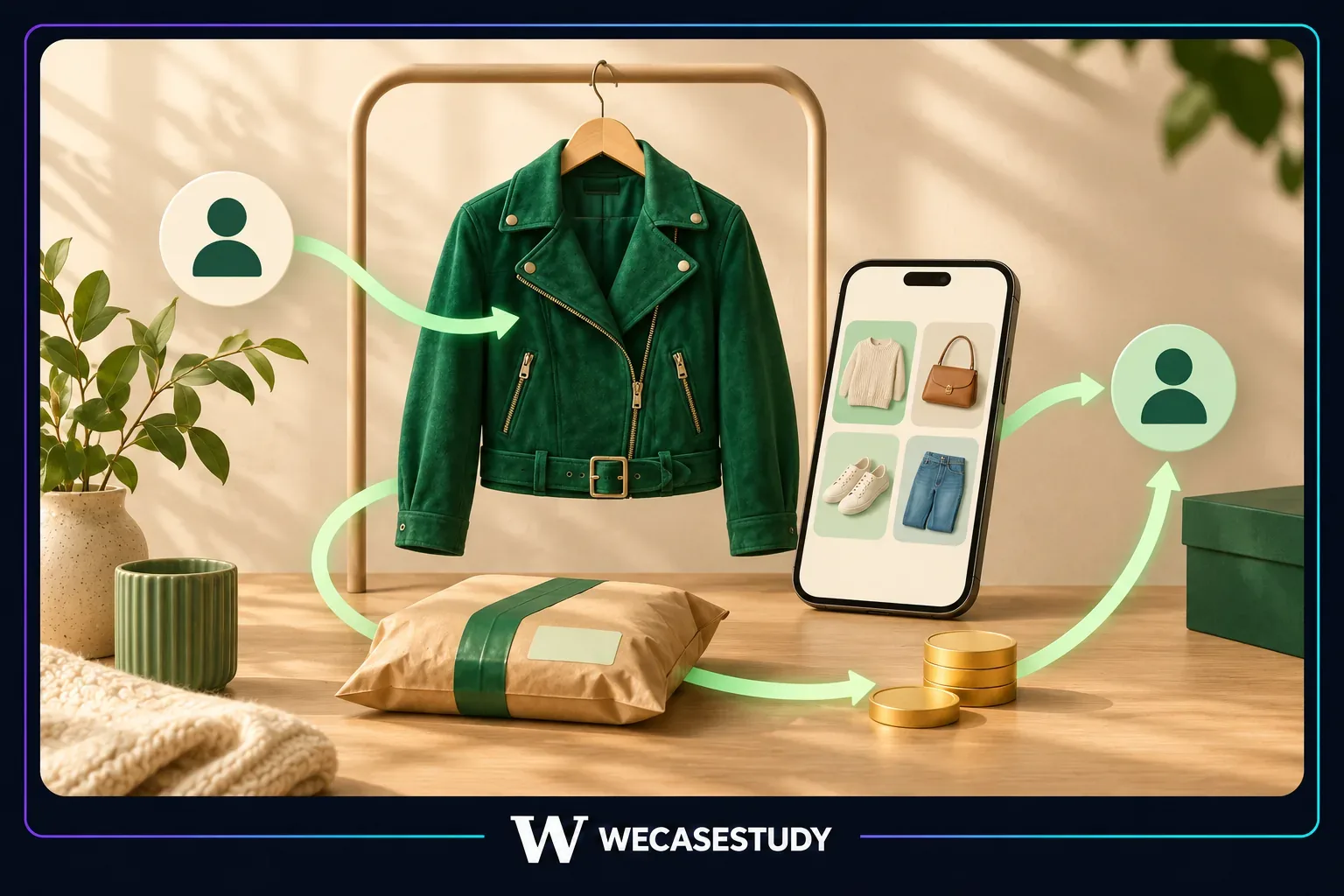
Vinted makes money without charging ordinary US sellers a standard sales commission. Its clearest US revenue mechanism is the mandatory Vinted fee paid by buyers at checkout, usually 5% of the item or bundle price plus $0.70. Sellers can also buy optional listing Bumps. Beyond the marketplace, Vinted Group earns advertising revenue and is building logistics and payment businesses. That model has scaled: Vinted reported €1.1 billion in 2025 revenue and €62 million in net profit.
How Does Vinted Make Money? Revenue at a Glance
Revenue source | Who pays? | Mandatory? | US availability | What is known |
Vinted fee | Buyer | Yes on Buy Now orders | Yes | Usually 5% + $0.70; exact fee can vary |
Listing Bumps | Seller | No | Yes | Price varies by item, duration, and scope |
Advertising | Advertisers | No | Commercial service exists | Financial contribution is not separately disclosed in Vinted's headline results |
Shipping / Vinted Go | Buyer and logistics customers | Transaction-dependent | US shipping exists; Vinted Go is broader group infrastructure | Buyers pay shipping; no standard US per-label profit margin is published |
Verification services | Buyer | No | Not currently listed as a US service | Available only in selected markets |
Vinted Pro | Professional sellers/buyers | Regional | Not currently available in the US | Pro seller access is available only in supported markets |
Vinted Pay belongs in a different bucket. It is payment infrastructure designed partly to improve efficiency and reduce dependence on outside providers, rather than a revenue stream Vinted currently breaks out as a material standalone line.
For company history, ownership context, and a broader overview of the platform, see WeCaseStudy's Vinted company profile.
Vinted's Business Model Explained
How Vinted Works
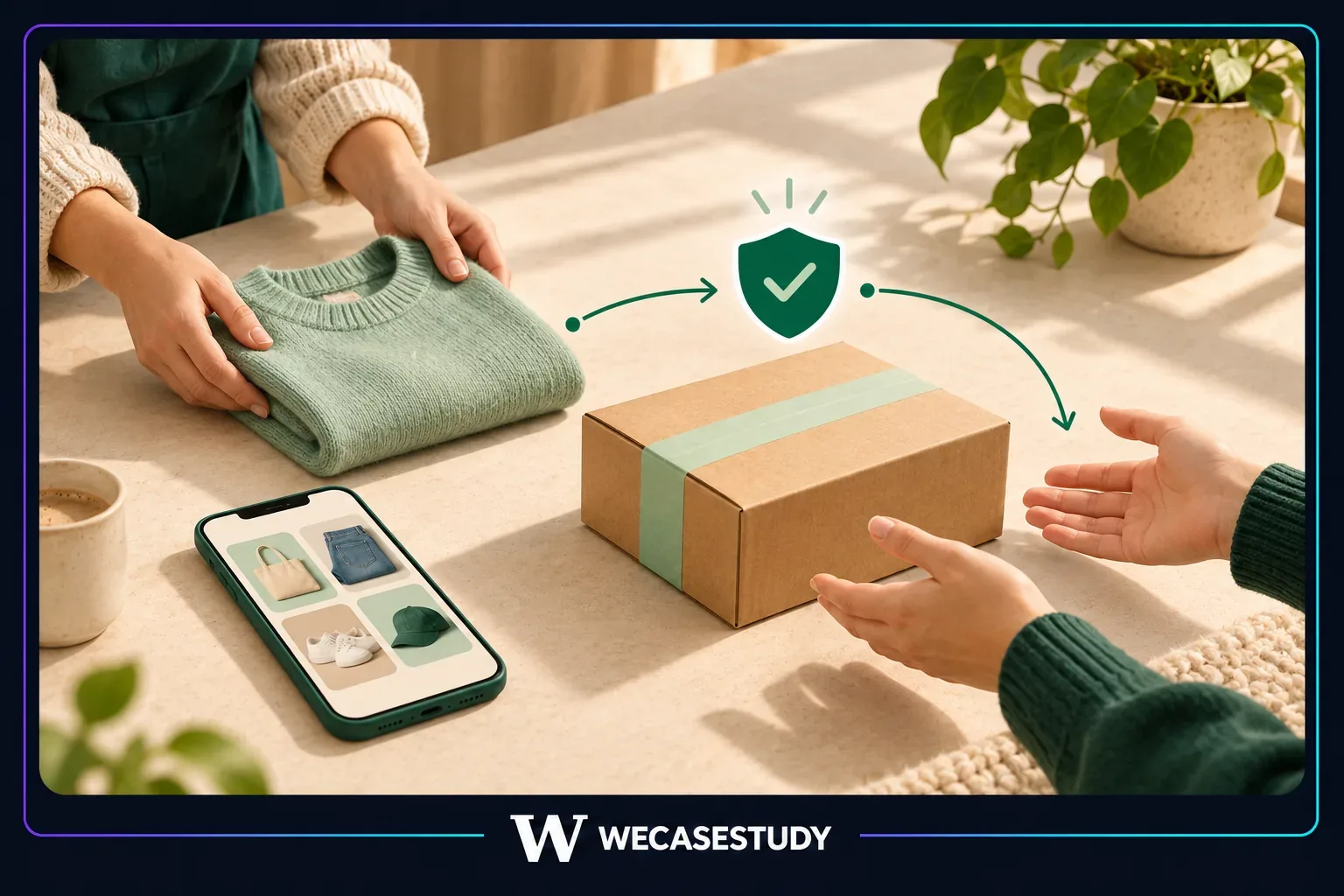
Vinted is a consumer-to-consumer, or C2C, marketplace for secondhand goods. A seller lists an item, a buyer finds it, Vinted facilitates checkout and payment, and the item is shipped using an available delivery method.
In the US, the buyer pays the item price, shipping, the Vinted fee, and any optional services that apply.
That makes Vinted a two-sided marketplace: sellers create supply and buyers create demand. Efficient matching between them is called marketplace liquidity.
The Business Model Pivot
Vinted did not always have today's monetization structure. Marketplace CEO Adam Jay has described the removal of seller fees as a major pivot in the company's development.
The logic was practical: a casual seller deciding whether to list a low-value shirt has less incentive to participate if the platform takes a meaningful cut.
Removing the standard seller commission did not make Vinted free as a business. It changed who pays. Buyers became the side charged a mandatory platform fee, while sellers could still spend voluntarily on visibility. Commission removal should not be treated as the sole cause of Vinted's growth, but it clearly changed the incentives on the supply side.
Why Free Selling Drives Marketplace Growth
The strategic flywheel is:
Free standard selling → lower seller friction → more potential inventory → greater buyer selection → more transactions → more monetization opportunities → more investment in marketplace infrastructure.
It is not automatic. Inventory quality, pricing, trust, buyer demand, shipping, and transaction completion still determine whether extra supply creates useful liquidity.
Vinted itself describes a similar dynamic: when sellers sell faster and buyers find what they want more easily, additional participation can make the marketplace more useful.
For a related platform example, WeCaseStudy's Airbnb case study shows how supply quality can influence marketplace demand.
How Vinted Generates Revenue
Buyer Protection and the Vinted Fee
The Vinted fee is the clearest answer to how does Vinted earn money in the US.
Vinted's current price list says the mandatory fee is paid by buyers on Buy Now orders and usually consists of 5% of the item or bundle price plus $0.70. The exact amount can vary with the item, order value, and whether the purchase is a single item or bundle.
Older articles may call this the Vinted Buyer Protection fee. Current US documentation uses the term Vinted fee.
The fee helps support platform operations, transaction tools, member support, and refund protections for qualifying purchases.
Paid Listing Promotions
US sellers can optionally buy Bumps, which increase an item's visibility in feeds and search for three or seven days, or until the item sells.
The price is shown before payment and varies with factors including item price, duration, and territorial scope.
Bumps monetize seller urgency rather than every seller transaction. That distinction is central to Vinted's monetization strategy: the basic supply side remains low-friction, while sellers who value extra exposure can pay for it.
Advertising and Other Verified Services
Vinted operates an official advertising business for commercial partners. Its advertising page actively invites brands and advertisers to work with the platform.
Filed Vinted accounts have also identified advertising services as a separate revenue category. For 2024, the accounts reported €33.1 million in advertising revenue alongside €780.3 million in marketplace-services revenue.
Other paid services are regional.
Item Verification is a buyer-paid service for eligible designer goods in selected European markets, but the current official page does not list the US among supported markets.
Vinted Pro serves professional sellers in supported European markets. It is currently unavailable to US professional sellers, and Vinted's US help documentation says commercial selling through standard accounts is not permitted.
Those services should therefore not be presented as current US revenue mechanisms.
Shipping and Vinted Go
US buyers normally pay shipping and choose from available delivery options at checkout. Vinted then supplies the seller with a prepaid label or digital code for integrated shipping.
A shipping charge paid by the buyer is not automatically Vinted profit. Public US documentation does not disclose a standard per-label margin Vinted keeps.
At group level, shipping is strategically important through Vinted Go. During 2025, Vinted expanded Vinted Go carrier operations and began testing delivery services for external clients.
That creates potential logistics revenue while also giving Vinted more control over delivery reliability and transaction costs.
Vinted Pay and Payment Infrastructure
Vinted Pay is the group's dedicated payments business. Its wallet began rolling out in selected European markets in January 2026.
Vinted says moving more activity onto its own payment infrastructure should eventually reduce payment-related costs and dependencies.
Lower processing costs can improve margins even without creating a new visible fee.
In the US, Vinted's terms still identify regulated third-party payment providers for relevant payment and wallet functions, so Vinted Pay should not be described as the processor behind every US transaction.
How Much Does Vinted Make From a Single Sale?
Consider a $50 US purchase using Vinted's usual 5% + $0.70 formula. Assume $4 shipping purely for illustration and exclude taxes and optional services.
Transaction component | Amount |
Item price | $50.00 |
Illustrative Vinted fee | $3.20 |
Assumed shipping cost | $4.00 |
Total paid by buyer | $57.20 |
Seller receives | $50.00 |
The $3.20 platform fee is not Vinted's net profit. Vinted still has payment, support, safety, technology, marketing, and other operating costs.
The $4 shipping charge should not automatically be counted as Vinted revenue or profit either.
The fixed $0.70 component also matters more on cheap items. Using the usual formula, a $10 item carries a $1.20 fee—12% of the item price—while a $100 item produces a $5.70 fee, or 5.7%.
That makes very low-value transactions particularly sensitive to checkout costs.
An interactive calculator allowing readers to enter an item price and shipping cost would add useful functionality to this page.
How Much Money Does Vinted Make?
Vinted's Revenue and Financial Performance
Vinted Group's latest annual results show rapid growth alongside substantial reinvestment.
Financial metric | 2023 | 2024 | 2025 |
Revenue | €596.3M | €813.4M | €1.1B |
YoY revenue growth | 61% | 36% | 38% |
Net profit | €17.8M | €76.7M | €62M |
Approx. net profit margin | 3.0% | 9.4% | 5.6% |
Marketplace GMV | Not disclosed in cited release | €7.3B | €10.8B |
Adjusted EBITDA | €76.6M | €159M | €151M |
The 2023 figures come from Vinted's first profitability announcement; 2024 and 2025 figures come from subsequent official annual-results releases.
The net profit margins above are calculations from reported revenue and profit figures. The 2025 margin is approximate because headline revenue is rounded to €1.1 billion.
GMV, or gross merchandise value, is the value of goods traded through the marketplace. Revenue is what Vinted Group recognizes as income. Net profit is earnings left after expenses. Adjusted EBITDA is an operating-performance measure before certain costs and accounting items.
Dividing €1.1 billion of 2025 group revenue by €10.8 billion of GMV gives roughly 10%. That is not Vinted's disclosed marketplace take rate. Group revenue covers multiple activities, while GMV measures merchandise traded, so the two numbers do not represent one single fee.
Is Vinted Profitable?
Yes.
Vinted first reported annual net profitability for 2023, earning €17.8 million. Profit rose to €76.7 million in 2024 before falling to €62 million in 2025.
Revenue still increased 38% in 2025.
Vinted attributed the lower profit to investments including Germany, additional marketplace categories, Vinted Go expansion, and the rollout of Vinted Pay's wallet.
Vinted's Company Valuation
In April 2026, a secondary share transaction valued Vinted at €8 billion in equity.
That does not mean Vinted earned €8 billion.
A valuation reflects what investors valued the company's equity at in that transaction. Revenue measures annual income, while net profit measures earnings after expenses.
Vinted vs. Depop, eBay, and Poshmark
US resale marketplaces place fees on different sides of the transaction.
Platform | Standard US seller fee | Buyer platform fee | Payment processing | Optional promotion | Main model |
Vinted | No standard seller sales commission | Usually 5% + $0.70; variable | No separate ordinary seller processing fee listed | Bumps | Buyer-funded platform fee |
Depop | No Depop selling fee | Up to 5% + up to $1 | Seller pays 3.3% + $0.45 | Boosted Listings; 12% for applicable new US listings | Buyer fee + seller processing |
eBay | Final value fee; 13.6% for most categories up to the applicable threshold, with exceptions | No comparable standard buyer platform fee | Included within eBay's fee system | Promoted Listings and upgrades | Primarily seller-funded |
Poshmark | $2.95 under $15; 20% on sales of $15+ | No comparable core buyer marketplace fee | Included within commission model | Seller promotional tools | Seller commission |
These figures come from the platforms' current official US fee documentation. eBay rates vary significantly by category and seller setup, so its 13.6% figure should be read as the current rate for most standard categories, not every transaction.
This is why Vinted vs Depop fees or Vinted vs eBay fees cannot be reduced to one percentage. Vinted's competitive difference is where it places its mandatory platform charge: it protects ordinary seller proceeds while increasing the buyer's checkout cost.
For another example of a platform that must balance both sides of a marketplace, see WeCaseStudy's Airbnb company profile.
Why Vinted's Business Model Works
Vinted's model aligns incentives around supply. Casual sellers can list without worrying about a standard commission reducing their proceeds, while Vinted earns when buyers transact and when some sellers choose extra visibility.
Useful supply can attract demand, while stronger demand can improve sellers' chance of completing a sale. At scale, Vinted can justify deeper investment in logistics, payments, support, and trust systems.
The competitive advantage is not simply “zero seller fees.” A new marketplace can copy that policy overnight; it cannot instantly copy Vinted's buyer demand, transaction volume, brand, trust systems, shipping relationships, or payment infrastructure.
Risks and Challenges of Vinted's Business Model
Vinted's model has real tradeoffs.
Buyers may resist platform fees, especially on inexpensive products where the fixed component represents a larger percentage of the item price. Fraud, counterfeit goods, disputes, refunds, and customer support also create costs for a C2C marketplace. Vinted maintains authenticity and enforcement policies specifically to manage counterfeit risk.
Competition adds pressure because Depop, eBay, Poshmark, and other resale marketplaces can change their pricing models.
Vertical integration creates another challenge. Logistics requires capital and operational execution, while payment infrastructure brings technical and regulatory complexity.
Vinted has reported positive net profit for three consecutive years, but it still has to balance buyer costs, trust, transaction growth, and infrastructure spending.
What Entrepreneurs Can Learn From Vinted
Vinted offers several specific marketplace lessons.
First, identify which side creates the scarce resource. If supply is difficult to acquire, taxing suppliers heavily can work against marketplace liquidity.
Second, optional promotion only becomes valuable when buyer demand is strong enough that extra visibility is worth paying for.
Third, transaction growth is not the same as profitability. A marketplace still needs enough revenue to cover payments, support, trust, marketing, and technology.
Founders should be more cautious about copying Vinted Go or Vinted Pay. Early-stage startups rarely need proprietary logistics or regulated payment infrastructure before establishing marketplace liquidity.
The transferable lesson is not simply “make selling free.” It is to place monetization where it causes the least damage to the marketplace's ability to match buyers and sellers.
Frequently Asked Questions
How does Vinted make money if selling is free?
Vinted charges US buyers a mandatory platform fee on Buy Now purchases, usually 5% + $0.70. Sellers can optionally pay for Bumps, while Vinted Group also earns advertising revenue and operates logistics and payment businesses.
Does Vinted take a cut of every sale?
Vinted's current US price list does not show a standard sales commission deducted from ordinary sellers. Buyers instead pay the Vinted fee, while sellers may purchase optional services such as Bumps.
Does Vinted make money when an item doesn't sell?
A seller can pay for a Bump even if the item ultimately does not sell. Vinted does not list a standard US listing fee for ordinary sellers.
How much does it cost to bump an item on Vinted?
There is no single published flat US price. Vinted says the Bump price depends on factors including item price, the three- or seven-day duration, and territorial scope. The amount is shown before payment.
Who pays for shipping on Vinted?
For standard integrated US shipping, the buyer pays at checkout and the seller receives the prepaid shipping label or digital code.
Is Vinted really free for sellers?
Ordinary US sellers do not pay a standard sales commission, but “free” needs qualification. Sellers can buy optional promotional services, and professional-selling rules and services vary between markets.
Conclusion
Vinted makes money by keeping ordinary seller-side transaction friction low and monetizing other parts of its marketplace. US buyers pay the mandatory Vinted fee, sellers can purchase optional visibility, and Vinted Group also earns from advertising while investing in logistics and payments. Its revenue growth and three consecutive profitable years show that the model can work at scale. The deeper lesson is marketplace design: Vinted protects the supply side while building monetization around transactions, demand, and supporting infrastructure.
Research methodology: This case study was checked against Vinted's current US price list, terms and help pages; Vinted Group financial announcements; Vinted company filings; and the current official US fee documentation of Depop, eBay, and Poshmark. Calculated figures are identified as approximate or illustrative, and regional services are separated because Vinted's products and fees vary by country.