Asch Conformity Experiment: Results and Business Case Study
The Asch conformity experiment reveals how group pressure shapes public judgment. Explore its results, limitations, a real fake-review case and practical tools for business decisions.


The Asch conformity experiment tested whether people would publicly follow an obviously wrong majority when judging line lengths. It showed that agreement can reflect social pressure as well as independent judgment. For businesses, the central lesson is to examine how consensus was formed before using it to justify a decision.
Imagine a meeting where everyone endorses a product launch. Perhaps each person checked the evidence. Perhaps everyone deferred to the same confident executive. The minutes would look identical. The quality of the decision would be very different.
This case study connects Asch’s research with a modern replication, the FTC’s Sunday Riley fake-review case, and eight practical frameworks for leadership and marketing. Its central argument is simple: a business can lose access to useful information when agreement becomes easier to reward than independent evaluation.
What Is the Asch Conformity Experiment?
Social psychologist Solomon Asch began reporting his line-judgment studies in 1951. A participant heard other apparent participants select a comparison line that visibly failed to match a reference. Those others were working with the experimenter. Their scripted agreement created a conflict between what the participant could see and what the room publicly endorsed.
Asch’s 1955 account, Opinions and Social Pressure, examines independence alongside conformity. That balance matters. A study showing that people sometimes yield is different from evidence that they always surrender their judgment.
The business application begins with a diagnostic question: did people reach the same answer separately, learn from one another’s evidence, or simply discover which answer was safest to express?
How Did Solomon Asch Conduct His Conformity Experiment?
The Solomon Asch experiment used a reference line and three comparison lines. One comparison matched; the others differed clearly. The real participant answered aloud near the end of the group, after hearing the others. In the series described in 1955, the group gave the same incorrect response on 12 of 18 trials.
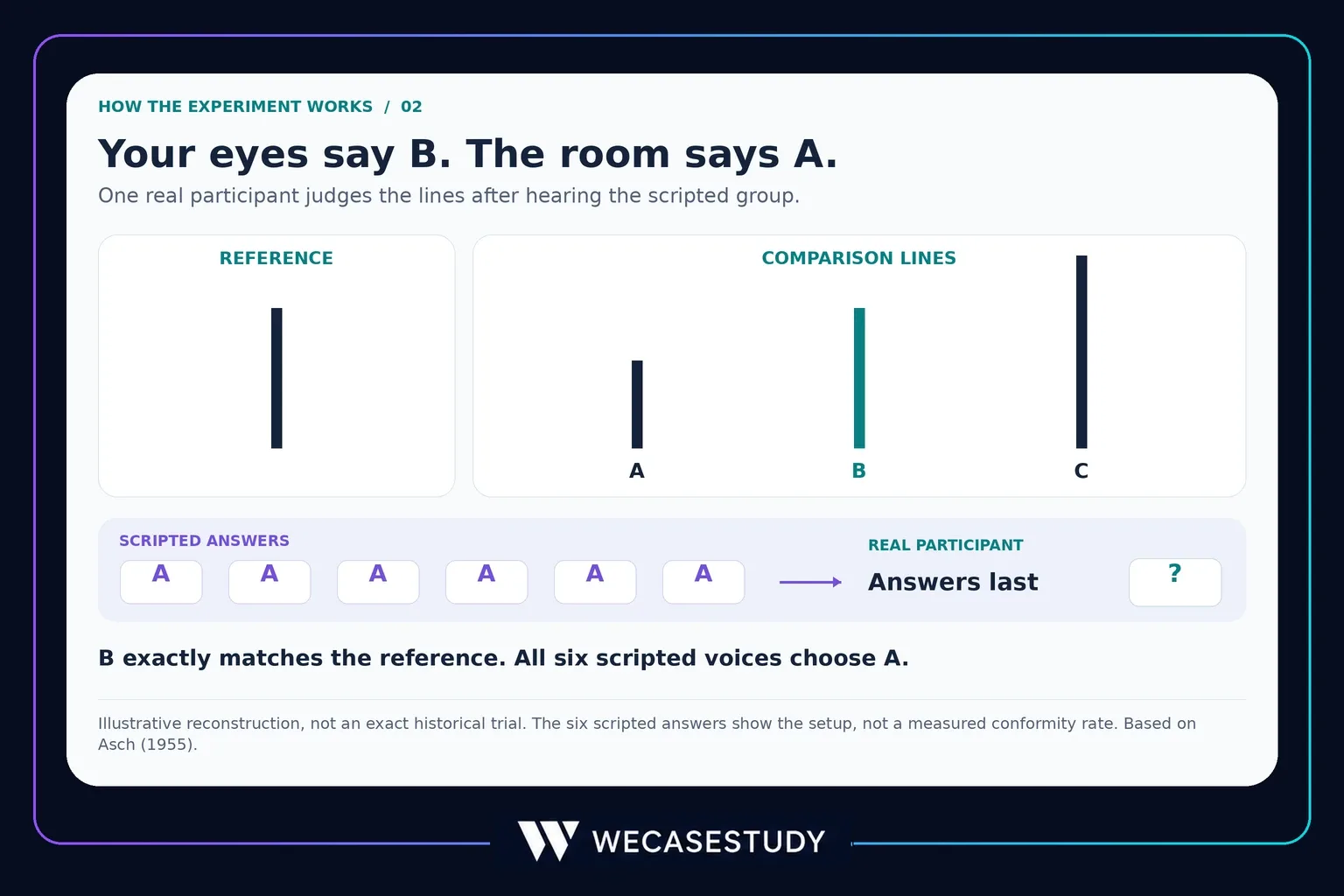 Illustrative reconstruction: B matches the reference exactly, but six scripted voices choose A. Their answers depict the setup, not a measured conformity rate.
The Solomon Asch conformity experiment was powerful because the visual task required little specialized knowledge. With a difficult question, agreement might reasonably suggest that others possessed useful information. Here, the majority’s answer directly conflicted with an ordinarily easy observation.
For a business reader, this separates two problems that meetings often mix together: uncertainty about the facts and reluctance to contradict people. Better data addresses the first. It may leave the second intact.
Asch Conformity Experiment Results: What Did the Study Find?
In the 1955 account’s series of 123 participants, 36.8% of critical responses followed the wrong majority. Ordinary line-matching errors were below 1%. About one-quarter of participants never yielded. The first two figures describe answers; the third describes people.
| Measure | Reported finding | Interpretation |
|---|---|---|
| Errors without misleading peers | Below 1% | The task was usually straightforward. |
| Majority-aligned errors on critical trials | 36.8% | Social pressure changed some public responses. |
| Participants who never yielded | About 25% | Individuals differed substantially. |
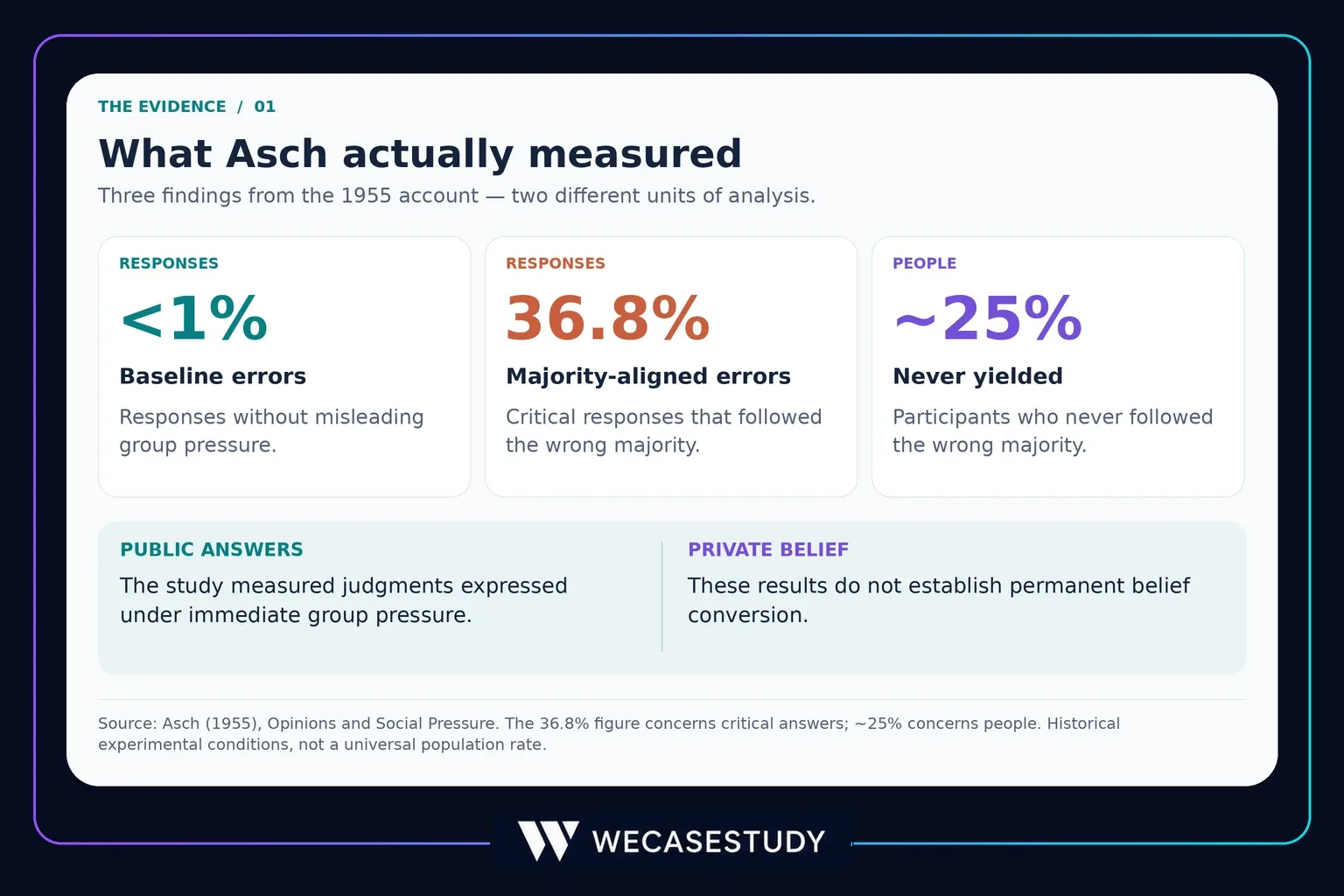 Asch’s 1955 findings use different units: responses for error rates and people for those who never yielded. The experiment did not establish lasting private belief change.
These are findings from particular experimental conditions. The 36.8% result cannot predict how many employees will approve a flawed strategy, how many customers will trust a review, or how many people will permanently adopt a false belief.
Which factors affected conformity?
Asch varied the majority’s size and unanimity. The effect did not rise indefinitely as the crowd grew. Introducing a partner who broke the incorrect consensus substantially reduced yielding. The practical lesson is that the structure of agreement can matter more than the number of agreeing voices.
That suggests a useful distinction for leaders: adding another person who repeats the preferred answer may contribute less than creating space for one independent assessment. This is a management inference, not a measured estimate of workplace performance.
Does the effect still appear in modern research?
Axel Franzen and Sebastian Mader’s 2023 replication and extension recruited 210 participants. They reported 33% errors in the standard line condition and 25% in an incentivized condition. Paying for correct answers reduced the effect without eliminating it.
Their political-opinion task requires a separate interpretation. Across five questions, the average difference in the share answering “yes” between groups hearing opposing scripted answers was 38 percentage points. It was not a count showing that 38% of individuals permanently changed their political beliefs.
The replication supports the continuing relevance of social influence, but its design and sample differ from Asch’s original series. Comparing 33% with 36.8% does not establish a historical trend. For managers, the useful inference is narrower: rewards for accuracy and protection for independent judgment address different parts of a decision process.
Strengths, Limitations and Ethics of the Asch Conformity Experiment
The Asch conformity study’s strength is its controlled conflict between clear perceptual information and a misleading group. Its simplicity makes the mechanism visible. That same simplicity limits how far the result can travel.
Sample limits: Asch’s account describes young male college students. It cannot establish a universal conformity rate across ages, cultures, occupations or genders.
Setting limits: A brief laboratory judgment differs from a board decision with deadlines, expertise, accountability and continuing relationships.
Measurement limits: Public answers and participants’ explanations help interpret behavior, but do not establish durable private belief change.
Interpretation limits: A wrong answer may reflect deference, doubt or an attempt to avoid social discomfort. One behavioral measure need not have one psychological cause.
Deception and discomfort also raise ethical questions. The participant did not initially know that the apparent peers were cooperating with the researcher. Today, the APA Ethics Code’s research standards require justification for deception, consideration of effective alternatives and appropriate debriefing. Deception is not automatically prohibited; its justification and safeguards matter.
A company should therefore transfer the lesson through transparent decision practices, rather than secretly staging pressure tests on staff. Ask for independent judgments openly. Make clear how responses will be used. The point is to improve the information reaching a decision, not to demonstrate who can withstand embarrassment.
Conformity Psychology: Normative vs. Informational Social Influence
Conformity psychology examines how people align their judgments or behavior with a group. Two mechanisms, formalized by Morton Deutsch and Harold Gerard in 1955, help explain why the same visible agreement can hide different motives.
| Mechanism | Underlying question | Business example | Useful response |
|---|---|---|---|
| Normative social influence | What will happen if I disagree? | A manager supports the CEO’s forecast to avoid appearing disloyal. | Protect objections and collect views before the leader speaks. |
| Informational social influence | Do the others know something I do not? | A buyer assumes a popular tool has already been independently tested. | Expose the original evidence and allow direct testing. |
Normative social influence: the cost of standing apart
Normative social influence means aligning with a group to gain acceptance or avoid disapproval. Someone can privately doubt a forecast while publicly supporting it. A leader’s invitation to “speak freely” has limited value if people expect a penalty for doing so. The useful test is what happens after a substantiated objection: is it investigated, ignored or treated as disloyalty?
Informational social influence: treating others as evidence
Informational social influence occurs when people use others’ judgments as evidence about what is correct, particularly under uncertainty. A junior engineer may reasonably defer to experienced colleagues. Give that engineer access to the tests and assumptions behind their conclusion. Encouragement alone cannot resolve an information gap, and another dashboard cannot remove a social penalty.
Both mechanisms can operate at once. The business needs to make evidence accessible and disagreement usable, rather than assuming one intervention will solve every kind of conformity.
Social Conformity: When Agreement Stops Adding Evidence
Consulting others is often sensible. Customers cannot test every product, and executives cannot personally verify every forecast. Social conformity becomes a problem when the apparent breadth of agreement conceals a narrow evidence base.
Consider four reviews of a software platform. In one scenario, four teams run separate tests and report similar findings. In another, four publishers reproduce the same vendor benchmark. The audience sees four endorsements in both cases. Only the first adds four independently formed assessments.
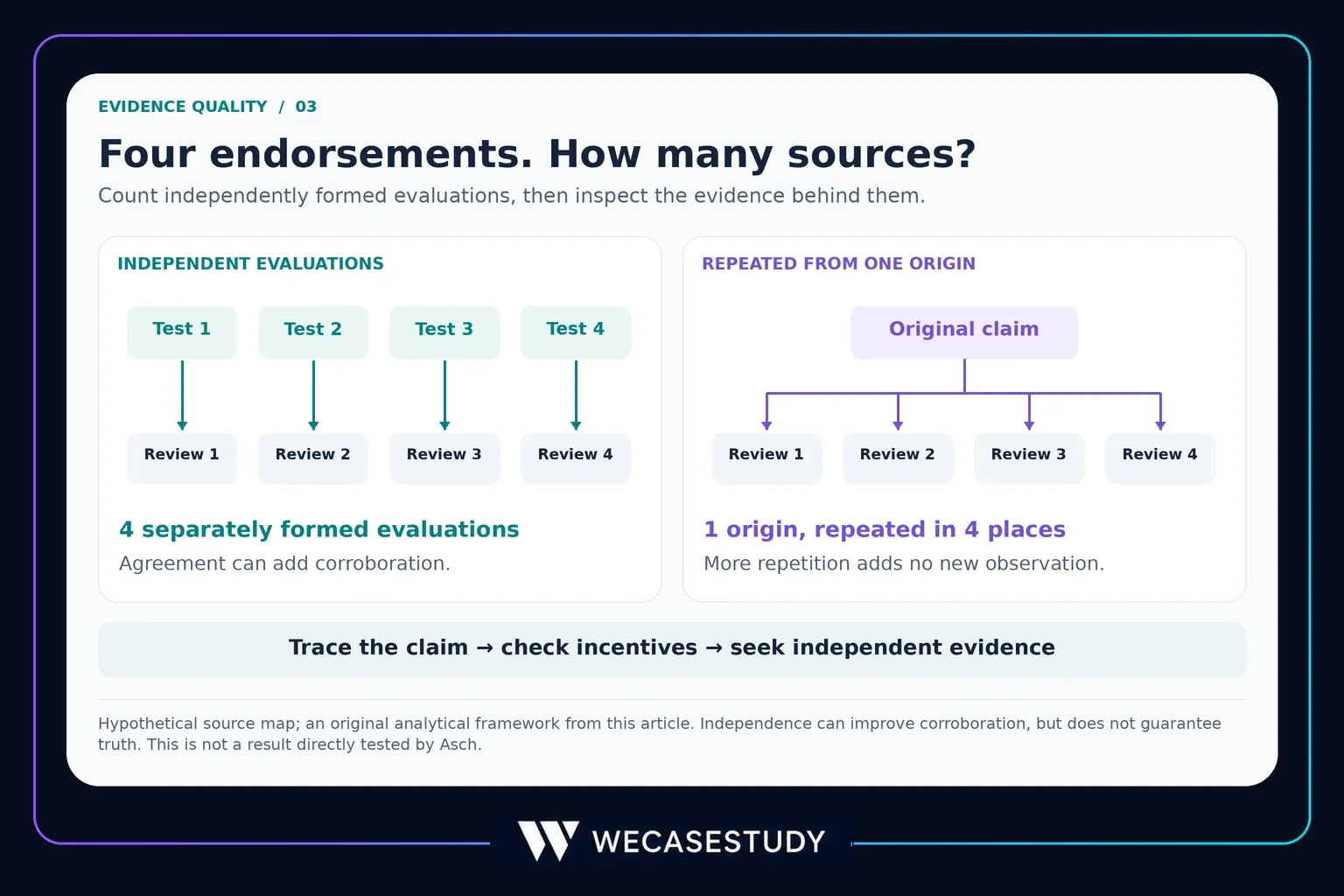 The Independent-Source Test: a hypothetical comparison of independent evaluations and repetition from one origin. Independence adds potential corroboration, not a guarantee of truth.
A commercial relationship adds another question, but does not settle it. An affiliate can conduct original testing; an unpaid reviewer can simply copy a press release. Independence depends on how the conclusion was formed, as well as who funded the work.
This is the article’s first strategic principle: count evidence origins before counting endorsements. Agreement deserves greater weight when it rests on separate, relevant and well-conducted evaluations. Independence alone still cannot rescue poor methods or irrelevant tests.
Propaganda Techniques and Manufactured Consensus: What Asch Can Explain
Some propaganda techniques exploit apparent unanimity: repeated endorsements suggest that a position is already accepted, making doubt feel isolated. Asch helps explain the pressure of that situation. He did not test online networks, long-running campaigns or irreversible ideological conversion.
Diffusion research supplies a different piece of the explanation. Soroush Vosoughi, Deb Roy and Sinan Aral studied roughly 126,000 verified true and false stories shared on Twitter from 2006 to 2017. False stories traveled farther and faster in that dataset. Bots accelerated both categories at comparable rates, making human sharing important to the observed difference. See the MIT research overview.
A five-stage apparent-consensus cascade
Visibility: Repeated claims attract attention.
Inferred endorsement: Observers assume many others have accepted them.
Suppressed hesitation: Some people become less willing to question the apparent majority.
Voluntary repetition: Independent participants may share the claims for their own reasons.
Feedback: Later audiences encounter an even larger chorus.
This is an analytical model connecting distinct mechanisms, not a sequence proven by one experiment. A claim can attract attention without creating belief, and people can repeat it while criticizing it. Investigations must distinguish exposure, endorsement and behavior.
That distinction changes the response. Removing the original deceptive accounts may leave downstream misunderstandings intact. A correction needs to reach the communities that adopted the message and explain what evidence has changed.
The Bandwagon Effect and Social Proof Psychology in Marketing
The bandwagon effect describes choices influenced by what others appear to choose. Social proof psychology concerns the informational weight people give to others’ behavior. Both can reduce search costs, but visible popularity can also make an early advantage look like settled evidence of quality.
In a 2006 artificial music market, Matthew Salganik, Peter Dodds and Duncan Watts studied 14,341 participants choosing unfamiliar songs. Stronger social influence increased both inequality and unpredictability of success. Quality mattered, but did not completely determine which songs prospered. The original research abstract sets out the result.
For founders, that means traction contains at least two questions: is the product satisfying customers, and is visible momentum affecting discovery? A campaign can improve the second while leaving the first unresolved. Track retention, refunds, repeat purchases and support problems alongside reach and conversion.
Authentic customer stories make uncertainty easier to resolve. Disclosed commercial relationships, reproducible product tests and visible limitations make that evidence inspectable. A five-star rating without its provenance may communicate enthusiasm while revealing little about why the product deserves it.
Business Case Study: Sunday Riley’s Fake Sephora Reviews
The FTC’s Sunday Riley case provides a documented example of a company attempting to make its own praise appear independent. It connects the laboratory’s question about apparent consensus to a commercial information channel.
The documented conduct and resolution
According to the FTC, managers at Sunday Riley Modern Skincare, including its CEO, posted product reviews through undisclosed employee accounts on Sephora between November 2015 and August 2017, and asked other employees to participate.
The agency’s November 2020 final consent agreement announcement describes the allegations and resolution. The order prohibited misrepresentations about reviewer independence and required disclosure of relevant material relationships. The announcement does not measure resulting sales, customer belief changes or long-term brand damage.
The strategic failure: controlling the signal and its apparent origin
A company can legitimately describe its product’s benefits. An independent customer review provides a different kind of information: experience from outside the seller’s control. Disguising employee promotion as customer feedback makes the second channel look stronger without adding a genuinely independent observation.
The managerial risk extends inward. If executives celebrate an inflated rating as evidence of product–market fit, they may allocate budget using a signal their own promotion has contaminated. This is a reasoned possibility, not an outcome established by the FTC case.
That creates a revealing trade-off. Manufactured approval may improve the appearance of customer acceptance while reducing the business’s ability to diagnose actual demand. The firm risks becoming a consumer of its own misleading signal.
A better operating model
Separate promotional testimonials from independent customer feedback. Disclose relevant relationships, retain critical reviews, investigate suspicious patterns and compare sentiment with customer outcomes. The FTC’s consumer-review guidance explains the current US rule, effective October 21, 2024; particular obligations depend on the conduct involved.
A disclosure helps readers assess incentives. It does not automatically make a claim accurate or an evaluation independent. A business still needs evidence that its promises survive ordinary customer use.
Groupthink in Business: The Financial Cost of Easy Agreement
Groupthink describes a wider failure of critical evaluation within a group; conformity describes alignment with perceived norms. The two can overlap when people suppress information that threatens unanimity. Applied to business, the Asch conformity experiment highlights the need to distinguish endorsement from investigation.
Consider an illustrative acquisition committee. The CEO endorses a 12-month integration plan before directors submit forecasts. Several privately expect 24 months, yet the recorded recommendation is unanimous. An apparently aligned board can therefore hide operational disagreement that will resurface after the transaction.
This is also why employee choices deserve attention beyond headline agreement. Our Microsoft buyout-offer case study examines a different setting in which incentives, alternatives and individual decisions matter.
A reproducible review-cost example
Independent review has value when it changes a consequential decision correctly. The following assumptions are hypothetical; none is an estimated effect from Asch’s research.
| Input | Assumption |
|---|---|
| Specified loss a review could prevent | $4,000,000 |
| Review cost | $25,000 |
| Expected cost of delay | $15,000 |
| Total review and delay cost | $40,000 |
Break-even prevention probability = $40,000 ÷ $4,000,000 = 1%. If the review has an assumed 2% chance of preventing that specified loss, its expected net value is (0.02 × $4,000,000) − $40,000 = $40,000. If it could prevent only half the loss, the break-even probability rises to 2%.
This simplified calculation leaves out other benefits and harms. Its purpose is to expose assumptions, not create false precision. Ask whether the reviewer can uncover decision-changing information, whether leaders would act on it and what delay could cost. More meetings without new evidence have no automatic value.
Asch Conformity Experiment: Eight Strategic Frameworks for Business
These frameworks organize the research into management tools. Their originality lies in the synthesis and application; they are not new scientific laws or claims that established psychological mechanisms were discovered here. Each includes a practical test and a boundary on its use.
1. Agreement–Evidence Substitution
The mechanism: A group starts using the existence of agreement as a substitute for examining the underlying claim. Counting supporters feels faster and safer than investigating assumptions. The Asch conformity experiment makes the danger visible: the wrong majority supplied social pressure without supplying better perceptual information.
Business application: Suppose a startup chooses a product category because several competitors recently raised funding. The fundraising becomes “proof” of customer demand, even though the team has not tested willingness to pay. Competitor activity may reveal investor enthusiasm, but the demand question remains open.
Use it: Give every major proposal two columns: direct evidence and social endorsement. For an AI product, distinguish observed customer usage from investor excitement; for an acquisition, distinguish independently tested cash-flow assumptions from advisers repeating management’s plan. Identify which evidence would still exist if the endorsements disappeared.
Boundary: Expert consensus can be highly informative when specialists independently examine strong evidence. The aim is to inspect the basis of agreement. Automatically rejecting the majority would reproduce the same reasoning error in reverse.
2. The Independent-Source Test
The mechanism: Several messages can originate in one evaluation. Publication count then overstates corroboration. The Sunday Riley case illustrates the related danger of interested parties appearing to be independent customers. This is a source-analysis application of the evidence, rather than a variable Asch directly tested.
Business application: A buyer finds five favorable software reviews. Four repeat one vendor benchmark; the fifth runs an original workload. There are two underlying evaluation records to inspect, including the vendor’s, rather than five separate tests. Neither record is necessarily reliable merely because its origin is distinct.
Use it: Record the claim, original evidence, test method, funding relationship and any independent reproduction. Ask whether reviewers used the product themselves. Commercial incentives and source dependence are separate dimensions: a disclosed affiliate may test carefully, while an unpaid publisher may reproduce unsupported claims.
Boundary: Do not turn a count of sources into a confidence score. Four weak tests can be less useful than one rigorous test. Independence improves the opportunity for corroboration; relevance and method determine whether that opportunity becomes knowledge.
3. The Private–Public Judgment Gap
The mechanism: What people endorse publicly can differ from their private assessment. Asch’s participant accounts help explain why an answer should not automatically be read as sincere conviction. For organizations, the unobserved gap can hide risk until execution makes disagreement costly.
Business application: Before an investment meeting, directors independently forecast a two-year integration. After the chair endorses one year, public recommendations shift toward that target. The shift could reflect persuasive new evidence. It could also reflect the social position of the speaker. The meeting record alone cannot distinguish them.
Use it: Capture forecasts and reasoning before discussion, then record what changed and why. Compare explanations, not just the number of people who changed their minds. Protect confidential input where appropriate while keeping decisions accountable to legitimate oversight.
Boundary: The goal is not to freeze initial opinions. A good meeting should change minds when it introduces better information. Treat unexplained convergence as a question to investigate, rather than proof that someone was dishonest or that all alignment is suspect.
4. The First-Dissenter Advantage
The mechanism: A credible objection can make further objections easier to express by breaking apparent unanimity. Asch’s partner variations support the importance of a group’s structure. The business inference is that the first usable challenge may have value beyond its own content.
Business application: An engineering lead hesitates to mention a launch risk after executives express confidence. A colleague asks which reliability test has passed. That concrete question gives the lead a legitimate opening to present contradictory results. The intervention succeeds by improving access to evidence, rather than winning an argument.
Use it: Provide a route for early objections and require a response to substantiated concerns. Rotate an evidence-review role, grant access to the relevant data and record what the review changed. A challenger should be free to support the proposal when the evidence warrants it.
Boundary: Dissent does not establish correctness. Reward the identification and investigation of material evidence, not performative opposition. A ritual devil’s advocate who is routinely ignored may add friction without protecting the decision.
5. The Organic-Amplification Handoff
The mechanism: A message may begin spreading through people who have reasons of their own to repeat it. At that point, explaining its reach solely through the original promoter becomes inadequate. MIT’s diffusion research and the music-market experiment motivate attention to human sharing and visible popularity; neither validates a universal handoff threshold.
Business application: A misleading product claim begins in promotional accounts, then appears in genuine user communities. Some members may have accepted it; others may be asking whether it is true. Counting all mentions as support obscures the distinction that matters for a response.
Use it: Trace early origins, identify communities that adopted the message and classify later repetition by intent. For a legitimate brand, investigate why customers voluntarily recommend the product. For a correction, check whether the updated evidence reaches the downstream groups that encountered the claim.
Boundary: Reach, endorsement, purchase and lasting belief are different outcomes. Avoid presenting a viral pattern as proof of conversion. The framework is a way to organize an investigation, not a numerical target for manufacturing momentum.
6. Consensus Debt
The mechanism: Promotional certainty can outrun demonstrated performance. The resulting gap creates exposure when customers test the promise. “Consensus Debt” is a strategic metaphor for that exposure, not a recognized accounting liability or a measured psychological law.
Business application: A SaaS firm surrounds an unreliable workflow with exaggerated testimonials. Sign-ups rise, but support complaints and cancellations follow. The firm may initially interpret acquisition growth as validation and spend more to scale the same mismatch. This scenario is illustrative, not a reported outcome of the Sunday Riley case.
Use it: Review marketing promises beside activation, reliability, refunds, retention and independently verified customer outcomes. Investigate material gaps. Ask which expectations the campaign creates and whether ordinary customers can reproduce the advertised result without unusual assistance.
Boundary: Early enthusiasm can be authentic, and weak retention has many possible causes. A discrepancy is a prompt for investigation, not proof of deception. Startups should communicate uncertainty honestly while improving the product, rather than suppressing enthusiasm simply because formal metrics are still developing.
7. The Correction–Identity Conflict
The mechanism: Updating a public claim can require someone to reconsider both the evidence and their earlier commitment. A person who recommended a product to colleagues may fear losing credibility by acknowledging a mistake. Lewandowsky and colleagues’ misinformation review discusses continued influence and obstacles to correction; identity-related pressures are one possible contributor.
Business application: A vendor retracts an exaggerated security claim. Customers who repeated it internally need more than a quiet website edit. They need a clear account of the error, its implications and the available remedy, so they can update their own stakeholders accurately.
Use it: Place corrections near the original assertion, state the verified replacement and communicate through the channels that carried the claim. Preserve a revision history. Make updating one’s position straightforward without using humiliation as a persuasion tactic.
Boundary: Resistance does not always reflect identity protection. Readers may reasonably distrust an incomplete correction or require stronger evidence. Assess the quality and reach of the explanation before attributing motives to those who remain skeptical.
8. The Truth-Recovery Architecture
The mechanism: Trustworthy decisions need a way to recover when evidence changes. This framework combines source traceability, independent review, protected objections and visible correction. Each addresses a different route by which confident agreement can drift away from what is known.
Evidence and application: Pennycook and Rand’s 2022 internal meta-analysis of 20 experiments involving 26,863 participants found that accuracy prompts improved news-sharing discernment in the studied settings. That supports the value of directing attention toward accuracy; it does not validate this entire management system.
Use it: Give consequential claims an owner, evidence date, independent reviewer, correction trigger and communication route. If a comparison relies on outdated pricing, the system should identify who checks it, who can challenge it and how affected readers receive the correction. Measure unresolved material issues and time to correction, rather than counting review meetings.
Boundary: Review has costs. Concentrate effort where claims are consequential, evidence is weak or decisions are hard to reverse. An organization can coordinate execution after a decision while preserving a defined route for materially new evidence.
What Most People Get Wrong
| Common assumption | Better interpretation |
|---|---|
| 36.8% of people permanently accepted a lie. | The figure describes critical responses under group pressure. |
| Everyone followed the crowd. | About one-quarter in the reported series never yielded. |
| More supporters always mean more influence. | Unanimity and independent support also mattered. |
| Following others demonstrates stupidity. | Knowledge, uncertainty and social costs can coexist. |
| Disagreement improves every decision. | It helps when it exposes relevant evidence or assumptions. |
| Corrections inevitably make misinformation worse. | Correction can be difficult, but effective approaches exist. |
The Transferable Business Playbook
Use this sequence for a consequential product, investment or marketing decision. It translates the evidence into an operating protocol; it has not been tested as a complete intervention.
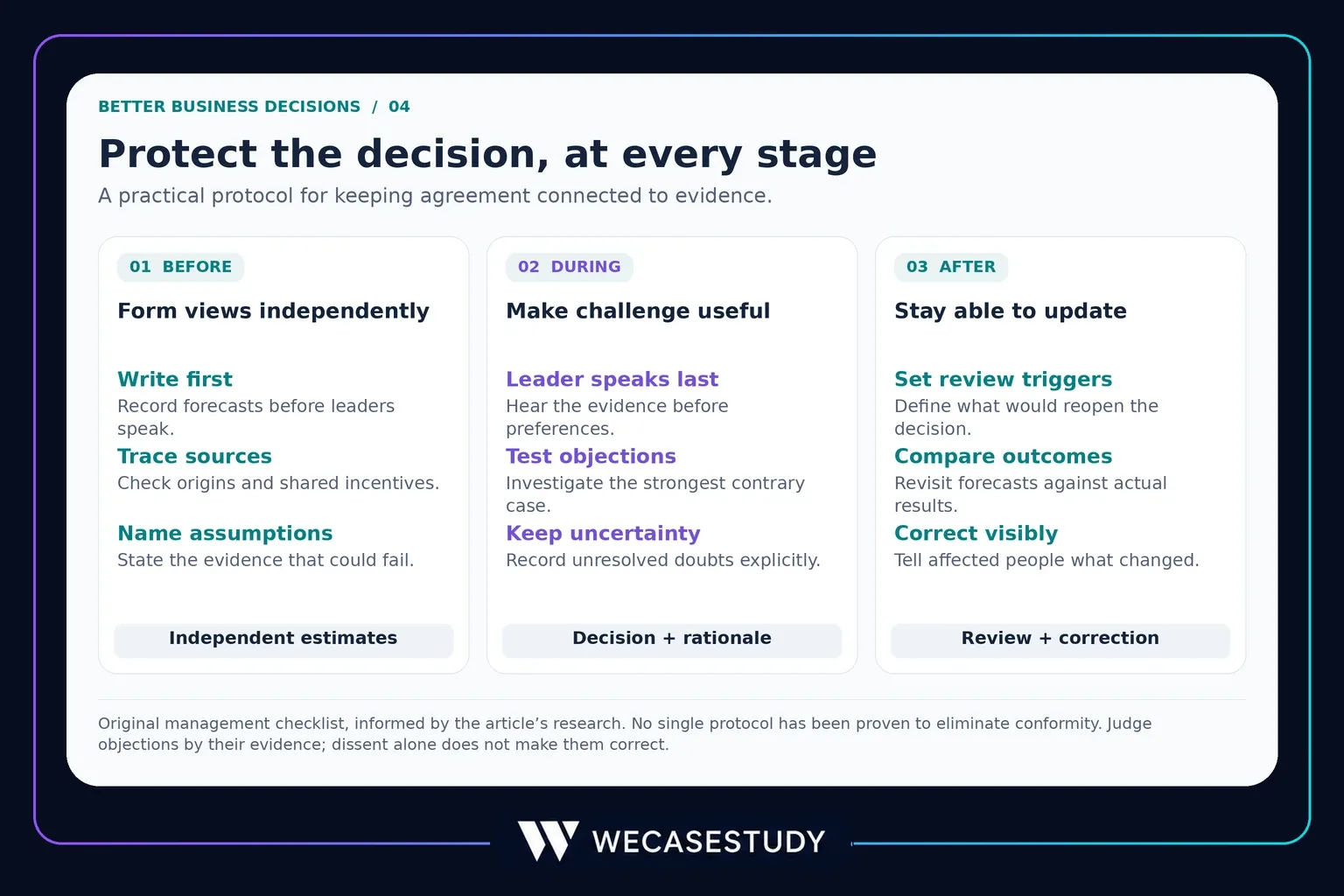 The article’s practical decision protocol: collect independent views, test objections, then review outcomes and correct errors. This analytical checklist is not a validated cure for conformity.
Before the decision: preserve independent information
Collect written estimates before circulating a leader’s preference. Ask each contributor for the evidence, the weakest assumption and the observation that would change their recommendation. Trace shared sources and state the cost of being wrong.
During the decision: make objections testable
Have the leader speak after others. Examine the strongest contrary evidence and record unresolved uncertainty. Give each material objection an owner and response. Agree a decision deadline so review does not become a substitute for deciding.
After the decision: preserve the ability to update
Set review triggers, compare forecasts with outcomes and communicate material corrections. Investigate which objections predicted problems and which created false alarms. Use that record to improve future judgment without punishing people merely for changing their minds.
A useful decision record answers five questions: what did we believe, why did we believe it, which sources were independent, what would change the decision, and who will check? For software procurement, the evaluation approach in our OpenAI versus Anthropic comparison offers an adjacent application: define criteria before interpreting popularity.
25 Lessons for Entrepreneurs and Business Leaders
These lessons follow from the studies and analytical applications above. They are practices to evaluate in context, rather than independently proven interventions.
Collect forecasts before participants see senior leaders’ preferences.
Record why an estimate changed after discussion.
Trace repeated claims to their original evidence.
Separate disclosure of incentives from assessment of research quality.
Give expert agreement weight when its evidence warrants it.
Check what a popular metric actually measures.
Distinguish percentages of responses from percentages of people.
Do not interpret silence as endorsement.
Provide access to data before asking for informed objections.
Protect the person who presents material contrary evidence.
Investigate a credible first objection promptly.
Reward useful challenges instead of opposition for its own sake.
State which observation would invalidate the preferred plan.
Include delay and review costs in decision analysis.
Use explicit assumptions in financial examples.
Compare customer acquisition with retention and service outcomes.
Keep promotional testimonials distinguishable from independent feedback.
Preserve criticism that reveals product weaknesses.
Examine whether reviewers conducted original tests.
Distinguish a mention from an endorsement.
Track how claims move into genuine communities.
Send corrections through the channels that carried the error.
Supply a verified replacement explanation when correcting a claim.
Assign ownership for checking consequential claims over time.
Coordinate execution while retaining a route for new evidence.
Future Outlook: AI, Social Proof and the Value of Provenance
AI-generated commentary makes the distinction between message count and evidence origin especially useful. Ten fluent summaries can all inherit the same unsupported assertion. Their consistency may reflect shared inputs rather than ten investigations.
For publishers, marketplaces and software buyers, the strategic opportunity is to make evidence easier to inspect: show the test method, source date, commercial relationship and correction record. The valuable product is a trustworthy route from a claim to the work supporting it.
Automation can help maintain that route by flagging outdated sources or conflicting records. Human accountability still matters when deciding whether a test is relevant or a correction is material. A disclosed assistant and an invented customer testimonial create different expectations about firsthand experience.
Business-model analysis needs the same discipline. Our ChatGPT revenue-model case study distinguishes product revenue from the wider company’s revenue. In both settings, a useful explanation starts by checking whether a persuasive label matches the underlying evidence.
Final Takeaways: Ten Principles for Better Judgment
Examine the process behind consensus. Identical votes can conceal different reasoning.
Preserve independent inputs. Later convergence becomes easier to interpret.
Separate evidence from endorsement. Popularity answers a different question.
Check source origins. Repetition can masquerade as corroboration.
Make objections usable. Access and protection both matter.
Test dissent. A minority position still needs evidence.
Measure customer outcomes. Promotion can distort apparent acceptance.
Price review realistically. Include delay, false alarms and avoidable losses.
Keep corrections visible. Updating should improve the shared record.
Protect the ability to reconsider. Commitment and revisability can coexist.
The lasting business lesson of the Asch conformity experiment is that confident agreement deserves an explanation. Build a process in which people can investigate the claim, challenge its assumptions and revise the decision when the evidence changes.
Primary Research and Further Reading
Solomon Asch, Opinions and Social Pressure (1955): the original report of the line-judgment experiment and its variations.
Deutsch and Gerard, normative and informational influence (1955): an influential distinction between two drivers of conformity.
Salganik, Dodds, and Watts, artificial music markets (2006): social influence and unpredictability in collective choices.
Vosoughi, Roy, and Aral, true and false news diffusion (2018): large-scale evidence on online sharing.
Lewandowsky and colleagues, misinformation correction (2012): why corrections sometimes leave residual influence.
Pennycook and Rand, accuracy-prompt meta-analysis (2022): interventions that improve sharing discernment.
FTC, consumer reviews and testimonials guidance: official US business guidance on deceptive review practices.
Franzen & Mader (2023) — line-judgment replication, incentives and political-opinion conditions.
FTC (2019) — original agency announcement describing the allegations against Sunday Riley Skincare.
FTC (2020) — final consent agreement announcement.
APA Ethics Code, Standards 8.07–8.08: conditions for deception and debriefing in psychological research.
Editorial method: Sources and links reviewed October 31, 2026. This article synthesizes published research; it does not report original experiments or firsthand product testing. Editorial note: Percentages refer to specific historical experimental conditions. Business scenarios are illustrative; named strategic frameworks are original analytical models, not empirically validated laws.
Asch Conformity Experiment: Frequently Asked Questions
What is the Asch conformity experiment?
The Asch conformity experiment tested whether an individual would publicly agree with an incorrect majority while matching simple line lengths. It showed that group pressure can influence judgments even when the correct answer is clear.
What were the main results of the Asch conformity experiment?
In the series Asch described in 1955, people made incorrect majority-aligned responses on 36.8% of critical trials. Without misleading group pressure, errors were below 1%, and about a quarter of participants never conformed.
What is normative social influence?
Normative social influence is conformity motivated by a desire for acceptance or avoidance of social disapproval. A person may agree publicly while privately remaining skeptical.
What is informational social influence?
Informational social influence occurs when people treat others’ judgments as evidence about what is correct, especially when they feel uncertain.
What does the Asch experiment tell us about propaganda?
It illustrates how perceived consensus can shape public responses, but Asch did not directly study propaganda campaigns, lasting conversion, or online networks. Later research is needed to analyze how misinformation spreads and persists.
How is conformity different from groupthink?
Conformity describes adjusting to group norms. Groupthink is a broader failure of critical evaluation within a group, which can involve pressure toward unanimity and suppression of dissent.
How can businesses reduce conformity bias?
Collect independent written judgments before meetings, trace claims to original sources, protect evidence-based objections, and define when a decision should be reconsidered.
Did a modern study replicate Asch’s conformity findings?
Franzen and Mader’s 2023 study reported 33% errors in a standard line-judgment condition and 25% with incentives. A separate political-opinion task found an average 38-percentage-point difference in yes responses between groups hearing opposing scripted answers. These measures do not establish lasting private belief change.
What is the Sunday Riley fake reviews case?
The US FTC alleged that Sunday Riley Skincare managers used undisclosed employee accounts to post positive Sephora reviews between 2015 and 2017. The FTC approved a final consent agreement in 2020 that prohibited misleading representations about reviewer independence.
Does the Asch experiment prove people permanently believe a lie?
No. The experiment measured public judgments under immediate group pressure. It did not establish lasting propaganda conversion, and public compliance can differ from private belief.
What are the limitations of the Asch conformity study?
The original account describes young male college students making brief laboratory judgments. The sample and setting limit generalization, and public responses do not establish lasting private beliefs. Business applications require additional interpretation.
Which factors affected conformity in Asch’s experiments?
Asch varied majority size and unanimity. Influence did not increase indefinitely with group size, and a partner who broke the incorrect consensus substantially reduced yielding.