Microsoft Buyout Offer 2026: Choice, Costs and Risks
The Microsoft buyout offer gives eligible staff a choice to leave with support. This case study examines one employee's view, the risks and the tests for success.


The Microsoft buyout offer lets eligible staff in selected teams choose a supported exit. Around 60,000 employees can consider it; that does not mean 60,000 people will leave. The case raises two questions: how much does choice improve an exit, and what does the business retain?
Microsoft announced the offer on 26 October 2026. Its official memo calls it the Voluntary Exit Offer. Meanwhile, CRN confirmed the eligible population with the company. These sources establish the offer's scope, not its final results.
Microsoft buyout offer at a glance
| Question | Confirmed or reported position |
|---|---|
| Who qualifies? | Eligible staff in participating teams at internal level 70 and below. |
| Which countries? | Canada, India, the United Kingdom and the United States. |
| What support? | Financial support and career-planning resources. Individual terms apply. |
| Decision window? | Early December, according to company statements reported by GeekWire. |
| Reported exit date? | 31 December 2026, according to CRN. |
The memo sets the country and level rules. However, the dates above also draw on GeekWire's company-attributed reporting and CRN's report.
Eligibility under the Microsoft buyout offer is not an exit target. Nor do gross departures equal net job losses, because hiring can change the total.
Why a profitable company would change its workforce
Microsoft's 2026 annual report records $331.8 billion in revenue and $155.2 billion in operating income. It also lists about 223,000 full-time employees at 30 June. Thus, the business context extends beyond a simple lack of cash.
A profitable firm may still need a different mix of skills and roles. But that does not prove a cut will help. Leaders must show how the team left behind can serve customers and deliver its work.
The Microsoft buyout offer followed other workforce changes. In its July workforce update, the company announced about 4,800 role cuts. It also reported more than 4,000 internal moves over the prior year. These are different measures, so they should not be added into one job-loss total.
AI adds context, but the October memo does not name it as the offer's cause. For broader business context, see our ChatGPT revenue model case study. Our OpenAI versus Anthropic comparison also examines costs and business strategy in the AI market.
What the Microsoft buyout offer includes
News reports use the word buyout, but the terms matter more than the label. GeekWire reports that the Microsoft buyout offer matches standard severance. It describes base pay tied to tenure and level, continued stock vesting, fixed-period health cover and career support.
However, this is not the same as the earlier retirement scheme. That programme covered qualifying US staff at level 67 and below, with an age-plus-service threshold. The new offer has no age or tenure entry rule, according to the company's statements to GeekWire.
KUOW reports that the earlier scheme offered more generous terms. Microsoft therefore expected lower uptake this time. Also, one reported US package should not be treated as the terms for every country. Employees need their own written offers.
Time, choice and one employee's experience
When I spoke to an employee eligible for the offer, I asked how he felt about it. He requested anonymity, but explained why he viewed the approach positively.
For him, the Microsoft buyout offer created time to prepare. He could weigh his next move and try for roles elsewhere, instead of reacting to a sudden loss of work.
He compared this with a layoff at another company. In his account, he had no advance notice. The company told him to stop work and withdrew his access. As a result, he felt undervalued, as though his work no longer counted.
By contrast, the current offer gave him an option to weigh. He felt that it showed greater regard for him. He therefore preferred a process that let him take part in the choice about his future.
His account shows why the process matters alongside the payment. Still, it is one person's view, not a survey of Microsoft's workforce. The passage paraphrases the conversation reported by the author; it does not present a verbatim quote.
Voluntary exits versus compulsory layoffs
A voluntary exit gives eligible staff a choice to accept. In a compulsory layoff, the employer selects the roles and people affected. However, either process can include notice, fair treatment and useful support.
| Tradeoff | Voluntary exit | Compulsory layoff |
|---|---|---|
| Employee choice | Staff choose whether to accept. | The employer makes the exit decision. |
| Staffing control | Uptake and the skills mix can vary. | Leaders can target the planned structure. |
| Main risk | Needed experts may choose to leave. | Those who stay may lose trust or quit. |
| Cost test | Support, handovers and replacement costs. | Severance, disruption and replacement costs. |
The Microsoft buyout offer adds choice, but it also raises a skills risk. People with good outside prospects may want to leave even when the firm needs them. This is a risk to assess, not a finding about those who will accept.
Internal moves offer another route. If a person's skills fit a new role, a transfer may avoid an exit. Likewise, planned handovers can help retain knowledge when someone does leave.
 AI-generated conceptual illustration. Planned handovers can help teams retain expertise when colleagues leave.
What research says about fairness and job loss
Fair treatment matters to those who stay
A 2012 research review on fairness after downsizing examined 37 samples with 11,256 people. It found a positive link between fairness and staff commitment, with a corrected correlation of 0.40. For those who stayed, a fair process mattered more than a fair share of outcomes.
However, 0.40 does not mean a 40% gain in morale, nor does it prove cause and effect. For the Microsoft buyout offer, the lesson is to track how staff view the process as well as the package.
Fewer staff does not ensure better results
A 2024 review of downsizing and financial results examined 905 effect sizes from 114 sources. It found mixed and often negative outcomes, with little long-term gain overall. Thus, leaders should test savings rather than assume them.
These studies span different firms and periods. They do not predict Microsoft's results or prove that every workforce cut fails.
A new job may not restore lost pay
The US Bureau of Labor Statistics' worker-displacement survey found that 66.1% of long-tenured displaced workers had jobs in January 2026. The group lost jobs during 2023–2025 after at least three years with their employer.
Among those who lost full-time wage and salary jobs, returned to such jobs and reported prior earnings, about 49% matched or exceeded their old pay. However, these are US labour-market figures, not Microsoft results or a test of voluntary exits. People also had different amounts of time to find work.
A useful comparison with Airbnb
Airbnb shows why choice and support need separate tests. In its May 2020 layoff announcement, the company said nearly 1,900 of 7,500 staff would leave. US support included 14 weeks of base pay plus a week per year of service. It also included 12 months of health cover through COBRA and job-search support.
That example does not rank Airbnb against the Microsoft buyout offer. The firms faced different conditions six years apart. Instead, it shows that a compulsory exit can still include concrete support. The label alone does not settle the question of care.
The Microsoft buyout offer cost test
Gross payroll savings tell only part of the story. For example, consider the made-up programme below. All figures are US dollars, not Microsoft's package costs or savings.
| Measure | No new recurring costs | Replacement support needed |
|---|---|---|
| One-off exit and transition cost | $3,000,000 | $3,000,000 |
| Monthly employment costs avoided | $1,000,000 | $1,000,000 |
| New monthly replacement costs | $0 | $400,000 |
| Net monthly savings | $1,000,000 | $600,000 |
| Simple payback | 3 months | 5 months |
| Net savings after 12 months | $9,000,000 | $4,200,000 |
Divide the one-off cost by net monthly savings to find simple payback. Then multiply monthly savings by twelve and subtract the initial cost for the annual figure. The model holds costs steady after exits and ignores tax, discounting and changes in sales or output.
Both cases save money, but the second takes longer to repay the cost. Moreover, lost skills or delayed projects could reduce the gain further.
How to judge results
The Microsoft buyout offer remains an ongoing case. Reports reviewed at launch did not provide final uptake, full costs or staff outcomes. GeekWire also reports that the offer does not replace layoffs. Therefore, it gives no blanket promise about future job security.
A useful review should track the following measures. However, a rise in profit alone would not isolate the offer's effect.
| Measure | Evidence to seek |
|---|---|
| Uptake | Accepted offers divided by eligible staff, by team and country. |
| Cost | Exit charges and net savings after replacement spending. |
| Skills | Critical expertise retained and handovers completed. |
| Staff outcomes | Suitable work, pay or planned retirement after departure. |
| Team health | Trust, workload, unwanted exits and service quality. |
This scorecard is our proposed framework, not a list of measured results. Also, volunteers may have different plans and job prospects from staff selected for layoffs. A fair comparison must account for those differences.
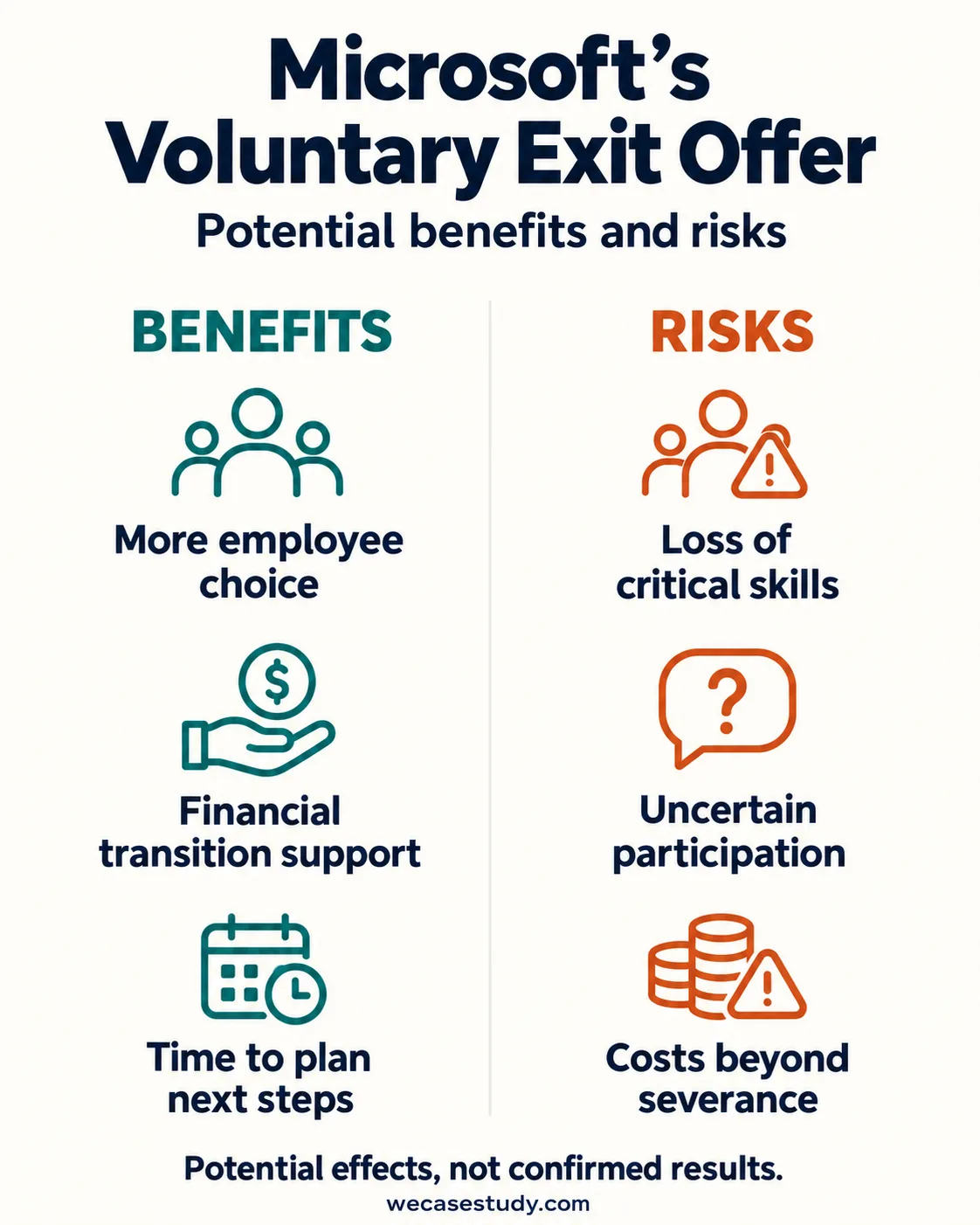 Potential benefits and risks from the case analysis. These are not confirmed Microsoft outcomes.
Lessons for leaders and employees
The Microsoft buyout offer highlights the value of time and choice. Yet a well-run process must also preserve the work the firm needs to do. Leaders should map critical skills first, consider internal moves and plan for the workload left behind.
Employees, meanwhile, need the written terms. Check pay dates, benefits, stock treatment and support against your own plans. Country-specific tax and employment rules also need answers suited to each person's situation.
The employee I spoke with valued the chance to prepare. His view gives the case its human test: do people have a meaningful say in their next step? The business test is whether the firm can still deliver. Strong results would need evidence on both.
Reporting and sources
This case draws on company disclosures, attributed reporting, official statistics and research linked above. The anonymous account comes from a conversation reported by the author. We paraphrase it rather than present a transcript, and withhold his name at his request.
Our comparisons, cost model and scorecard are analysis, not claims of proven results. The illustrations depict concepts, not real Microsoft staff. Our Editorial Policy explains the site's approach to sourcing and review.
Questions about the Microsoft buyout offer
Is Microsoft laying off 60,000 employees?
The figure refers to employees eligible for the voluntary offer, not a confirmed departure count. Separate compulsory job cuts should not be confused with this programme.
Who is eligible for the Microsoft buyout offer?
The offer covers eligible staff at internal level 70 and below in participating teams in Canada, India, the United Kingdom and the United States. Not every team takes part.
How does this differ from the earlier retirement programme?
The earlier scheme covered qualifying US employees at level 67 and below, with an age-plus-service threshold and more generous terms. The new offer has broader eligibility, so its uptake may differ.
Does the voluntary offer replace future layoffs?
Microsoft told GeekWire that the offer does not replace layoffs. It should not be read as a blanket promise about future job security.
Are voluntary exits better than compulsory layoffs?
They give eligible staff more choice, but can create risks around skills, uptake and costs. The evidence reviewed does not establish a universal winner; outcomes depend on the process and the support.