

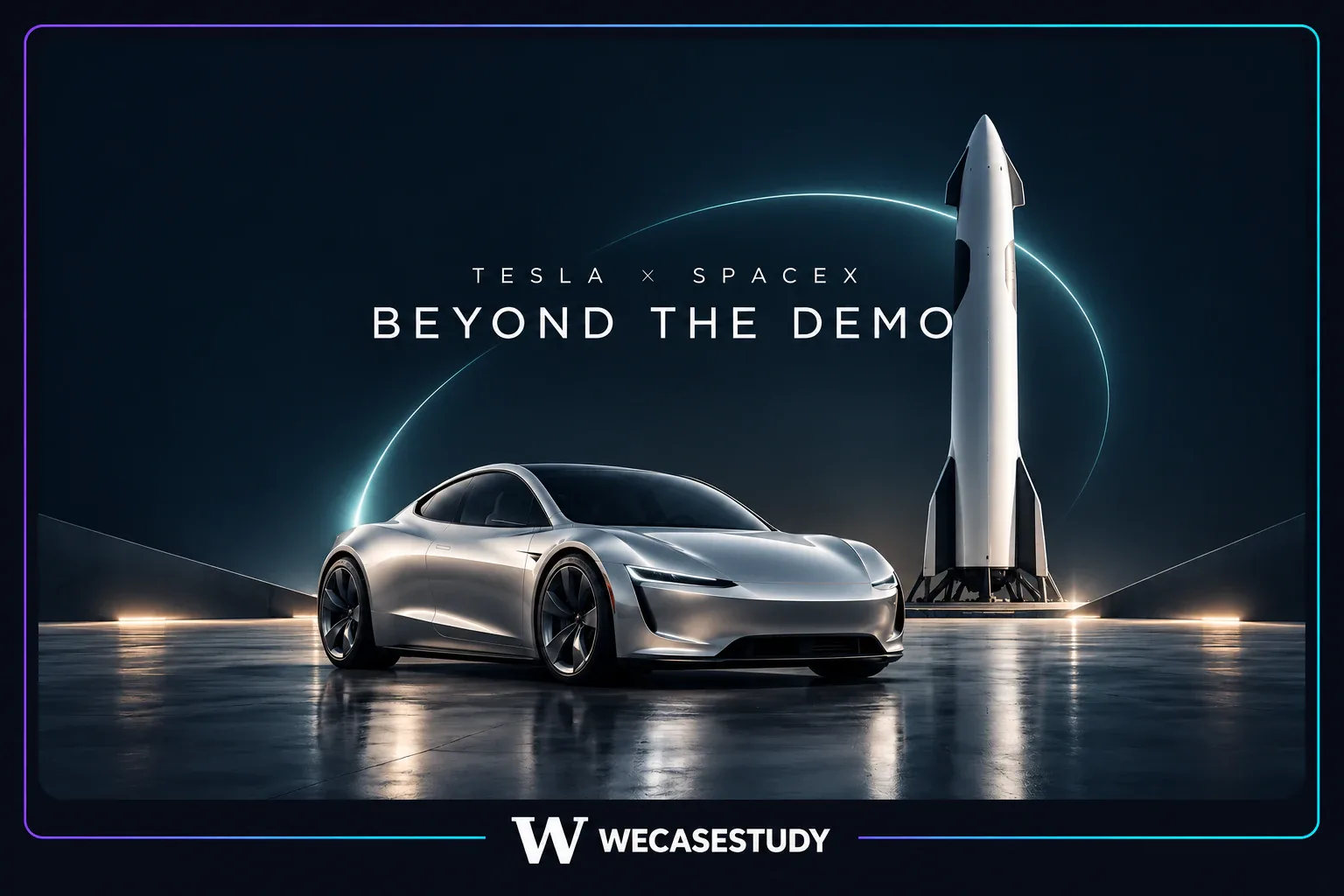
Tesla and SpaceX: What the Flying Roadster Really Demonstrates
A technology demonstration and a planned halo product can serve several goals. This case examines what Tesla has shown, what it proposes to sell, and what remai...
Company · Wiki
Automotive, Energy, Software, AI & Robotics
Tesla, Inc. is an American automotive and technology company that develops electric vehicles, battery-storage systems, charging infrastructure, software, artificial intelligence, autonomous-driving technology, solar products, and humanoid robotics. Automotive remains Tesla’s economic core, while energy storage, charging, software, AI, and robotics form an increasingly connected technology ecosystem.
Last updated: September 2026
Tesla is best known for electric vehicles such as the Model 3, Model Y, Model S, Model X, Cybertruck, and Semi, but the company operates across a much broader set of technologies.
Its activities include electric transportation, residential and utility-scale battery storage, EV charging, connected vehicle software, autonomous-driving systems, artificial intelligence, solar-energy products, and humanoid robotics.
The company’s defining characteristic is the way several of these businesses share underlying capabilities. Batteries, power electronics, software, AI, electric motors, manufacturing, and energy-management technology appear across multiple Tesla products.
That makes Tesla more accurately described as an automotive-led technology company than either a conventional automaker or a pure AI company.
Tesla operates across several major business areas.
Business Area | What Tesla Does |
Automotive | Designs, manufactures, sells, and leases electric vehicles |
Energy storage | Develops residential and utility-scale battery systems |
Charging | Operates the Supercharger fast-charging network |
Software | Develops connected vehicle software and over-the-air updates |
AI and autonomy | Develops driver-assistance and autonomous-driving technology |
Robotics | Develops the Optimus humanoid robot |
Solar | Offers solar-energy products |
Manufacturing | Produces vehicles, batteries, energy products, and related systems at large scale |
Automotive remains Tesla’s largest commercial activity. Energy storage has become a meaningful second business, while autonomous transportation and humanoid robotics represent less mature but strategically important areas.
Tesla’s business model combines hardware, software, infrastructure, energy, and direct customer relationships.
Unlike a traditional automaker that primarily manufactures vehicles and relies heavily on independent dealership networks, Tesla sells directly to customers in many markets and maintains greater control over software, charging, vehicle updates, and parts of the ownership experience.
The broader business system can be understood through several connected technology chains.
On the automotive side:
Battery systems → power electronics → electric drivetrain → vehicle software → charging → driving data → AI → autonomy
On the energy side:
Solar generation → Powerwall → Megapack → energy management
On the robotics side:
AI → perception → control software → electric motors → batteries → manufacturing → Optimus
These products are not identical, but they share important technical capabilities.
Battery expertise supports both vehicles and stationary storage. Software controls vehicles and energy systems. AI and computer vision support autonomous-driving and robotics programs. Manufacturing determines whether Tesla can move physical products from prototypes into large-scale commercial production.
Tesla also develops infrastructure around its products. The Supercharger network supports EV use, while software updates allow Tesla to modify certain vehicle functions after delivery.
This integrated approach is one of the main characteristics that distinguishes Tesla’s business model from that of many traditional automotive companies.
Tesla earns most of its revenue from automotive activities, with additional revenue coming from energy generation and storage, services, leasing, regulatory credits, software-related offerings, and other activities.
Its 2025 revenue breakdown was:
Revenue Category | 2025 Revenue |
Automotive sales | $65.821 billion |
Automotive regulatory credits | $1.993 billion |
Automotive leasing | $1.712 billion |
Total automotive revenues | $69.526 billion |
Energy generation and storage | $12.771 billion |
Services and other | $12.530 billion |
Total revenue | $94.827 billion |
Tesla’s SEC filing separately reports an automotive reportable segment of $82.056 billion because that segment includes services and other revenue. That should not be confused with the $69.526 billion specifically reported as total automotive revenues.
Vehicle sales remain Tesla’s largest source of revenue.
This is why describing Tesla primarily through its future AI, Robotaxi, or robotics ambitions can give an incomplete picture of the current company. Tesla remains economically dependent on designing, manufacturing, and selling vehicles at scale.
Tesla also earns revenue by leasing vehicles in selected markets.
Leasing represents a much smaller part of the automotive business than direct vehicle sales but remains part of the company’s broader automotive revenue model.
Tesla earns revenue by selling automotive regulatory credits to other manufacturers under applicable emissions and environmental programs.
In 2025, regulatory credits contributed approximately $1.993 billion in revenue.
Tesla’s energy business has become increasingly significant.
Energy generation and storage revenue increased from $6.035 billion in 2023 to $10.086 billion in 2024 and $12.771 billion in 2025. The segment reported approximately $3.802 billion in gross profit for 2025.
The business includes products such as Powerwall and Megapack.
Tesla also generates revenue from services and other activities.
Its filings indicate that automotive revenue can include connectivity, access to FSD (Supervised), Supercharging programs, over-the-air software updates, and related services.
Autonomous transportation could eventually introduce another revenue model by allowing Tesla to earn money from transportation services rather than only from selling the vehicle itself.
Tesla’s products span automotive, energy, charging, software, autonomous mobility, and robotics.
Tesla’s major vehicle lines include:
Model 3
Model Y
Model S
Model X
Cybertruck
Tesla Semi
Model 3 and Model Y address higher-volume sedan and crossover categories. Model S and Model X occupy more premium segments. Cybertruck expands Tesla into pickup trucks, while Tesla Semi targets commercial freight transportation.
The importance of the vehicle lineup extends beyond individual models. Tesla applies related batteries, motors, power electronics, software, and manufacturing systems across multiple vehicle categories.
Powerwall is Tesla’s residential battery-storage product.
It can store electricity for later use, including energy generated from solar systems. Depending on the installation and electricity market, stored energy can also support backup power and help shift electricity consumption between different times of day.
Megapack is Tesla’s utility-scale battery-storage product.
It is intended for utilities, energy developers, and large electricity-storage projects.
Unlike Powerwall, which primarily serves individual homes, Megapack can form part of large-scale electricity infrastructure used to store and later dispatch energy.
Tesla also offers solar-energy products designed to work with its energy-storage ecosystem.
A household using multiple Tesla energy products could potentially generate electricity using solar, store it using Powerwall, and later use that energy in the home or to charge an electric vehicle.
Tesla operates the Supercharger network, a fast-charging system originally developed primarily for Tesla vehicles.
The network has expanded beyond Tesla’s own customers. Tesla says selected Supercharger locations in North America can support compatible non-Tesla EVs through NACS ports, approved adapters, or Magic Dock equipment depending on the vehicle and location.
Tesla’s North American Charging System connector was later standardized through SAE as J3400.
Software is an important part of Tesla’s product architecture.
Over-the-air updates allow Tesla to change or improve certain vehicle functions after delivery, including aspects of navigation, infotainment, charging behavior, user-interface functions, and driver-assistance systems.
This software-centered approach means the vehicle can continue changing after the customer purchases it.
Tesla currently calls its advanced consumer driver-assistance system Full Self-Driving (Supervised).
Tesla states that the system requires active driver supervision and does not make the vehicle autonomous.
This distinction matters because FSD (Supervised) should not be confused with a fully autonomous consumer vehicle.
Tesla also operates a separate Robotaxi program.
As of September 2026, Tesla says Robotaxi rides are available in limited service areas of Austin, Dallas, and Houston in Texas and Miami, Orlando, and Tampa in Florida. Availability and operating hours vary by location.
Robotaxi differs from consumer FSD (Supervised). The consumer system still requires an attentive driver, while Robotaxi is intended as an autonomous transportation service.
Optimus is Tesla’s humanoid-robot program.
Tesla describes its goal as developing a general-purpose bipedal robot capable of eventually handling repetitive, unsafe, or undesirable physical tasks. Its AI documentation identifies challenges such as perception, navigation, balance, and interaction with the physical world.
The program builds on technologies Tesla already works with, including AI, computer vision, control software, electric motors, batteries, and manufacturing.
Tesla serves several distinct customer groups.
Individual consumers remain one of Tesla’s most important customer groups.
They purchase or lease Tesla vehicles and may also use products and services such as:
Supercharging
vehicle connectivity
FSD (Supervised)
Powerwall
solar-energy products
Tesla also serves commercial customers through products such as Tesla Semi and fleet-related vehicle applications.
Megapack targets electricity utilities, renewable-energy developers, and large energy projects that need grid-scale battery storage.
This customer base is fundamentally different from Tesla’s automotive consumer market and gives the company exposure to the electricity-infrastructure industry.
Robotaxi introduces another potential customer group: people purchasing transportation as a service rather than buying a vehicle.
The scale of this market for Tesla will depend on how widely the service expands.
Tesla operates across major markets in North America, Europe, and Asia.
Its manufacturing footprint in the United States, China, and Germany supports regional production and gives Tesla direct exposure to several of the world’s largest automotive markets.
Tesla competes with different companies depending on the business segment.
Tesla Business | Main Type of Competition |
Electric vehicles | Traditional automakers and EV specialists |
Battery storage | Battery and energy-storage companies |
EV charging | Charging-network operators |
Autonomous driving | Automakers and autonomous-vehicle technology companies |
Artificial intelligence | Physical-AI and machine-learning developers |
Robotics | Humanoid and industrial robotics companies |
Tesla competes with both established automakers and newer EV-focused manufacturers.
Competition increasingly centers on:
vehicle pricing
range and efficiency
software
manufacturing costs
charging access
product variety
brand strength
Competition is especially intense in China, where several manufacturers compete aggressively on price and technology.
Tesla’s Megapack business competes with other battery-storage providers and energy-infrastructure companies for utility and commercial projects.
The Supercharger network competes with other charging providers while also increasingly functioning as shared infrastructure for compatible non-Tesla vehicles.
Autonomous Driving
Tesla competes with automakers, AI developers, and autonomous-vehicle companies pursuing different technical and commercial approaches to automated driving.
Optimus places Tesla in an emerging competitive field that includes humanoid-robotics developers, industrial robotics companies, and AI firms focused on physical machines.
Tesla’s development can be understood through a series of major turning points.
Year / Period | Milestone | Why It Mattered |
2003 | Tesla established | Created the company that would focus on electric vehicles |
2008 | Original Roadster enters production | Demonstrated that EVs could deliver strong performance |
2012 | Model S launches | Established Tesla in the premium EV market |
2010s | Model X follows Model S | Expanded Tesla into electric SUVs |
Late 2010s | Model 3 scales production | Shifted Tesla toward higher-volume vehicles |
Late 2010s / early 2020s | Model Y expands lineup | Strengthened Tesla’s position in crossovers |
2010s–2020s | Global manufacturing expands | Added production capacity in North America, China, and Europe |
2020s | Energy storage expands rapidly | Made Tesla Energy a more substantial commercial business |
2020s | AI, Robotaxi, and Optimus gain strategic importance | Expanded Tesla’s ambitions beyond conventional automotive manufacturing |
Tesla began with the Roadster rather than a low-cost mass-market vehicle.
The Roadster provided a way to demonstrate electric performance before Tesla attempted much larger manufacturing programs.
Model S and Model X later established Tesla in premium vehicle segments, while Model 3 and Model Y shifted the challenge toward mass production and broader customer adoption.
As vehicle volumes increased, manufacturing became central to Tesla’s competitive position.
Factories, supply chains, battery availability, production efficiency, and vehicle design became critical to the company’s ability to grow.
Tesla later expanded further into large-scale energy storage, autonomous-driving technology, AI, Robotaxi, and humanoid robotics.
These areas now exist at different levels of commercial maturity, ranging from established energy-storage revenue to developing robotics programs.
Elon Musk serves as Tesla’s Chief Executive Officer and remains the company’s most influential executive figure.
He joined Tesla during its early financing period and later became CEO, playing a major role in the company’s product direction, manufacturing expansion, AI strategy, and public identity.
Tesla’s leadership structure supports several major areas including automotive engineering, manufacturing, energy, software, AI, finance, and operations.
Because Tesla is strongly associated with Musk, leadership decisions and strategic priorities can have an unusually visible effect on how investors, customers, employees, and the public perceive the company.
Tesla, Inc. is a publicly traded American company listed on Nasdaq under the ticker symbol TSLA.
The company operates through two primary reportable segments:
Automotive
Energy Generation and Storage
Tesla’s automotive reportable segment includes vehicle-related activities as well as services and other revenue. This is why Tesla’s formal automotive segment revenue is higher than the line reported specifically as “total automotive revenues.”
The company also operates activities spanning:
vehicle manufacturing
vehicle leasing
charging
software
energy storage
solar
AI
autonomous transportation
robotics
services
Tesla acquired SolarCity in 2016, integrating solar-energy operations more closely with its battery-storage strategy.
Tesla’s strategy extends beyond increasing electric-vehicle sales.
Several major priorities define the company’s current direction.
Maintain and Scale the Automotive Business
Automotive remains Tesla’s main economic engine.
The company therefore still depends on:
vehicle demand
competitive pricing
manufacturing efficiency
product development
supply-chain management
cost control
Even if software or autonomous services become more important over time, Tesla’s current scale is built primarily on the automotive business.
Energy storage has become one of Tesla’s most important growth areas outside vehicles.
The expansion of Megapack and Powerwall gives Tesla exposure to residential energy, utility infrastructure, and renewable-energy integration.
Tesla is attempting to move from driver-assistance technology toward autonomous transportation services.
Robotaxi is strategically important because it could create recurring transportation revenue rather than generating revenue only when a vehicle is sold or leased.
The challenge is scaling the service safely and economically across much larger geographic areas.
Tesla increasingly frames its AI strategy around systems that operate in the physical world through vehicles and robots.
FSD, Robotaxi, and Optimus all involve different combinations of perception, planning, AI inference, control systems, and real-world physical interaction.
Tesla develops or controls significant parts of the ecosystem around its products, including:
vehicle design
software
charging
manufacturing
energy storage
AI development
This level of integration can allow technologies developed in one area to support another, but it also increases the complexity of execution.
Tesla’s opportunities are significant, but each major business area carries substantial execution risk.
Area | Major Challenge |
Electric vehicles | Demand, pricing, competition, and manufacturing efficiency |
Energy storage | Manufacturing scale and project execution |
FSD | Reliability, safety, and regulatory acceptance |
Robotaxi | Geographic expansion, regulation, operations, and economics |
Optimus | Real-world usefulness and scalable manufacturing |
Global manufacturing | Cost control, supply chains, tariffs, and utilization |
Technology ecosystem | Managing several capital-intensive programs simultaneously |
Tesla faces stronger competition from both established automakers and EV-focused manufacturers.
Competitors continue to improve electric vehicles, software, charging access, pricing, and manufacturing efficiency.
An early lead in EV adoption does not guarantee a permanent advantage.
Autonomous systems must operate reliably across unpredictable real-world conditions.
A service that performs well in selected geographic areas still faces a much larger challenge when expanding to different roads, weather conditions, traffic behavior, and regulatory environments.
Technical operation alone does not determine whether Robotaxi becomes a major business.
Tesla also needs viable economics around:
fleet utilization
maintenance
service availability
geographic scale
regulation
operational costs
A humanoid robot can perform impressive demonstrations without yet becoming commercially useful.
For Optimus to become a major business, Tesla would need to demonstrate reliable task performance, repeatability, useful economics, and scalable manufacturing.
Manufacturing and Supply Chains
Tesla’s businesses depend heavily on physical manufacturing.
Vehicles, battery-storage products, and robots require factories, raw materials, supply chains, and capital investment.
Poor factory utilization, supply disruptions, trade restrictions, or cost increases could affect profitability and growth.
Tesla remains automotive-led financially. In 2025, it reported $69.526 billion in total automotive revenues from $94.827 billion of company revenue.
Energy storage is already a substantial business. Tesla’s energy generation and storage revenue reached $12.771 billion in 2025.
Tesla operates across both transportation and electricity infrastructure. Its products range from consumer EVs and charging networks to residential batteries and utility-scale Megapack projects.
The company’s businesses share important technologies. Batteries, power electronics, software, AI, electric motors, controls, and manufacturing recur across vehicles, energy systems, and robotics.
The Supercharger network extends beyond Tesla vehicles. Compatible EVs from other manufacturers can use selected Tesla charging locations.
Consumer FSD remains supervised. Tesla explicitly states that Full Self-Driving (Supervised) requires active driver attention and does not make the vehicle autonomous.
Robotaxi and FSD are separate products. Tesla’s consumer FSD system requires supervision, while Robotaxi is a distinct autonomous transportation service.
Tesla’s AI strategy extends beyond cars. The company links AI development to both autonomous driving and bipedal robotics.
Manufacturing is a strategic capability. Tesla operates major manufacturing facilities across North America, Europe, and Asia.
Tesla’s current economics and long-term identity are different. It remains primarily automotive by revenue while strategically expanding toward energy, autonomous transportation, and robotics.
What is Tesla?
Tesla is an American automotive and technology company that develops electric vehicles, battery-storage systems, charging infrastructure, software, autonomous-driving technology, artificial intelligence, solar products, and humanoid robotics.
What does Tesla do besides make cars?
Tesla develops residential and utility-scale battery storage, solar products, EV charging infrastructure, connected vehicle software, autonomous-driving systems, AI technology, and humanoid robotics.
How does Tesla make money?
Tesla earns most of its revenue from automotive sales. It also earns revenue from vehicle leasing, regulatory credits, energy generation and storage, services, charging, software-related products, and other activities.
Is Tesla a car company or a technology company?
Tesla is best described as an automotive-led technology company.
Automotive still provides most of its current revenue, but Tesla also has significant activities in energy storage, charging, software, AI, autonomous transportation, and robotics.
Who founded Tesla?
Tesla was established in 2003, with Martin Eberhard and Marc Tarpenning playing central roles in creating the company. Elon Musk joined during Tesla’s early financing period and later became CEO.
Who is Tesla’s CEO?
Elon Musk is Tesla’s Chief Executive Officer.
Where is Tesla headquartered?
Tesla Investor Relations lists the company’s headquarters at 1 Tesla Road in Austin, Texas.
What is Tesla Energy?
Tesla Energy covers the company’s energy-generation, battery-storage, and related energy-management activities.
Its major battery products include Powerwall for residential use and Megapack for utility-scale energy storage.
What is Tesla Powerwall?
Powerwall is Tesla’s residential battery-storage system. It is designed to store electricity for later household use, including energy generated from solar systems.
What is Tesla Megapack?
Megapack is Tesla’s utility-scale battery-storage system designed for electricity grids, utilities, renewable-energy developers, and other large projects.
Is Tesla Full Self-Driving fully autonomous?
No.
Tesla currently calls the consumer product Full Self-Driving (Supervised) and states that it requires active driver supervision and does not make the vehicle autonomous.
What is Tesla Robotaxi?
Robotaxi is Tesla’s autonomous transportation-service program.
As of September 2026, Tesla says service is available in limited areas of Austin, Dallas, Houston, Miami, Orlando, and Tampa.
What is Tesla Optimus?
Optimus is Tesla’s humanoid-robot program.
Tesla says it is developing a general-purpose bipedal robot intended eventually to perform repetitive, unsafe, or undesirable physical tasks.
What are Tesla’s main competitors?
Tesla faces different competitors in different markets, including traditional automakers, EV specialists, battery-storage companies, charging-network providers, autonomous-driving developers, AI companies, and robotics firms.
What is Tesla’s biggest business?
Automotive remains Tesla’s largest business by revenue.
In 2025, Tesla reported $69.526 billion in total automotive revenues from $94.827 billion of total company revenue.
A technology demonstration and a planned halo product can serve several goals. This case examines what Tesla has shown, what it proposes to sell, and what remai...