

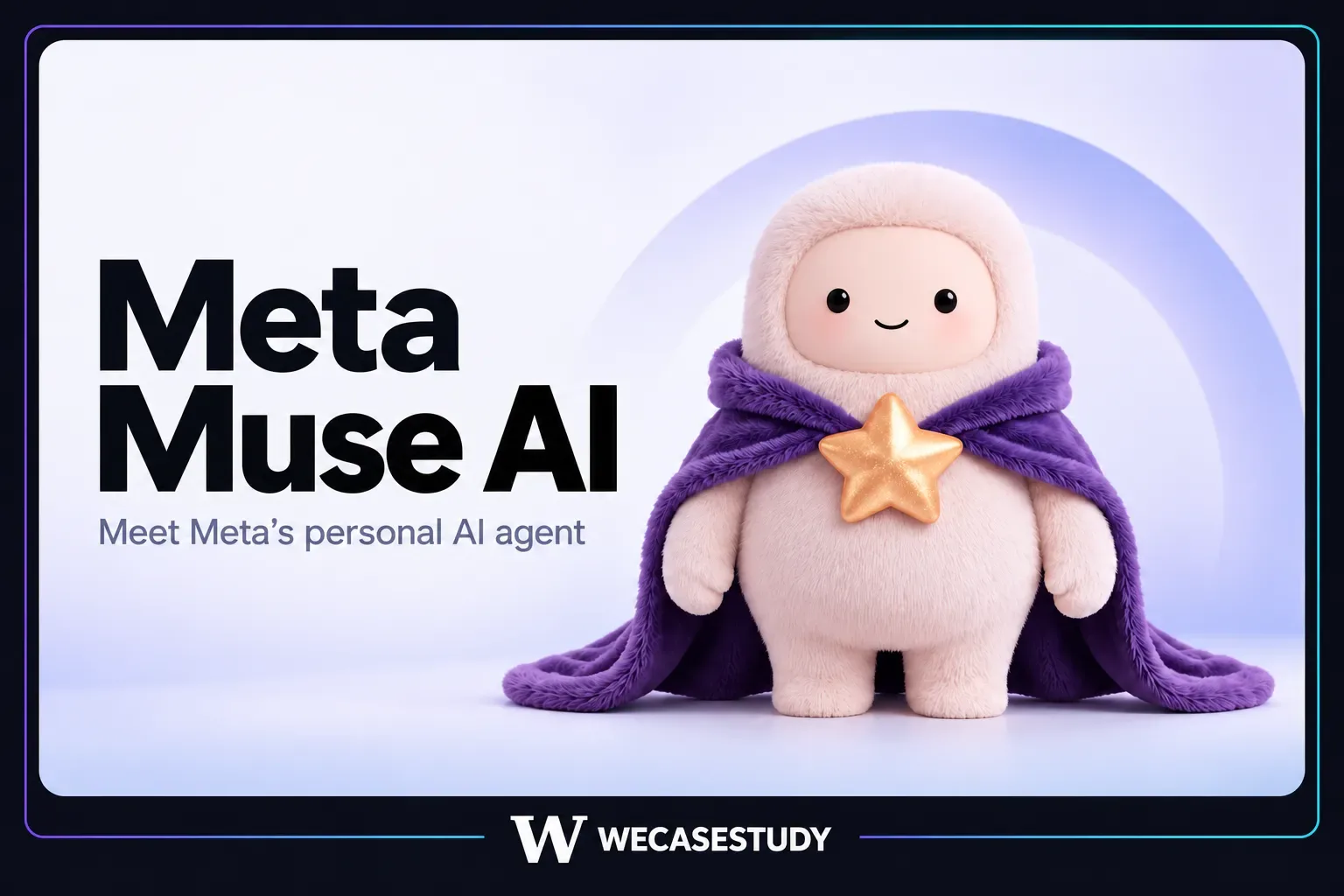
Introducing Meta Muse AI: What Meta’s Personal AI Agent Can Do
Meta Muse AI is a personal AI agent, designed to do more than answer questions. Instead of simply explaining how to complete a task, Meta Muse can work through...

Company · Wiki
Technology, Social Media, Digital Advertising & AI
Meta is the technology company behind Facebook, Instagram, WhatsApp, Messenger, Threads, Meta AI and a growing portfolio of virtual, mixed-reality and wearable-computing products. Originally founded as Facebook in 2004, the company has evolved from a university social network into a global communications, digital advertising and artificial intelligence business.
Advertising remains Meta's financial engine, while the company is investing heavily in AI infrastructure, assistants, smart glasses, virtual and mixed reality, and emerging enterprise technologies.
Last updated: October 11, 2026
Meta is an American technology company headquartered in Menlo Park, California. It operates some of the world's largest social networking and communication platforms and develops technologies spanning digital advertising, artificial intelligence, virtual and mixed reality, and wearable computing.
Facebook remains one of Meta's best-known products, but Facebook and Meta are not the same thing. Meta Platforms is the parent company; Facebook is one product within its wider ecosystem.
That distinction became formal in October 2021, when Facebook, Inc. adopted the Meta corporate name. Facebook, Instagram, WhatsApp and the company's other products retained their individual names.
Meta's position is unusual because it combines enormous consumer distribution with a highly profitable advertising business and large-scale investment in emerging technology. Its established apps generate most of the company's economic value today, while AI, smart glasses, immersive computing and enterprise products represent attempts to expand beyond the traditional social-media model.
Meta operates across several connected areas of technology.
Facebook, Instagram and Threads allow users to publish, discover and interact with content.
Facebook focuses broadly on personal connections, communities, video, Pages and Marketplace. Instagram is centered more heavily on visual content, short-form video, creators and discovery. Threads provides a text-focused platform for public conversations.
These products also provide much of the audience and engagement that support Meta's advertising business.
WhatsApp and Messenger provide private messaging, voice and video communication.
WhatsApp also supports business communication, allowing companies to interact directly with customers. Messaging gives Meta a different type of user relationship from public social networking and extends its reach into everyday communication.
Meta provides advertising systems that allow businesses to run campaigns across eligible parts of Facebook, Instagram and its wider ecosystem.
Advertisers can select objectives, reach audiences, distribute creative material and measure campaign performance. Advertising remains the company's dominant source of revenue.
AI supports content recommendations, advertising systems, assistants and other product experiences across Meta's platforms.
The company also develops its own AI models and infrastructure. Meta AI has been integrated into multiple consumer products and is also available through a standalone app and connected devices.
Through Reality Labs, Meta develops Quest headsets, software for immersive computing and AI-powered glasses.
These businesses remain much smaller economically than advertising, but they are strategically important because Meta is attempting to participate directly in future computing interfaces rather than relying entirely on smartphones and platforms controlled by other technology companies.
Meta's business model connects large consumer platforms with digital advertising, AI-driven recommendations and long-term technology investment.
A simplified version of the system works like this:
Large audiences → more content and engagement → better recommendation signals → more advertising opportunities → advertiser spending → revenue → investment in AI and infrastructure → stronger products
Facebook, Instagram, WhatsApp, Messenger and Threads give Meta enormous consumer distribution. Most people use these products without paying a subscription fee.
Businesses, however, pay Meta to reach audiences through advertising.
AI supports this system in several ways. Recommendation systems attempt to show users more relevant content. Advertising technology helps businesses create, deliver and optimize campaigns. AI assistants and other features may also make Meta's products more useful or increase the amount of activity taking place within its ecosystem.
Instagram Reels provides a practical example. If recommendation systems show people videos they are more likely to watch, users may spend more time consuming content. That can create additional opportunities to deliver advertising. If advertisers see worthwhile campaign performance, demand for those placements can increase.
Revenue generated by the core business can then support further spending on computing infrastructure, AI research, product development, smart glasses and Reality Labs.
This means a Meta product does not necessarily need to generate direct subscription revenue to create economic value. It may instead improve engagement, distribution, advertising performance or retention elsewhere in the ecosystem.
The tradeoff is cost. Advanced AI infrastructure, hardware development and immersive-computing projects can require large amounts of capital before Meta knows whether they will become durable new businesses.
Meta makes the overwhelming majority of its revenue from digital advertising.
Businesses pay to distribute ads across Meta's platforms, particularly Facebook and Instagram. Meta provides campaign-management, targeting, creative and measurement tools intended to connect advertisers with relevant audiences.
The company's other revenue-generating activities include hardware and related products, but these remain far smaller than advertising.
Meta reported approximately $200.97 billion in total revenue for 2025, an increase of 22% from 2024. Operating income was approximately $83.28 billion.
For the second quarter of 2026, Meta reported approximately $60.80 billion in revenue and $15.85 billion in net income.
Revenue / Business Area | Role in Meta's Business | How It Generates Revenue |
Digital advertising | Primary revenue engine | Businesses pay to place advertising across eligible Meta platforms |
Reality Labs hardware and related products | Smaller revenue contributor | Sales of Quest devices and other hardware-related products and services |
Emerging AI and enterprise offerings | Developing business area | Potential business and developer services; still early relative to advertising |
The important business point is concentration.
Meta is highly diversified in products but much less diversified in monetization. Facebook, Instagram, WhatsApp, Messenger, Threads, Meta AI and Reality Labs give the company multiple consumer and technology platforms, yet advertising still supplies the overwhelming majority of revenue.
That structure allows a mature advertising operation to finance much more speculative investments in AI, wearables, immersive computing and enterprise technology.
Meta's portfolio includes consumer applications, business tools, AI products and computing hardware.
Facebook is a social networking platform supporting personal profiles, communities, Pages, video, content sharing and Marketplace.
It remains a major source of audience scale and advertising inventory for Meta.
Instagram is a visual content and discovery platform built around photos, video, Stories, Reels, messaging and creator content.
Its importance to Meta extends beyond audience size. Instagram gives the company a major position in visual discovery, creator activity and mobile advertising.
WhatsApp provides private messaging, group communication, voice and video calls, and business communication.
Its global messaging reach gives Meta a communications platform that is structurally different from Facebook and Instagram.
Messenger provides text messaging, voice and video communication and remains part of Meta's broader communication ecosystem.
Threads is Meta's text-focused platform for public conversations and content discovery.
It expands Meta's presence in public discussion beyond the formats associated with Facebook and Instagram.
Meta AI is the company's AI assistant and is available through multiple Meta products as well as a standalone application.
Meta is increasingly treating AI as a layer that can operate across its existing apps rather than as a completely separate product category.
Meta Quest is a family of virtual- and mixed-reality devices developed through Reality Labs.
Quest represents Meta's long-term effort to build a position in immersive computing.
Meta has expanded its work on smart glasses that combine cameras, audio, communication and AI capabilities.
These devices support Meta's broader goal of developing computing experiences beyond the conventional smartphone screen.
Meta serves both consumers and businesses.
Consumers use Facebook, Instagram, WhatsApp, Messenger, Threads, Meta AI, Quest devices and other Meta products for communication, entertainment, content discovery and computing.
Meta reported approximately 3.60 billion Family daily active people in June 2026, measuring people using at least one of Facebook, Instagram, WhatsApp or Messenger on an average day.
That figure illustrates the scale of Meta's consumer ecosystem rather than the audience of any single product.
Advertisers are Meta's most important paying customer group.
Customers range from small local businesses to multinational companies using Facebook and Instagram to promote products, acquire customers and measure marketing performance.
Meta's ability to connect advertisers with extremely large audiences is central to its business model.
WhatsApp Business and Meta's advertising tools support direct interaction between companies and customers.
Meta has also begun expanding its business-facing AI ambitions. In September 2026, the company announced Meta Enterprise Platform, outlining plans to provide businesses and developers with AI models, agents, APIs and supporting technologies.
Meta operates globally.
Its applications serve users and businesses across many countries, making geographic diversity an important part of its scale while also exposing the company to different privacy, competition, safety and platform regulations.
Meta competes across several markets rather than against one single type of company.
Meta competes for user attention, creators and engagement with other large social and content-distribution platforms.
Competition in this area centers on audience growth, time spent, recommendation quality, creator participation and the ability to introduce successful new content formats.
Meta also competes with other large digital advertising platforms for advertiser budgets.
The competition is not simply about audience size. Advertising performance, measurement, automation, targeting capabilities and return on advertising spend all affect where businesses allocate their budgets.
WhatsApp and Messenger compete with other messaging and communication services for daily communication, business messaging and user retention.
Meta's growing AI business places it in competition with other companies developing large AI models, assistants, developer platforms and enterprise AI services.
The company's primary advantage in this market is distribution: it can introduce AI features across products already used by billions of people.
Reality Labs competes in virtual reality, mixed reality and wearable technology.
These markets remain strategically important because the companies that control future computing interfaces may gain influence over how consumers access software, services and digital content.
Meta's development is best understood through the major events that changed the scale or direction of the business.
Year | Milestone | Why It Mattered |
2004 | TheFacebook launches at Harvard | Established the social network that became Facebook |
2005 | TheFacebook becomes Facebook | Created the brand that would drive the company's early global expansion |
2006 | Facebook expands registration more broadly | Accelerated growth beyond universities |
2007 | Facebook Platform and business-focused tools expand | Helped transform Facebook from a social website into a broader digital platform |
2011 | Messenger becomes a standalone messaging application | Expanded Facebook's communications capabilities |
2012 | Facebook goes public and acquires Instagram | Added public-market capital and strengthened the company's position in mobile visual content |
2014 | Facebook acquires WhatsApp and Oculus VR | Expanded into global messaging and virtual-reality technology |
2018 | Cambridge Analytica controversy intensifies scrutiny | Brought global attention to Facebook's data and platform-governance practices |
2021 | Facebook, Inc. becomes Meta Platforms, Inc. | Separated the corporate identity from the Facebook product and reflected broader technology ambitions |
2023 | Threads launches | Added a new platform for public text-based conversations |
2025 | Standalone Meta AI app launches | Expanded Meta's AI assistant beyond its existing social applications |
2026 | Muse Spark and Meta Enterprise Platform announced | Broadened Meta's AI strategy across consumer, device, developer and enterprise markets |
Three periods were particularly important to Meta's development.
Facebook's IPO and the acquisitions of Instagram, WhatsApp and Oculus transformed the company from a business centered primarily on one social network into a portfolio of major communication and technology assets.
Instagram gave Facebook a stronger position in mobile visual content. WhatsApp expanded its global messaging presence. Oculus provided technology and expertise in virtual reality.
On October 28, 2021, Facebook announced Meta as its new corporate identity.
The Facebook product retained its existing name. The rebrand instead reflected the broader organization encompassing Facebook, Instagram, WhatsApp, Messenger and the company's investments in immersive computing.
Meta launched a standalone Meta AI application in April 2025.
In April 2026, Meta Superintelligence Labs announced Muse Spark, a model intended to support AI experiences across Meta's products and connected devices.
In September 2026, Meta announced Meta Enterprise Platform, signaling an effort to expand AI from consumer applications into services for businesses and developers.
Mark Zuckerberg remains Meta's founder, chairman and chief executive officer.
His continuing leadership makes Meta unusual among technology companies of comparable age and scale. Zuckerberg has remained closely associated with the company's major strategic transitions, including the expansion beyond Facebook, the acquisitions of Instagram and WhatsApp, the metaverse-era rebrand and the company's more recent emphasis on artificial intelligence.
Because the founder continues to lead the company, Meta's current strategic direction is still closely connected to the leadership that established Facebook in 2004.
Other executives oversee major operational, financial, product and technology functions, but Zuckerberg remains the most influential figure in Meta's long-term direction.
Meta Platforms, Inc. is a publicly traded company listed on the Nasdaq stock market under the ticker META.
The corporate structure brings several major consumer platforms and technology activities under one parent organization.
Facebook, Instagram, WhatsApp, Messenger and Threads operate within Meta's broader Family of Apps ecosystem, while Reality Labs encompasses the company's major virtual-, mixed-reality and wearable-computing efforts.
Instagram, WhatsApp and Oculus entered the organization through acquisitions. Other products, including Messenger, Threads and Meta AI, were developed within the broader company.
Meta's public ownership means shares are held by public and institutional investors. Mark Zuckerberg remains particularly influential through his leadership role and the company's voting structure. Current ownership percentages and voting-control figures should be interpreted using Meta's latest regulatory filings because shareholdings can change over time.
Meta's current strategy combines defense of its highly profitable advertising operation with heavy investment in AI and future computing platforms.
Facebook and Instagram advertising remain the foundation of Meta's economics.
That gives the company a strong incentive to improve recommendations, campaign automation, advertiser tools, creative systems and measurement.
AI investment therefore supports Meta's established business as well as its newer products.
Meta is integrating AI into products that already have enormous distribution.
Rather than relying exclusively on one standalone AI service, the company can bring assistants and generative-AI features into Facebook, Instagram, WhatsApp, Messenger, connected devices and other services.
This distribution advantage does not guarantee product success, but it reduces the challenge of finding an initial user base.
Quest devices and AI-powered glasses reflect Meta's attempt to participate more directly in future computing interfaces.
The strategic logic is significant. Meta currently depends heavily on smartphones and operating systems controlled by other companies to distribute many of its services.
If new computing formats become widely adopted, owning more of that interface could reduce Meta's dependence on external platforms.
Meta Enterprise Platform points toward another possible source of growth.
The initiative broadens Meta's AI ambitions from consumer products to models, agents, APIs and supporting technologies intended for businesses and developers.
It remains too early to treat enterprise AI as a business comparable with Meta's advertising operation, but it represents a potentially important extension of the company's existing AI infrastructure.
Meta's advertising operation generates the financial resources needed to support investments that may take years to mature.
That structure gives Meta more strategic patience than smaller companies, but it also raises the standard those investments eventually need to meet.
Large spending on AI infrastructure, Reality Labs and hardware only creates long-term value if those technologies strengthen the existing business or develop into meaningful new sources of economic value.
Meta's scale creates advantages, but it also exposes the company to significant risks.
Meta operates many products, but most of its revenue still comes from advertising.
That concentration means changes in advertiser demand, measurement capabilities, privacy rules or digital-advertising economics can have an outsized effect on the company.
Meta faces scrutiny over privacy, competition, content governance, child safety and the use of personal data.
These issues can affect product design, advertising systems, acquisitions, operating costs and how the company launches new technologies in different jurisdictions.
Meta's platforms compete in markets where consumer behavior changes quickly.
New content formats, communication habits and competing services can reduce engagement even when Meta retains a very large installed user base.
Maintaining relevance therefore requires continuous product adaptation.
Meta is committing significant resources to AI models, infrastructure and products.
The strategic opportunity is substantial, but so is the cost. Building increasingly capable AI systems requires computing infrastructure, energy, talent and capital.
The long-term return on those investments depends on whether AI materially improves Meta's existing products or becomes the basis of successful new businesses.
Virtual reality, mixed reality and wearable computing remain long-term investments rather than businesses comparable with Meta advertising.
Hardware markets can require years of development, and widespread consumer adoption is not guaranteed.
Many Meta services are distributed through mobile devices and operating systems controlled by other companies.
Changes to those platforms can affect data access, advertising measurement, distribution and the economics of Meta's products.
This dependence helps explain Meta's long-term interest in developing its own computing interfaces.
Meta is the parent company behind Facebook, Instagram, WhatsApp, Messenger and Threads; Facebook is not the corporate parent.
The company reported approximately 3.60 billion Family daily active people in June 2026, illustrating the reach of its combined app ecosystem.
Meta is diversified across social networking, messaging, AI and hardware, but its revenue remains heavily concentrated in digital advertising.
Instagram, WhatsApp and Oculus were strategically important acquisitions because they expanded Meta into mobile visual content, global messaging and immersive computing.
Meta's established advertising business finances large investments in AI infrastructure, smart glasses and Reality Labs.
The 2021 corporate rebrand did not rename the Facebook app; it created a broader identity for the parent company.
Meta's AI strategy increasingly spans consumer assistants, advertising technology, underlying AI models, wearable devices and enterprise services.
Reality Labs represents Meta's attempt to participate directly in future computing platforms rather than relying entirely on smartphones.
Meta remains led by co-founder Mark Zuckerberg more than two decades after Facebook was created.
Explore upcoming WeCaseStudy case studies examining Meta's acquisitions, advertising model, artificial intelligence strategy, platform expansion, product decisions and long-term technology investments.
Is Meta the Same Company as Facebook?
No. Meta Platforms is the parent company, while Facebook is one of its products. Facebook, Inc. adopted the Meta corporate name in 2021, but the Facebook social network kept its existing name.
When Did Facebook Become Meta?
Facebook announced the Meta corporate brand on October 28, 2021. The change applied to the parent company rather than renaming the Facebook application.
What Apps and Businesses Does Meta Own?
Meta's major platforms include Facebook, Instagram, WhatsApp, Messenger and Threads. It also develops Meta AI, Quest devices and AI-powered glasses through its wider technology organization.
What Is Meta's Main Source of Revenue?
Digital advertising is Meta's dominant source of revenue. Businesses pay to place advertising across eligible parts of Facebook, Instagram and other Meta services.
Does Meta Own Instagram and WhatsApp?
Yes. Facebook acquired Instagram in 2012 and WhatsApp in 2014. Both now operate within Meta Platforms.
Who Owns Meta Platforms?
Meta Platforms is a publicly traded company listed on Nasdaq under the ticker META. Its shares are held by public and institutional investors, while founder and CEO Mark Zuckerberg retains significant influence through the company's voting structure.
Who Is the CEO of Meta?
Mark Zuckerberg is Meta's founder, chairman and chief executive officer.
Is Meta Still Mainly a Social Media Company?
Meta still derives most of its economic strength from platforms associated with social networking, communication and digital advertising. However, the company now also invests heavily in artificial intelligence, virtual and mixed reality, smart glasses, computing infrastructure and emerging enterprise AI services.
Sources and Further Reading
Meta Muse AI is a personal AI agent, designed to do more than answer questions. Instead of simply explaining how to complete a task, Meta Muse can work through...