
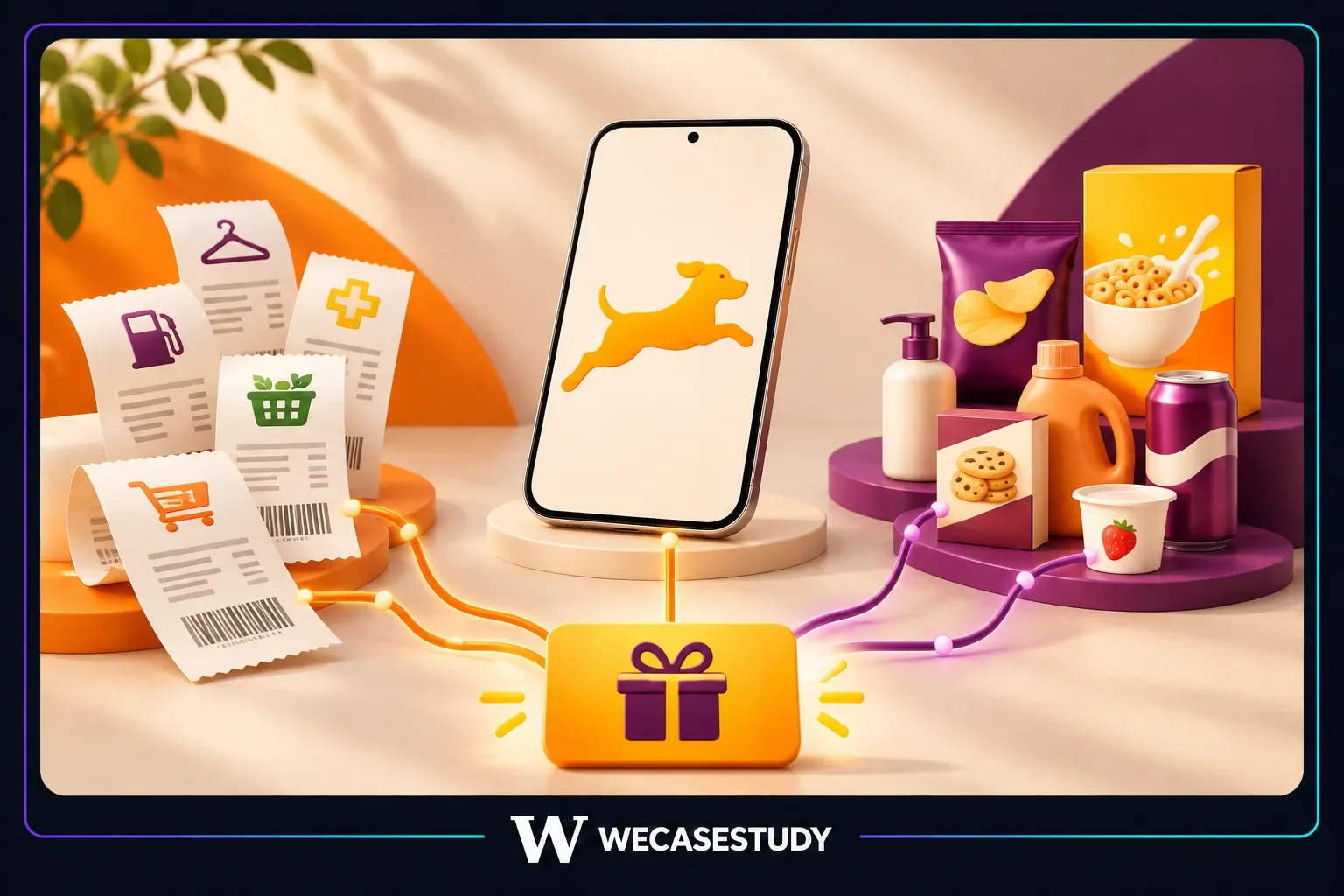
How Does Fetch Make Money? The Business Behind Free Rewards
Fetch is a free U.S. rewards app that gives users points for eligible receipts, offers, online shopping, games, and other activities. So how does Fetch make mon...

Fetch is a privately owned U.S. technology company that combines a consumer rewards app with an outcomes-based advertising platform. Consumers earn Fetch Points through qualifying shopping, offers, gaming, and other activities, while brands use Fetch to distribute incentives, reach purchase-based audiences, drive trial or repeat buying, and measure campaign results against transaction data.
The business originated in Madison, Wisconsin, and traces its operating history to 2013. Fetch's current corporate history credits Wes Schroll and Tyler Kennedy with launching the original Shop Fetch concept; contemporaneous UW–Madison reporting also documents Dan Litvak as a co-founder of the early grocery-app business, creating a historical discrepancy discussed below.
Last updated: November 7, 2026
Fetch, formerly branded primarily as Fetch Rewards, operates at the intersection of consumer rewards, loyalty, advertising technology, and digital commerce.
Its consumer-facing app rewards users with Fetch Points for qualifying activities. Its business platform uses purchase data and incentive-based advertising to help brands reach shoppers, target audiences based on buying behavior, acquire customers, encourage repeat purchases, and evaluate campaign performance. Fetch describes itself in 2026 as both a rewards app and an outcomes-based advertising platform.
The company was founded in Madison, Wisconsin. Fetch's consumer FAQ continues to describe the business as privately owned and founded in Madison. The company now operates with a distributed workforce and lists offices or coworking locations in Madison, Chicago, Birmingham, Boston, New York, and Mexico City, while supporting remote employees in the United States and beyond.
Fetch's current official history identifies Wes Schroll and Tyler Kennedy as the people who launched Shop Fetch in 2013. However, a contemporaneous October 2013 UW–Madison report described Schroll and computer science student Dan Litvak as co-founders of the early Fetch Rewards grocery application. Later UW–Madison material identifies Schroll and Kennedy as Fetch co-founders. Because the historical record differs across periods, it is more accurate to recognize Litvak's documented early co-founder role rather than erase it, while noting that Fetch's current official company history centers Schroll and Kennedy.
Fetch operates two closely connected businesses: a consumer rewards platform and a brand advertising platform.
For consumers, Fetch provides multiple ways to earn points, including physical receipts, qualifying electronic receipts, personalized offers, Fetch Play, Fetch Shop, referrals, and other in-app opportunities. Points can then be exchanged for available rewards.
For brands, Fetch provides incentive-driven advertising and measurement. Its business products include Offers, Point Boost, display and video media, audience targeting based on purchase behavior, and measurement tools intended to track effects such as sales lift, customer acquisition, repeat purchasing, and longer-term value.
The relationship between those activities is central to the company. Rewards encourage consumers to share qualifying shopping activity and remain active in the platform; Fetch then uses the resulting transaction data, together with its media and promotional products, to create advertising services for brands.
Fetch operates a two-sided platform connecting consumers with brands and advertisers.
Consumers participate because they can earn rewards from shopping and other activities. Brands participate because Fetch gives them access to shoppers, purchase-based audience segments, promotional tools, and measurement based on observed transactions.
Participant | What It Contributes | What It Receives |
Consumers | Shopping activity, receipt data, attention, and engagement | Fetch Points, offers, and redeemable rewards |
Brands and advertisers | Advertising and promotional spending | Audience access, promotions, customer acquisition and retention tools, and measurement |
Fetch | Rewards infrastructure, technology, media inventory, purchase data, and campaign tools | Commercial revenue |
Fetch reports that its users provide SKU-level visibility into approximately $212 billion in annual gross merchandise value. In 2026 company materials, Fetch also said users were submitting more than 13 million receipts per day. These are company-reported platform-scale metrics rather than Fetch revenue.
The model differs from a conventional single-retailer loyalty program because Fetch sits across eligible retailers rather than inside one merchant's ecosystem. It also differs from a pure affiliate-shopping service because receipt data and brand-funded incentives are core parts of the platform.
Fetch states that most of its revenue comes from relationships with partner brands. Its consumer FAQ specifically says brands pay to be featured through high-point offers, while Fetch's business materials show a broader commercial offering that includes in-app media, Offers, Point Boost, audience targeting, customer acquisition and retention campaigns, and measurement.
Because Fetch is privately held, it does not publish a public-company-style segment revenue breakdown. No reliable public disclosure establishes how much revenue comes from each advertising product, industry, or customer category, so an estimated revenue mix would be speculative.
One of Fetch's core commercial products is the brand-funded Offer.
A brand can create an incentive that awards Fetch Points when a user completes a defined purchase requirement. Campaigns can be designed around specific objectives such as acquiring new-to-brand buyers, increasing basket size, driving repeat purchases, or reactivating lapsed customers. Fetch also sells in-app display and video placements that can increase visibility for those campaigns.
The practical distinction is that the advertiser is not simply buying generic app impressions. Fetch can use historical purchase behavior to build audiences and combine the advertising exposure with a reward tied to a desired action.
Fetch's published 2026 brand case studies show campaigns segmented into groups such as existing buyers, new-to-brand consumers, competitor purchasers, and category newcomers. These examples are company-produced marketing materials, so their reported results should be interpreted as vendor case studies rather than independent performance benchmarks.
Fetch's transaction data is central to its advertising proposition.
Traditional digital advertising commonly measures impressions, clicks, website activity, and conversions. Fetch can supplement those signals with qualifying purchase information derived from receipts and other supported transactions.
Its current business platform promotes audience targeting based on actual buying behavior and measurement that can include sales lift, new versus retained buyers, repeat purchasing, incrementality, and long-term customer value. Fetch says its consumers share data covering a large majority of their spending outside excluded categories such as housing, transportation, and healthcare.
Fetch has also expanded purchase-based audience activation beyond its own app. In June 2026, for example, Fetch and Unity announced a partnership designed to extend Fetch purchase-based audiences into mobile gaming advertising.
These capabilities do not mean every observed purchase can automatically be attributed to a Fetch advertisement. The company still needs control groups, attribution methods, and other measurement techniques to estimate incremental campaign effects.
Consumers generally do not pay a membership fee to participate in Fetch's core rewards program. The economic support comes largely from brand advertising, promotions, and other commercial partnerships.
A brand may pay Fetch to run an Offer or media campaign intended to produce a specific shopper behavior. Fetch awards points when applicable conditions are met, and the points help make the promotion attractive to consumers.
It would be inaccurate, however, to assume that one specific advertiser directly funds every individual Fetch Point. The rewards pool is part of the broader economics of attracting and retaining consumers while monetizing the platform through advertisers.
Fetch has disclosed several financing and operating milestones since 2021. The figures need to be kept separate because funding, debt, valuation, and revenue are different measures.
Financial Metric | Reported Figure | Period | What It Represents |
Series D funding | More than $210 million | 2021 | Investor capital raised |
Equity and debt financing | $240 million | 2022 | New financing |
Historical valuation | More than $2.5 billion | April 2022 | Private financing-round valuation |
Debt financing | $50 million | March 2024 | Debt capital from Morgan Stanley Private Credit |
Annual revenue run rate | $500 million | Q4 2024 | Annualized revenue pace reported by Fetch |
Senior debt facility | $110 million aggregate | September 2025 | Size of the upsized facility, not $110 million of entirely new capital |
Fetch's April 2021 Series D raised more than $210 million, led by SoftBank Vision Fund 2, and brought total capital raised at that point to $328 million.
In April 2022, Hamilton Lane announced a $240 million equity-and-debt financing round at a valuation above $2.5 billion. The round included new and existing investors and brought Fetch's total funding to more than $500 million. That $2.5 billion-plus number is a historical transaction valuation, not evidence of Fetch's current value in 2026.
In March 2024, Morgan Stanley Private Credit provided $50 million in debt financing. In September 2025, Morgan Stanley Private Credit led incremental financing that increased the existing senior debt facility to $110 million in aggregate. The latter figure should not be interpreted as a new $110 million cash injection.
Fetch reported in March 2025 that it had achieved a $500 million annual revenue run rate in Q4 2024, up 65% year over year. A run rate annualizes the revenue pace reached during that period; it is not the same thing as confirmed audited revenue of exactly $500 million for calendar year 2024.
Fetch and Morgan Stanley stated in March 2024 that Fetch had "achieved profitability" in Q4 2023. The announcement did not identify a specific profitability metric such as GAAP net income, adjusted EBITDA, operating income, or free cash flow.
The most defensible interpretation is therefore limited: Fetch reported reaching profitability in Q4 2023, but the public announcement did not provide enough financial detail to determine the accounting measure or establish continuous profitability afterward.
No estimated profit figure should be inferred from that announcement.
Fetch's products are built around a shared rewards account but use different earning mechanics. Physical receipts, eReceipts, Fetch Shop, Offers, and Fetch Play should not be treated as interchangeable features because eligibility and point-crediting rules differ.
The Fetch app is the primary consumer interface for earning and redeeming Fetch Points.
Users can submit receipts, scan qualifying eReceipts, activate or discover Offers, access Fetch Shop, play supported games through Fetch Play, review their points activity, and redeem eligible rewards.
A simple current example illustrates the system: a shopper who makes an eligible in-store purchase can submit the physical receipt within the permitted period and receive at least the base receipt points. If an item on that receipt also satisfies the terms of an active in-app Offer, the user may receive additional Offer points. Accumulated points can later be exchanged for an available reward.
Reward availability and point requirements vary. Fetch's current FAQ states that most rewards require at least 3,000 points and that reward processing can take up to 72 hours for account-security reasons.
Physical receipt scanning remains Fetch's foundational earning method.
Fetch's current Help Center says eligible physical receipts must be submitted within 14 days of the transaction date. Receipts need to include required information such as the store name, transaction date, and total. Certain receipt types—including returns, utility and medical bills, bank transactions, airline tickets, and some non-itemized or nontraditional receipts—are not accepted.
Fetch's dedicated receipt-limit article currently states that a user can submit up to 35 receipts within a rolling eight-day period. eReceipts do not count toward that physical-receipt limit.
Eligible physical receipts currently earn at least 25 base points, while qualifying brand Offers can add more points.
Users may submit only receipts from purchases they made themselves. Fetch states that submitting other people's receipts is prohibited.
eReceipts are designed for qualifying online purchases.
Users can connect supported email or retailer accounts and allow Fetch to identify eligible digital receipts. Current eligibility rules state that only supported retailers and connections qualify, forwarded receipts from an unconnected email account are not accepted, and the order generally must have been delivered or picked up before becoming eligible. eReceipts currently must normally be submitted within 30 days of delivery or pickup.
Fetch's privacy policy explains that participation in the Digital Receipt Program can involve access to purchase information contained in connected email or retailer accounts. Users can disable participation through the app.
Fetch Offers provide bonus points when users satisfy defined purchase requirements.
An Offer may require buying a particular product, purchasing from a specified retailer, reaching a spending threshold, or completing another stated condition. Offer terms vary, and users need to review the individual conditions before purchasing.
Fetch says point calculations for Offers may be based on the pre-tax purchase amount after discounts, coupons, and other savings, with exclusions depending on the specific Offer.
For advertisers, Offers function as an incentive mechanism that can be targeted to different shopper groups based on prior purchase behavior.
Fetch Play is Fetch's mobile-gaming rewards product.
Launched in 2024 through a partnership with mobile game connection platform adjoe, Fetch Play allows eligible users to earn points by playing supported games and reaching specified milestones or completing challenges. Fetch said at launch that the product was available across supported Android and iOS games.
Fetch Play differs from receipt rewards because points come from game-related milestones rather than from scanning a shopping receipt. Current game availability, point opportunities, and eligibility can vary by account and campaign.
Fetch Shop is Fetch's online-shopping rewards channel.
Users start a qualifying shopping session through Fetch and shop with a participating retailer. Fetch Shop points are generally based on the purchase amount and may be credited only after the retailer confirms the transaction. Processing time varies by category and merchant.
Fetch distinguishes Fetch Shop from eReceipts and Linked Offers. A purchase can potentially produce an eligible eReceipt in addition to Fetch Shop points, but Linked Offer points and Fetch Shop points do not stack on the same purchase.
Fetch's business-facing products include Offers, Point Boost, in-app display and video media, purchase-based audience targeting, customer acquisition and retention programs, and campaign measurement.
In 2026, the company also launched rewarded video advertising and expanded purchase-based audience activation through partners such as Unity. These products reflect Fetch's shift from a receipt-rewards app toward a broader outcomes-based advertising platform.
Fetch's measurement claims should still be distinguished from independently audited financial results. Some campaign methodologies are described as third-party validated, while many performance examples published on Fetch's site rely partly on Fetch internal data.
Fetch serves two primary constituencies: U.S. consumers using the rewards app and businesses purchasing advertising, promotional, or measurement services.
Fetch reported 12.5 million monthly active users in Q4 2024. Its current consumer FAQ also refers to more than 12.5 million active users.
By 2026, Fetch said users were submitting more than 13 million receipts per day, representing visibility into approximately $212 billion in annual gross merchandise value. These figures are company-reported usage and transaction-visibility metrics, not audited revenue.
The core consumer proposition is simple: earn points from qualifying activities and exchange them for rewards. The actual value for an individual user depends on shopping habits, available Offers, redemption choices, and current program rules.
Fetch works with consumer brands across categories including food, beverages, personal care, household products, pet products, restaurants, retail, and other consumer sectors.
Its current brand platform is designed around several common advertiser objectives:
acquiring new buyers
encouraging product trial
retaining existing customers
increasing purchase frequency
growing spend
winning buyers from competitors
measuring incremental campaign performance
Fetch's CPG materials emphasize targeting based on observed purchase behavior rather than only demographic or browsing signals.
Because Fetch is privately held, public sources do not provide a reliable customer-by-customer revenue concentration table.
Fetch's consumer rewards service is currently available only to shoppers in the United States, according to the company's FAQ.
Fetch's receipt rules add an important nuance: the Help Center currently accepts qualifying physical receipts from the United States and Puerto Rico.
The company itself is more geographically distributed than the consumer service. Fetch lists workspaces in several U.S. cities as well as Mexico City and says it supports remote employees in the U.S. and beyond. That international workforce footprint should not be confused with international consumer-app availability.
Fetch competes across several overlapping markets: consumer rewards, cashback shopping, retailer loyalty, promotional technology, retail media, and performance advertising.
Its competitive position is best understood by comparing business models rather than treating every rewards service as identical.
Retailers such as supermarkets, mass merchants, restaurants, and pharmacy chains operate proprietary loyalty programs to encourage repeat purchasing and collect first-party customer data.
These programs compete with Fetch for shopper attention and promotional budgets, but their structure is different. A retailer loyalty program typically observes purchases made within that retailer's own ecosystem. Fetch's receipt-based model can observe qualifying shopping across multiple retailers and payment methods, which gives it a cross-retailer view of participating users' purchasing behavior. Fetch reports SKU-level visibility into $212 billion of annual GMV.
That cross-retailer visibility is a meaningful differentiator, but it does not guarantee better campaign performance than every retailer-owned program. Retailers may have stronger first-party relationships, checkout integration, and direct control over their own customers.
Ibotta is one of Fetch's closest U.S. competitors. It operates a consumer cash-back app as well as the Ibotta Performance Network, which distributes digital promotions through publishers including major retailers and third-party platforms. Ibotta says brands generally pay when its promotions generate a sale, and its network can reach more than 200 million consumers.
The practical difference is that Ibotta is strongly centered on cash-back offers and a large publisher network, while Fetch's consumer product is built around Fetch Points, universal receipt submission, personalized Offers, gaming, and purchase-data-driven advertising.
Rakuten competes more directly for online-shopping reward behavior. Rakuten's U.S. cashback model is largely referral- and affiliate-driven: participating stores pay Rakuten for sending shoppers, and Rakuten shares part of that payment with members as Cash Back. Its service is commonly activated through Rakuten's website, app, browser extension, or linked-card programs.
Fetch differs because receipt capture and brand-funded purchase incentives remain central to its platform, whereas Rakuten's core U.S. shopping proposition is cashback from merchant referral relationships.
None of these differences establishes a universal "best" rewards service; they reflect distinct monetization and consumer-engagement models.
Fetch also competes for brand budgets with retail media networks, digital promotion platforms, performance marketers, and advertising technology providers.
Retail media networks can offer advertisers direct access to a retailer's first-party shopping data and ad inventory. Ibotta competes through its performance network and pay-per-sale digital promotions. Other advertising platforms compete for the same acquisition and retention budgets even when they do not operate consumer rewards apps.
Fetch's evidence-based differentiation is its combination of a direct consumer rewards app, cross-retailer receipt data, purchase-based audience segmentation, and campaign tools designed to connect advertising with observed shopping behavior.
That positioning is a competitive claim and business model, not proof that Fetch will outperform alternative channels for every advertiser.
Fetch's history is defined by a transition from grocery checkout technology to a broader consumer rewards and advertising platform.
Year | Milestone | Why It Mattered |
2013 | The early Fetch grocery app launches in Madison | Established the company's first retail technology model; current Fetch history credits Wes Schroll and Tyler Kennedy, while contemporaneous UW reporting also identifies Dan Litvak as an early co-founder |
2016 | Shop Fetch reaches its 100th store and more than 1 million app checkouts | Demonstrated adoption of the original scan-as-you-go model |
2017 | Fetch Rewards launches with a universal receipt-rewards model | Shifted the business away from retailer-dependent checkout integration |
2018 | Shop Fetch is discontinued; Fetch Rewards reaches about 1 million monthly active users | Concentrated the company on the new rewards model |
2019 | Fetch signs major multinational CPG brands | Strengthened the advertiser-funded side of the platform |
2020 | Fetch expands rewards beyond grocery receipts | Broadened eligible shopping into categories such as retail, gas, and restaurants |
2021 | Fetch raises more than $210 million in Series D funding | Added significant growth capital |
2022 | Fetch raises $240 million in equity and debt at a valuation above $2.5 billion | Marked a major private financing milestone; Fetch also reported more than 10 million users |
2023 | Fetch drops “Rewards” from its primary brand name | Reflected expansion beyond the original receipt-rewards identity |
2024 | Fetch launches Fetch Play and Fetch Shop | Added gaming and online-shopping earning channels |
2024 | Fetch secures $50 million from Morgan Stanley Private Credit | Added debt capital after the company reported achieving Q4 2023 profitability |
Q4 2024 | Fetch reaches a reported $500 million annual revenue run rate | Demonstrated increased commercial scale; the figure is a run rate rather than confirmed full-year revenue |
2025 | Morgan Stanley-led financing upsizes Fetch's senior debt facility to $110 million aggregate | Expanded the company's debt capacity |
2026 | Fetch expands purchase-based advertising through products such as rewarded video and a Unity partnership | Shows continued development of the outcomes-based advertising business |
Fetch's current official timeline traces Shop Fetch to 2013, the universal receipt-rewards pivot to 2017, the brand simplification from Fetch Rewards to Fetch in 2023, and the launch of Fetch Play and Fetch Shop in 2024.
The founder record requires nuance. Fetch's current history says Wes Schroll and Tyler Kennedy launched Shop Fetch in 2013. A contemporaneous UW–Madison article from October 2013, however, explicitly described Wes Schroll and Dan Litvak as co-founders of the grocery application that had just launched. UW–Madison later documented Tyler Kennedy as Fetch's co-founder and senior vice president of operations. The available record therefore supports recognizing Schroll and Kennedy as the founders named by Fetch today, while also acknowledging Litvak's documented co-founder role in the early 2013 business.
Fetch's current leadership team is led by founder and CEO Wes Schroll and includes executives responsible for operations, finance, product, revenue, technology, artificial intelligence, people, accounting, and legal functions.
Wes Schroll is Fetch's current chief executive officer. Fetch's official leadership page lists him as CEO, and the company's current FAQ identifies him as the founder and CEO.
Schroll has led Fetch through the transition from the early grocery application to the receipt-rewards model and later expansion into advertising, online shopping, gaming, and AI-driven platform development.
As of November 7, 2026, Fetch's leadership page also lists Meredith Guerriero as Chief Operating Officer, Gideon Oppenheimer as Chief Financial Officer, Ayo Jimoh as Chief Product Officer, Robin Wheeler as Chief Revenue Officer, Ori Schnaps as Chief Technology Officer, Michelle Morris as Chief People Officer, Dave Toomey as General Counsel, Sean Han as Chief Accounting Officer, and Gowtham Gundu as Chief Artificial Intelligence Officer.
Tyler Kennedy is documented by Fetch's current corporate history and UW–Madison as a co-founder of the business.
UW–Madison identified Kennedy as Fetch's Senior Vice President of Operations in 2023. However, Fetch's current 2026 executive leadership page does not list Kennedy among the present executive leadership team. Public sources reviewed for this profile therefore support his historical co-founder status but do not establish a current operating title as of November 7, 2026.
The early-history record also includes Dan Litvak. UW–Madison's contemporaneous 2013 coverage identified Litvak and Schroll as co-founders of the original grocery app. Litvak is not listed on Fetch's current leadership page.
Fetch is privately owned and does not have a publicly traded stock ticker. Its current consumer legal pages identify Fetch Rewards, LLC and its subsidiaries and affiliates as the entities covered by the Fetch privacy framework. Public sources reviewed for this profile do not provide a complete current corporate organization chart.
Historically disclosed investors include SoftBank Vision Fund 2, ICONIQ Growth, DST Global, Greycroft, Hamilton Lane, Headline, Gaingels, NielsenIQ, Archer Venture Capital, TelevisaUnivision, Yieldstreet-related funds, and other investors that participated in funding rounds.
Those names should be understood as historical financing participants, not as a complete list of current shareholders. Private funding announcements generally disclose who invested in a particular round but not how later dilution, secondary transactions, employee equity, or other ownership changes affected each stake.
No authoritative current public cap table was identified during this review. Accordingly, exact founder ownership, investor percentages, and controlling shareholder status should not be presented as established facts.
Likewise, Fetch's public materials refer to subsidiaries and affiliates but do not publish enough information to construct a reliable list of material operating subsidiaries. The absence of a public subsidiary list should not be interpreted to mean none exist.
Fetch's current strategy can be separated between priorities the company has explicitly announced and broader editorial interpretation of how those priorities fit together.
Fetch has explicitly expanded the number of ways consumers can earn points beyond physical receipts.
The 2024 launches of Fetch Play and Fetch Shop added mobile gaming and online shopping to the rewards ecosystem, while the company continues to support eReceipts, personalized Offers, referrals, and other earning methods.
From a strategic perspective, these products reduce dependence on a single post-purchase receipt-scanning interaction and give Fetch more opportunities to engage users between traditional shopping trips.
Fetch explicitly describes itself as an outcomes-based advertising platform.
Its 2025 and 2026 product development has emphasized purchase-based audience targeting, real-world transaction measurement, rewarded media, and partnerships that extend Fetch audiences outside its own app. The Unity partnership and rewarded-video launch are concrete examples.
The company's appointment of its first Chief AI Officer in 2025 also reflects a stated AI-first strategy focused on advertising personalization, product discovery, and receipt-scanning technology.
Fetch's business materials consistently frame advertiser value around three activities: acquiring customers, retaining them, and measuring results.
Its current capabilities include Offers, Point Boost, in-app media, purchase-based audience segmentation, sales-lift measurement, incrementality analysis, and longer-term customer-value measurement.
Fetch has also published research and campaign examples that shift the emphasis from isolated transactions toward repeat purchase, retention, frequency, and lifetime customer value. Some of this evidence comes from commissioned or company-produced analysis, so it is better viewed as support for Fetch's stated strategic direction than as neutral proof of superior performance.
Receipt data remains central to Fetch, but the company is broadening both consumer activity and advertiser inventory.
Fetch Play, Fetch Shop, electronic receipts, video advertising, and off-platform audience activation all reduce the degree to which the company's growth depends solely on users photographing physical receipts.
That does not mean receipt data has become less strategically important. Fetch continues to emphasize receipts as the foundation of its cross-retailer purchase visibility. The broader strategy appears to be using that data asset across more consumer experiences and advertising formats rather than replacing it.
Fetch's two-sided model creates risks on both the consumer and advertiser sides of the platform, as well as privacy, fraud, financial, and competitive challenges.
Fetch needs users to continue submitting receipts, using digital shopping features, playing supported games, activating Offers, and redeeming rewards.
If users perceive the reward value as too low relative to the effort required, engagement can weaken. Program complexity is another consideration: physical receipts, eReceipts, Linked Offers, Fetch Shop, and Fetch Play all have different eligibility and crediting rules.
Because active consumers generate the purchase signals and audience scale sold to advertisers, sustained user participation is commercially important to both sides of the business.
Fetch competes for budgets that brands can also spend on retailer media networks, Ibotta, social platforms, search advertising, affiliate programs, promotions, and other performance channels.
The company therefore needs to show that its campaigns create incremental outcomes rather than merely reward purchases that would have happened anyway.
Fetch publishes measurement methodologies and campaign results, including third-party or commissioned studies in some cases, but advertisers will still assess performance against alternative channels, internal benchmarks, and their own profitability requirements.
Rewards create value for consumers but also create program costs and opportunities for abuse.
Fetch publicly states that it maintains fraud-detection capabilities and can suspend accounts for behaviors including fake or altered receipts, changing receipt items to claim partner rewards, multiple accounts on a device, and fake referral accounts. It also prohibits submitting receipts from purchases made by other people.
Fraud prevention therefore has an operational role in the business: Fetch must identify invalid claims without creating excessive friction for legitimate users. Public sources do not disclose the company's fraud-loss rate or the cost of its anti-fraud systems, so those amounts should not be estimated.
More broadly, Fetch must balance the amount consumers receive in points with advertiser economics, reward-redemption costs, and the value generated by increased engagement.
Fetch's advertising model depends heavily on consumer purchase information, making privacy a material operational and reputational issue.
Its privacy policy, last reviewed October 13, 2026, describes collection of information including purchase histories, app activity, device information, and—when users opt into certain programs—digital receipt information from connected accounts. The policy also describes disclosures to brand partners, service providers, and advertising platforms and provides state-law opt-out mechanisms for certain sharing or targeted-advertising practices.
Changes in state privacy laws, platform rules, consent requirements, or consumer attitudes could increase compliance costs or affect how Fetch collects and uses data.
The scale of Fetch's purchase dataset makes transparent consent, security, fraud controls, and data governance particularly important.
Fetch competes with several different reward mechanics.
Ibotta offers cash back and distributes promotions through a large publisher network. Rakuten focuses heavily on cashback from merchant referrals. Retailers operate their own loyalty programs, while credit cards, browser extensions, gaming-reward services, and shopping apps offer other incentives.
Fetch therefore needs to compete not only on reward value but also on ease of use, relevant Offers, redemption options, app engagement, and the breadth of activities that earn points.
No public evidence establishes that Fetch has a permanent advantage over these alternatives. Its competitive position depends on continuing to attract consumers and brands at the same time.
Fetch's private ownership limits outside visibility into its financial position.
The company has disclosed financing events, a revenue run-rate milestone, and a Q4 2023 profitability statement, but it does not publish the audited quarterly income statements, balance sheets, cash-flow statements, segment margins, or customer-concentration disclosures expected from a public issuer.
That makes it difficult for outside readers to independently evaluate current profitability, cash generation, leverage, reward costs, or advertiser concentration.
Historical funding-round valuations should therefore not be treated as a continuously updated measure of company value.
1.Fetch's roots date to 2013 in Madison, Wisconsin. Its current corporate history credits Wes Schroll and Tyler Kennedy with launching Shop Fetch, while contemporaneous UW–Madison reporting also documents Dan Litvak as an early co-founder.
2.The defining business-model change came in 2017. Fetch Rewards shifted the company from retailer-dependent scan-as-you-go checkout technology toward universal receipt rewards.
3.Fetch now describes itself as both a rewards app and an outcomes-based advertising platform.
4.The platform reported 12.5 million monthly active users in Q4 2024. By 2026, Fetch said users were submitting more than 13 million receipts per day.
5.Fetch says its purchase dataset represents about $212 billion in annual GMV visibility. This is shopping activity observed by the platform, not Fetch revenue.
6.Fetch's reported $2.5 billion-plus valuation is historical. It came from the April 2022 financing round and should not be presented as a verified current valuation.
7.The $500 million figure reported for Q4 2024 was an annual revenue run rate. It was not disclosed as audited full-year 2024 revenue.
8.The company has expanded beyond physical receipts. Its current ecosystem includes eReceipts, Fetch Play, Fetch Shop, Offers, and multiple advertising formats.
9.Fraud detection is an explicit part of the rewards system. Fetch says fake or altered receipts, fake referral accounts, and other abusive behavior can lead to suspension.
10.The consumer rewards service remains U.S.-focused. Fetch says the app is currently available only to U.S. shoppers, although qualifying physical receipts from Puerto Rico are also accepted.
Fetch's development offers a useful company-level case study in changing distribution economics.
The original Shop Fetch model required grocery stores to participate in a scan-as-you-go checkout system. Fetch Rewards shifted the core experience toward consumers submitting receipts after a purchase. That reduced the need for every retailer to implement Fetch technology before a shopper could use the platform, while still giving Fetch access to transaction information that could support brand-funded rewards.
The later expansion into Fetch Play, Fetch Shop, purchase-based advertising, rewarded media, and off-platform audience activation follows the same broader pattern: increase the number of consumer interactions while using the accumulated purchase dataset to create more services for advertisers.
Fetch also publishes its own advertiser case studies involving brands such as MALK, Tofurky, Odele, Banza, and Vive Organic. Those studies provide useful examples of how Fetch structures purchase-based audiences and Offers, but they are vendor-produced marketing materials and should not be treated as independent evaluations of Fetch's performance.
Fetch is a U.S. rewards and advertising technology company. Its consumer app awards points for qualifying activities, while its business platform sells advertising, promotions, targeting, and measurement services to brands.
Fetch's current official history credits Wes Schroll and Tyler Kennedy with launching Shop Fetch in 2013. Contemporaneous UW–Madison reporting also identifies Dan Litvak as a co-founder of the early grocery-app business, so the historical record is not completely uniform.
Wes Schroll is Fetch's current CEO.
Fetch earns most of its revenue from brands and advertisers that pay for products such as Offers, media, audience targeting, customer acquisition and retention campaigns, and measurement. Fetch does not publicly disclose a detailed revenue mix by product.
Brand advertising and commercial partnerships support the broader rewards model. This does not mean a specific advertiser directly pays for every point issued to an individual user.
Fetch reported achieving profitability in Q4 2023, but its announcement did not specify whether that meant GAAP net income, adjusted EBITDA, or another profitability measure. Continuous profitability after that quarter cannot be confirmed from public disclosures.
Fetch is privately owned. Historical investors are publicly known, but Fetch does not publish a complete current cap table, so exact present-day ownership percentages cannot be verified from authoritative public sources.
No. Fetch is privately owned and has no publicly traded stock ticker.
Fetch was valued at more than $2.5 billion in its April 2022 financing round. That is a historical financing valuation, not a verified current valuation.
Fetch operates across consumer rewards, loyalty, advertising technology, performance marketing, digital commerce, and purchase-data measurement.
Yes. Fetch is an established operating business with a documented history dating to 2013, institutional financing, a large U.S. consumer base, and active brand advertising products. Whether its rewards offer good value for an individual user is a separate question that depends on current program terms and usage.
No. Fetch, the company described here, operates a consumer rewards and advertising platform. Fetch.ai is a separate technology project and is not the company behind the Fetch rewards app.
Fetch Advertising Capabilities
Fetch is a free U.S. rewards app that gives users points for eligible receipts, offers, online shopping, games, and other activities. So how does Fetch make mon...