How SULT’s Community-First Marketing Created a Challenger Hydration Brand
SULT’s growth is not mainly a story about electrolyte powder. It is a case study in changing the order of brand building.Instead of following the typical startu...

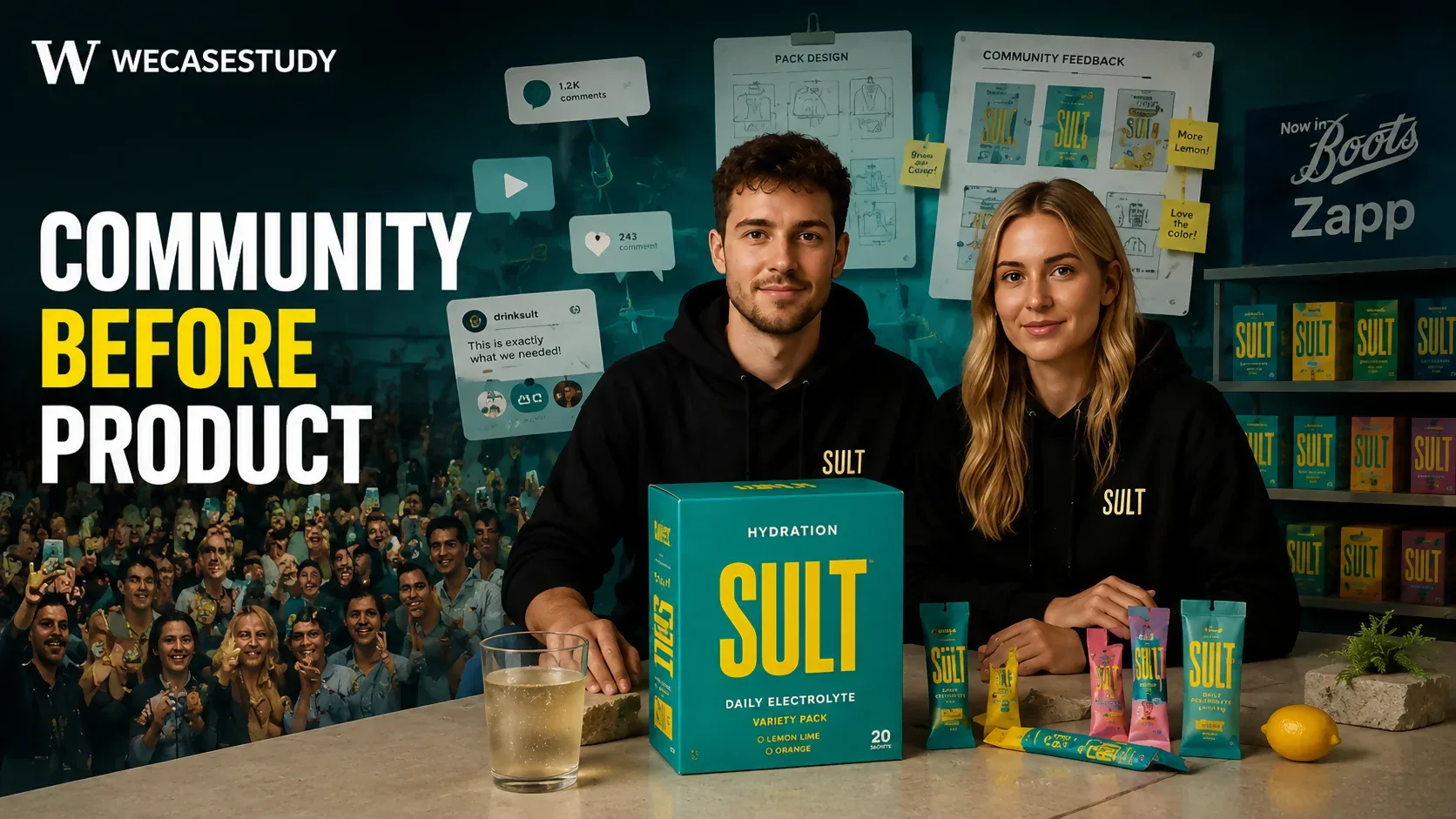
SULT’s growth is not mainly a story about electrolyte powder. It is a case study in changing the order of brand building.
Instead of following the typical startup sequence build the product, launch, advertise, then search for customers SULT built an audience before the product was fully launched. The founders involved that audience in product development, packaging feedback, launch anticipation, content, community participation and early demand creation.
The strategic lesson is simple:
SULT did not build a product and then look for a community. It built much of the product inside a community it had already created.
Last Updated: August 2026
Key Takeaways
SULT’s strongest advantage was sequencing: audience and demand came before full-scale launch.
The brand treated community as a development asset, not just a marketing channel.
Founder-led storytelling made the business itself part of the content.
Customer participation helped create emotional ownership before purchase.
SULT repositioned electrolytes around everyday life, not only athletic performance.
Social proof helped support retail credibility, including expansion into Boots.
The biggest challenge is whether the brand can scale beyond founder personality while maintaining quality, operations and cultural relevance.
The Strategic Shift: Marketing Started Before the Product Was Finished
Most consumer startups follow a familiar path:
Product → Inventory → Launch → Advertising → Audience → Feedback
SULT moved closer to a different model:
Problem → Audience → Community → Feedback → Product Refinement → Anticipation → Launch
That shift is the core of this case study.
Marketing did not begin when the product was ready. It began while the product, packaging, positioning and customer understanding were still being shaped.
This mattered because SULT could test assumptions early:
Would people care about everyday hydration?
Did the brand language feel different from sports-focused electrolytes?
Which packaging direction created the strongest reaction?
Which use cases felt natural: work, gym, travel, nights out, recovery?
Would people join a waitlist before the product was available?
Could founder-led content create enough trust to reduce launch uncertainty?
The answer was not discovered after launch. It was discovered through repeated community interaction before launch.
From Audience to Participation
SULT’s strategy worked because it did not treat followers as passive viewers.
A passive audience watches.
A participating community contributes.
That distinction appears throughout SULT’s early growth. The founders publicly shared decisions, invited feedback, tested packaging directions, created launch games, asked for input and turned routine business moments into content.
One of the clearest examples was the packaging process. SULT showed possible packaging directions publicly. Community feedback influenced the final direction, including input from a LinkedIn user who challenged the original options and suggested an alternative.
This was not just engagement.
It was customer research, product feedback and emotional investment happening at the same time.
Framework: Participation Equity
The most useful way to describe SULT’s community advantage is Participation Equity.
Participation Equity is the psychological ownership people feel when they help shape a brand before it becomes widely known.
They do not own shares in the company.
But they may feel:
“I saw this before launch.”
“I voted on that.”
“I remember when they changed the packaging.”
“I helped build this.”
That feeling can become commercially valuable.
Participation Effect | Business Value |
|---|---|
Feedback before launch | Reduces expensive wrong decisions |
Public involvement | Makes the audience more emotionally invested |
Visible iteration | Builds trust and momentum |
Community memory | Creates a story competitors cannot instantly copy |
Advocacy | Participants are more likely to share the brand |
This is why SULT’s audience was more valuable than a simple follower count.
Followers create reach.
Participants create commitment.
Pre-Launch Demand: The Waitlist Was the Real Launch Asset
SULT’s launch was powerful because the brand had already created demand before asking people to buy.
The company reportedly built a waitlist of more than 6,000 people before launch. That matters because a waitlist is a stronger demand signal than casual social impressions.
A follower may be curious.
A waitlist subscriber has taken action.
This gave SULT a more useful launch foundation:
Attention → Interest → Email capture → Anticipation → Early purchase intent
The April 2025 launch did not create demand from zero. It released demand that had been built gradually through content, founder visibility, community participation and curiosity.
That is the bigger lesson for founders:
A launch date without accumulated demand is just a publishing date.
Turning Boring Business Functions Into Content
One of SULT’s most transferable strengths was its ability to turn ordinary business moments into audience experiences.
A flavour reveal became a puzzle.
Packaging became a public decision.
Launch access became a hunt.
Partnership outreach became content.
Retail progress became a storyline.
This is what we can call the Boring-Function Transformation.
Normal Business Action | SULT-Style Content Opportunity |
|---|---|
Reveal a flavour | Turn it into a game or clue |
Choose packaging | Invite public feedback |
Launch a website | Create hidden access or early entry |
Pitch a partner | Explain the pitch publicly |
Announce retail | Show the journey to getting stocked |
Fix a mistake | Document the problem and response |
The principle is not “use crosswords” or “copy SULT’s launch mechanics.”
The principle is:
If your business has to do something anyway, ask whether it can become a story, a game, a public decision or a reason for people to return.
Framework: The Content-Operations Flywheel
SULT’s content engine was effective because it was connected to real business activity.
The business created the content.
The content created feedback.
The feedback improved the business.
The improved business created more content.
The flywheel looks like this:
Operate → Document → Involve → Learn → Improve → Reveal → Launch → Operate Again
This is more efficient than treating content as a separate marketing task.
For example:
Packaging content created design feedback.
Flavour content created taste curiosity.
Founder updates created trust.
Operational problems created transparency moments.
Retail goals created recurring storylines.
Customer requests created new product ideas, such as sample formats.
That is why SULT’s content was more than promotion.
It was also research, product development, customer education, launch preparation and community building.
Founder-Led Marketing: Henry and Milly Became Recurring Characters
SULT benefited from having visible founders.
Henry Porpora and Milly Goldsmith did not behave like distant brand owners. They became part of the brand’s media system.
Their decisions, disagreements, humour, progress, setbacks, content style and relationship with the community became part of the SULT story.
This gave the brand a human advantage.
People were not only following a hydration product.
They were following a company being built.
That is an important distinction.
Traditional brand content often says:
“We launched a product.”
“We are now stocked here.”
“Here is a discount.”
SULT-style founder content says:
“We are trying to build this.”
“Here is what went wrong.”
“Here is what we changed.”
“Here is what customers told us.”
“Here is what we are trying next.”
The second version creates narrative momentum.
It gives people a reason to keep watching.
Framework: The Founder Character Moat
Product features can be copied.
Founder history is harder to copy.
An electrolyte brand can copy:
sachets;
flavours;
colourful packaging;
TikTok formats;
subscription offers;
lifestyle positioning.
But it cannot instantly copy:
months of founder updates;
the community’s memory of early decisions;
inside jokes;
public failures;
customer participation;
the feeling of having watched the brand grow.
This creates what we can call the Founder Character Moat.
It is not a permanent moat by itself. Founder-led brands can become too dependent on the founder. But in the early stage, it can give a startup something larger competitors often struggle to manufacture: intimacy.
Positioning: Removing the Identity Tax
SULT’s positioning was not only about hydration. It was about identity.
Many electrolyte brands are built around athletes, endurance, gym culture, optimisation or recovery. SULT aimed at people who may care about health and movement but do not necessarily identify as serious athletes.
That is the identity gap.
The customer may think:
“I exercise, but I am not an athlete.”
“I care about wellness, but I still go out.”
“I want hydration, but I do not want extreme fitness branding.”
SULT made electrolytes feel more compatible with everyday life.
This is a strong challenger-brand move because it expands the category beyond its obvious users.
Framework: Identity-Tax Removal
Every category carries cultural baggage.
Protein can imply bodybuilding.
Investing can imply finance-bro culture.
Wellness can imply discipline and perfection.
Electrolytes can imply athletes and intense performance.
The opportunity is to find people who want the functional benefit but reject the identity attached to the category.
SULT did this by making hydration feel relevant to:
office days;
workouts;
travel;
nights out;
busy routines;
recovery;
everyday wellness.
The strategic value is that SULT did not need to fight only for existing electrolyte customers. It could make the category feel relevant to people who had not previously seen themselves as electrolyte users.
Anti-Category Adjacency: Avoiding the Most Obvious Channel
Run clubs, gyms and endurance events are obvious places for electrolyte brands.
But obvious channels can also trap a brand inside the same perception as every competitor.
SULT’s more interesting move was to place hydration in less predictable lifestyle contexts. That included social settings, everyday routines, unexpected partnerships and environments outside traditional sports performance.
This is Anti-Category Adjacency.
Instead of asking only:
“Where do electrolyte customers already exist?”
SULT also asked:
“Where could hydration make sense if we changed the story?”
That helped the brand move away from athlete-only positioning.
Partnerships as Positioning
SULT’s collaboration with Lovehoney is a useful example of partnership as brand strategy.
Electrolytes and sexual wellness are not an obvious pairing. That unexpected connection created attention. More importantly, it helped communicate that hydration could belong in a wider range of life moments than sport or recovery.
The partnership did three jobs:
Job | Why It Mattered |
|---|---|
Reach | SULT accessed a new audience |
Attention | The unexpected pairing created conversation |
Positioning | The brand moved further from athlete-only hydration |
This is the difference between partnership as promotion and partnership as positioning.
A weak partnership only asks:
“Can we reach more people?”
A stronger partnership asks:
“What will this teach people about who we are?”
From Social Proof to Retail
SULT’s move from social-first demand into retail distribution is one of the most important parts of the case study.
Online community can create attention and early sales.
Retail creates a different kind of trust.
A customer discovering a new brand on social media may wonder whether it is legitimate. Seeing the same product in a major retailer like Boots changes that perception.
Retail provides borrowed credibility.
It also expands the brand beyond people who follow the founders.
This creates the Social Proof-to-Shelf Loop:
Social Attention → Visible Demand → Retailer Confidence → Shelf Presence → Mainstream Trust → More Customers
For challenger consumer brands, social traction is not only useful for direct sales. It can also help open distribution opportunities.
Business Model: Content Creates Demand, Habit Sustains It
SULT’s early growth was content-led, but the long-term business cannot depend only on content.
The stronger version of the model is an omnichannel replenishment business.
Layer | Role |
|---|---|
Social content | Creates awareness and trust |
Email / waitlist | Captures high-intent demand |
DTC website | Controls customer journey and data |
Bundles | Increases trial across flavours |
Sample formats | Reduces first-purchase risk |
Subscription | Encourages repeat purchase |
Retail | Adds mainstream discovery and trust |
Marketplaces / delivery | Improves convenience |
The key point is that content may create the first purchase, but product quality, availability, taste, habit and distribution must create the second, third and fourth purchase.
What SULT Did Especially Well
1. It built demand before launch
The brand did not wait until launch day to start marketing. It built attention, community and intent in advance.
2. It turned customers into contributors
Community members did not only react to finished decisions. They influenced some of the decisions themselves.
3. It used founder visibility as media
Henry and Milly became recurring characters in the brand’s story, giving the audience a reason to return.
4. It made operations interesting
Packaging, hiring, retail, partnerships, product issues and launch mechanics all became content material.
5. It repositioned the category
SULT did not only sell electrolytes to athletes. It made hydration feel more everyday, social and lifestyle-driven.
6. It converted social proof into retail opportunity
The brand’s online traction helped create credibility beyond social platforms.
What Most Brands Get Wrong When Copying SULT
Many brands will look at SULT and conclude:
“We need founder videos.”
“We need funny content.”
“We need to build in public.”
“We need a waitlist.”
Those are surface-level conclusions.
The real system is deeper:
clear positioning;
visible founders;
community participation;
product feedback loops;
recurring storytelling;
demand capture;
operational transparency;
retail credibility;
category repositioning.
Copying the tone without copying the operating system will not create the same result.
Risks and Limits
SULT’s model is powerful, but it is not risk-free.
Risk | Why It Matters |
|---|---|
Founder dependency | The brand must eventually become bigger than Henry and Milly |
Wrong audience | Followers may enjoy the story without becoming buyers |
Community capture | Vocal early fans may not represent mainstream retail customers |
Operational pressure | Content can scale faster than inventory and fulfilment |
Authenticity fatigue | “Real” content can become formulaic if overused |
Retail economics | Wholesale changes margin, data access and working-capital needs |
Copycat products | Functional electrolyte products are easier to copy than community history |
The main warning is this:
Community can create patience, but it cannot replace operational excellence.
A product issue can become an authentic story once.
Repeated product issues become a trust problem.
The Biggest Strategic Challenge: Scaling Beyond the Story
SULT’s early customers often discovered the brand through content. They knew the founders, the packaging journey, the launch build-up and the community energy.
But a retail customer may see only a box on a shelf.
That creates the Narrative Compression Problem.
How can months of story become understandable in a few seconds?
To scale, SULT needs more than founder-led content. It needs:
clear packaging;
simple positioning;
strong taste;
credible formulation;
repeat-purchase reasons;
retail visibility;
brand meaning that works without context.
The more SULT grows, the less it can assume that every customer knows the backstory.
Transferable Playbook
Step | What Other Brands Can Learn |
|---|---|
1 | Start building audience before the product is fully ready |
2 | Discuss the problem before selling the solution |
3 | Convert social attention into owned demand |
4 | Let customers influence reversible decisions |
5 | Turn business operations into storylines |
6 | Create recurring content formats, not isolated posts |
7 | Use founder visibility where it genuinely strengthens trust |
8 | Position around identity, not only product features |
9 | Use partnerships to change brand meaning |
10 | Make sure operations can support the demand content creates |
Final Lessons
SULT’s case study is ultimately about sequencing.
The brand did not simply launch an electrolyte product and then search for customers.
It built community first.
It used that community to shape the brand.
It turned product development into content.
It converted curiosity into a waitlist.
It launched into existing demand.
It used founder-led storytelling to build trust.
It then moved from social proof toward retail credibility.
The most useful lesson is not:
“Make your marketing look like SULT.”
It is:
Build a business whose customers have reasons to care before you ask them to buy.
FAQ
What is the main lesson from the SULT case study?
The main lesson is that SULT built community and demand before launch. The brand used audience participation as marketing, product research, feedback and early social proof.
Why is SULT’s strategy called community-first?
Because the community was involved before the product was fully launched. SULT used feedback, public decisions, founder updates and audience participation to shape the brand and create anticipation.
What made SULT different from traditional hydration brands?
SULT positioned electrolytes around everyday life rather than only athletes, endurance sports or gym culture. This helped the brand speak to a wider lifestyle audience.
How did founder-led content help SULT?
Founder-led content made the brand feel more human and gave audiences an ongoing story to follow. Henry and Milly became part of the brand’s trust-building system.
What is Participation Equity?
Participation Equity is the psychological ownership customers feel when they help shape a brand. It can make people more emotionally invested and more likely to advocate for the company.
What is the biggest risk in SULT’s strategy?
The biggest risk is founder dependency. If the brand depends too heavily on Henry and Milly, it may struggle to scale beyond the original community.
Can other startups copy SULT’s strategy?
Other startups can copy the principles, but not the exact personality. The transferable system is audience-before-launch, community feedback, founder storytelling, demand capture and operational content.
Why does retail matter for SULT?
Retail gives the brand broader reach and credibility. A product discovered on social media may feel new or risky, but a product seen in a major retailer can feel more trustworthy.