

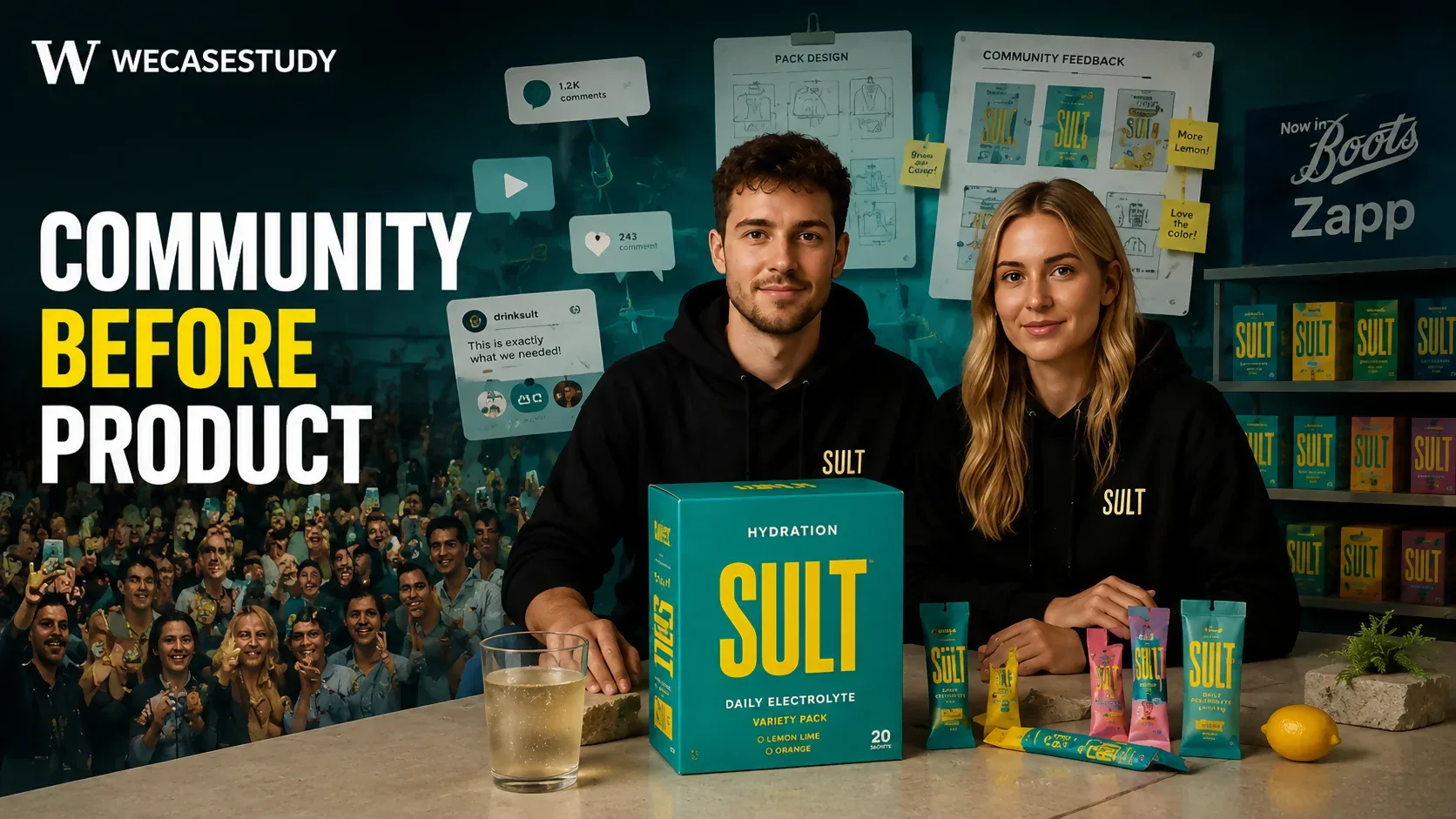
How SULT’s Community-First Marketing Created a Challenger Hydration Brand
SULT’s growth is not mainly a story about electrolyte powder. It is a case study in changing the order of brand building.Instead of following the typical startu...
Company · Wiki
Hydration & Wellness
SULT is a British hydration and electrolyte brand founded by Henry Porpora and Milly Goldsmith. Launched in April 2025, the company sells flavoured electrolyte powders while positioning hydration as part of everyday wellness rather than something reserved for endurance athletes or intensive sports performance.
SULT operates through UK company Index Health Ltd and has expanded from a founder-led direct-to-consumer launch into physical retail through Boots. Its distinctive position comes less from inventing a new product category and more from combining lifestyle branding, founder-led content, community participation and broader everyday-use positioning.
Last updated: August 27, 2026
SULT is a UK hydration company whose core products are powdered electrolyte drink mixes.
Its name is a play on salt, reflecting sodium's role in electrolyte products. The company's consumer-facing phrase “Season your water” captures its broader positioning: SULT wants adding electrolytes to feel like an ordinary hydration habit rather than something associated only with serious training.
Co-founder Henry Porpora has described SULT as targeting a “middle market” consumer — someone who may exercise and care about wellbeing but also work a conventional job, travel, socialise and live without making performance optimisation the centre of daily life.
That gives SULT three closely connected propositions:
Layer | SULT's Proposition |
Functional | Powdered electrolytes mixed with water |
Audience | Everyday wellness consumers as well as active users |
Brand | A colourful, founder-led lifestyle identity rather than athlete-only performance branding |
The functional product places SULT in the hydration category. Its audience and brand positioning explain how the company has tried to differentiate itself within that category.
SULT develops, markets and sells electrolyte drink powders designed to be mixed with water.
Its main business activities include:
developing flavoured electrolyte products;
selling directly to consumers through its own online store;
offering bundles and recurring purchase options;
distributing products through retailers such as Boots;
building awareness through founder-led social content;
collaborating with consumer brands outside traditional sports nutrition;
using customer and community feedback during product and brand development.
SULT remains primarily a consumer-products company rather than a technology platform, marketplace or service business.
Its commercial activity revolves around turning a relatively simple consumable product into a repeat-purchase lifestyle brand.
SULT combines a direct-to-consumer consumer goods model with growing physical retail distribution.
The business begins with a consumable product: customers buy electrolyte sachets, use them and may return for additional boxes, bundles or recurring orders.
Direct-to-consumer sales give SULT control over how the brand is presented. Its website can explain the founders, product, positioning and community in much greater depth than a retail shelf can.
Retail adds a different advantage. Boots gives SULT exposure to consumers who may never encounter the founders' social content or visit the company's own website.
The overall model can therefore be viewed as four connected components:
Component | Role in the Business |
DTC sales | Direct customer acquisition and product sales |
Repeat purchases | Revenue from replenishment of a consumable product |
Bundles/subscriptions | Encourage larger or recurring orders |
Retail distribution | Expands physical discovery and mainstream reach |
SULT's content and community activity support these channels by building brand familiarity before or between purchases.
SULT primarily generates revenue by selling electrolyte products.
The company does not publicly disclose a detailed revenue breakdown, so the relative contribution of each revenue stream is not available.
Its identifiable revenue channels include:
Revenue Stream | How It Generates Revenue |
Direct online purchases | Customers buy boxes and products through SULT's website |
Bundles | Customers purchase multiple products or larger combinations |
Recurring orders | Repeat or subscription-style purchases replenish used products |
Retail sales | Products are sold through Boots and potentially other stockists |
Accessories | Branded hydration products such as bottles provide additional sales |
Because SULT is a private company, important financial metrics such as total revenue, gross margin, customer acquisition cost, subscription retention and customer lifetime value are not publicly disclosed.
SULT's website states that more than one million sachets have been sold. That is a company-reported product-volume milestone rather than independently audited revenue data.
SULT's core business is built around powdered electrolyte sachets.
The current product range contains six electrolytes:
sodium;
potassium;
magnesium;
calcium;
chloride;
phosphorus.
Current Boots product information lists 500 mg of sodium, 304 mg of potassium, 120 mg of calcium and 100 mg of magnesium per sachet in the relevant listed format, with chloride and phosphorus also present.
Product formulas and nutritional information can change, so current packaging remains the best source for exact composition.
Boots currently lists three core SULT flavours:
Peach Citrus
Watermelon Berry
Mango Tropical
SULT also sells mixed and variety formats.
Alongside individual electrolyte products, SULT sells larger bundles and branded hydration accessories such as bottles through its own channels.
These products broaden average order possibilities without moving the company far outside its core hydration proposition.
SULT primarily serves UK consumers interested in hydration, fitness and everyday wellness.
Its target customer is broader than the endurance-athlete audience traditionally associated with electrolyte products.
The founders have described customers who may:
exercise several times per week;
work office or desk-based jobs;
travel;
socialise;
use wellness products without adopting an extreme performance lifestyle.
This positioning allows SULT to participate in several overlapping consumer markets:
This is central to SULT's positioning.
The company presents hydration as part of an ordinary routine rather than a specialised sports activity.
SULT still serves people who exercise and use electrolyte products around physical activity, but the brand does not make competitive athletics its sole identity.
Boots gives SULT access to shoppers who may discover the brand through mainstream health and wellness retail rather than social media.
SULT's website serves customers who already know the brand and want to purchase directly, buy bundles or make repeat orders.
The company's strongest documented commercial presence remains in the United Kingdom.
SULT operates in a crowded electrolyte and hydration category.
Its competition comes from several types of brands rather than one single business model.
These companies typically position electrolytes around training, endurance, sweat replacement and athletic performance.
SULT competes with them for customers who use hydration products around exercise, while trying to differentiate through less performance-heavy branding.
SULT also competes with newer consumer brands that package functional hydration as part of broader wellness and everyday routines.
This is arguably the more direct positioning battle because lifestyle, design and brand identity become major decision factors.
Larger supplement companies can introduce electrolyte powders or adjacent hydration products using established distribution, customer awareness and retail relationships.
That creates an important competitive challenge for a younger brand whose differentiation depends heavily on identity and community.
Inside retailers such as Boots, SULT also competes for shelf attention against other hydration, supplement and wellness products.
This changes the competitive environment because a consumer encountering SULT in-store may know little about its founders or social-media history.
SULT began taking shape in 2024 and launched commercially in 2025.
The company's early development is closely linked to its decision to document the startup process publicly.
Year | Milestone | Why It Mattered |
2024 | SULT begins development | Establishes the product and audience proposition |
September 2024 | Index Health Ltd is incorporated | Creates the formal operating company |
2024–2025 | Founders document development publicly | Builds familiarity before launch |
April 2025 | SULT launches | Converts the pre-launch audience into a live customer base |
2025 | Candy Kittens collaboration | Expands visibility through a consumer-brand partnership |
2025 | Lovehoney collaboration | Moves SULT further outside traditional sports-hydration marketing |
February 2026 | Boots announces SULT among new high-street exclusives | Expands the company beyond primarily DTC distribution |
2026 | SULT reports 1M+ sachets sold | Provides a first-party signal of product traction |
2026 | FEBE includes SULT on its Watch List | Adds external recognition of the young company |
NutraIngredients reported that SULT's social following was approaching 40,000 by July 2025. A founder interview published in August 2026 described the community as exceeding 50,000 followers.
The later figure is founder-reported rather than independently audited, but it illustrates how important audience development has been to SULT's early company story.
SULT remains closely associated with its founders.
Henry Porpora is a SULT co-founder and a director of Index Health Ltd.
He has become one of the company's most visible representatives, regularly discussing product development, growth, marketing, retail and the challenges of building a self-funded consumer brand.
Porpora has argued publicly that in a category where similar functional products can be created relatively quickly, brand identity and customer connection become important sources of differentiation.
Milly Goldsmith is SULT's co-founder and a director of Index Health Ltd.
Her background in content creation has been particularly relevant to the company's founder-led communication model.
Goldsmith's role goes beyond acting as an external creator promoting a product. She is part of the company's leadership and has been involved in developing the brand while documenting the process publicly.
Companies House records also list Alex Oliver Mirzoeff Campbell as a director of Index Health Ltd.
Public SULT material has associated Campbell with the company's creative output and brand development.
SULT operates through Index Health Ltd, a UK private limited company incorporated on September 12, 2024.
The company is privately held rather than publicly listed.
SULT's founders have described the business as bootstrapped and funded without external investment during its early growth.
As of the latest public records used for this profile, Companies House lists:
Henry Carmine Franco Porpora;
Amelia Joanne Marguerite Goldsmith;
Alex Oliver Mirzoeff Campbell
as directors of Index Health Ltd.
No major subsidiary structure or public parent company is identified in the available source material.
Because SULT is privately held, detailed ownership percentages and shareholder economics are not publicly presented in the same way they would be for a listed company.
SULT's company strategy currently appears to revolve around four main priorities.
H3: Position Hydration Beyond Performance Sport
SULT deliberately targets consumers who care about health and activity without identifying as elite or endurance athletes.
This gives the company a broader everyday-use proposition than a purely performance-focused electrolyte brand.
SULT documented product development before launch and has continued to place its founders prominently in its public communication.
By 2026, the founders were describing the approach less as simply “building in public” and more as allowing customers to participate in the building process.
Customers have been shown packaging decisions, product-development challenges, launch preparation and other parts of the startup process.
SULT has used partnerships with brands such as Candy Kittens and Lovehoney to reach contexts beyond conventional electrolyte marketing.
The strategy does not remove SULT from fitness entirely. Instead, it allows the brand to enter fitness and wellness occasions in ways that do not resemble standard sports-nutrition promotion.
Boots represents an important development in SULT's distribution strategy.
DTC allows the company to tell a detailed founder and brand story. Retail increases physical discovery but requires the product and packaging to communicate more quickly without that background.
SULT therefore has to operate successfully in both environments as the business develops.
SULT has gained early traction, but several risks become more important as the company grows.
The founders are unusually visible in SULT's marketing.
That creates personality and familiarity, but it also raises the question of whether the company can maintain the same voice when more employees, products and channels become involved.
A founder-led brand eventually needs to become larger than the founders without losing the qualities that made the founders valuable.
Porpora has himself described hydration as an increasingly crowded market.
SULT's visual identity, informal content and lifestyle positioning are observable by competitors and can be imitated at a surface level.
The longer-term challenge is turning those elements into durable brand recognition and repeat preference.
Customers who discover SULT through founder content already know some of the brand story.
Customers encountering the product for the first time in Boots may know none of it.
Retail expansion therefore places more pressure on packaging, pricing, product understanding and in-store recognition.
SULT publicly reports sales and audience milestones, but those figures do not reveal several metrics that determine the long-term economics of a consumer brand.
Public information does not currently disclose:
customer acquisition cost;
repeat-purchase rate;
subscription retention;
gross margin;
customer lifetime value;
retail sell-through;
churn.
One million sachets sold is evidence of product volume. It is not sufficient on its own to establish profitability or durable unit economics.
SULT's early positioning benefits from feeling different from more technical or athlete-focused competitors.
As the category adopts more colourful, lifestyle-led branding, maintaining that distinction may require the company to develop new sources of brand recognition rather than relying only on its original aesthetic.
SULT is a UK-founded electrolyte and hydration brand launched in April 2025.
The company operates through Index Health Ltd, incorporated in September 2024.
Henry Porpora and Milly Goldsmith co-founded the brand and remain directly involved in its public identity.
SULT positions itself toward an everyday “middle market” rather than only endurance athletes.
The company documented its product-development journey before launch, making founder storytelling part of its customer-acquisition approach.
SULT's current core range includes Peach Citrus, Watermelon Berry and Mango Tropical.
Boots added SULT to its UK wellness offering in 2026, expanding the brand beyond primarily direct-to-consumer distribution.
SULT says it has sold more than one million sachets; this remains a company-reported figure.
SULT appears on FEBE's 2026 Watch List, within its “New Wave” grouping.
Unlike many consumer brands that use external creators mainly as advertisers, SULT has a content creator as an active co-founder, making creator-led storytelling part of the company's operating identity.
What is SULT?
SULT is a British hydration company selling powdered electrolyte sachets. It positions the products for everyday wellness consumers as well as people who exercise.
Who founded SULT?
SULT was co-founded by Henry Porpora and Milly Goldsmith.
When was SULT founded?
Development began in 2024. The company behind SULT, Index Health Ltd, was incorporated on September 12, 2024, and SULT launched commercially in April 2025.
Is SULT a UK company?
Yes. SULT operates through UK private limited company Index Health Ltd, and Boots identifies the SULT products it lists as manufactured in the United Kingdom.
What does SULT sell?
SULT primarily sells powdered electrolyte drink mixes supplied in individual sachets. It also offers variety packs, bundles and branded hydration accessories.
What electrolytes are in SULT?
Current product information lists six electrolytes: sodium, potassium, magnesium, calcium, chloride and phosphorus.
What flavours does SULT sell?
The current core range listed by Boots includes Peach Citrus, Watermelon Berry and Mango Tropical.
Where can you buy SULT?
SULT sells directly through its own website and is also available through Boots in the UK. Product and store availability can change.
Is SULT only for athletes?
No. Its founders have deliberately positioned the company for a broader everyday wellness audience rather than only serious athletes.
Is SULT publicly traded?
No. SULT operates through privately held UK company Index Health Ltd.
Is SULT bootstrapped?
The founders have repeatedly described SULT as self-funded and built without external investment during its early development.
How many SULT sachets have been sold?
SULT's own website states that more than one million sachets have been sold. This is a first-party company claim rather than independently audited sales data.
Resources:
SULT’s growth is not mainly a story about electrolyte powder. It is a case study in changing the order of brand building.Instead of following the typical startu...